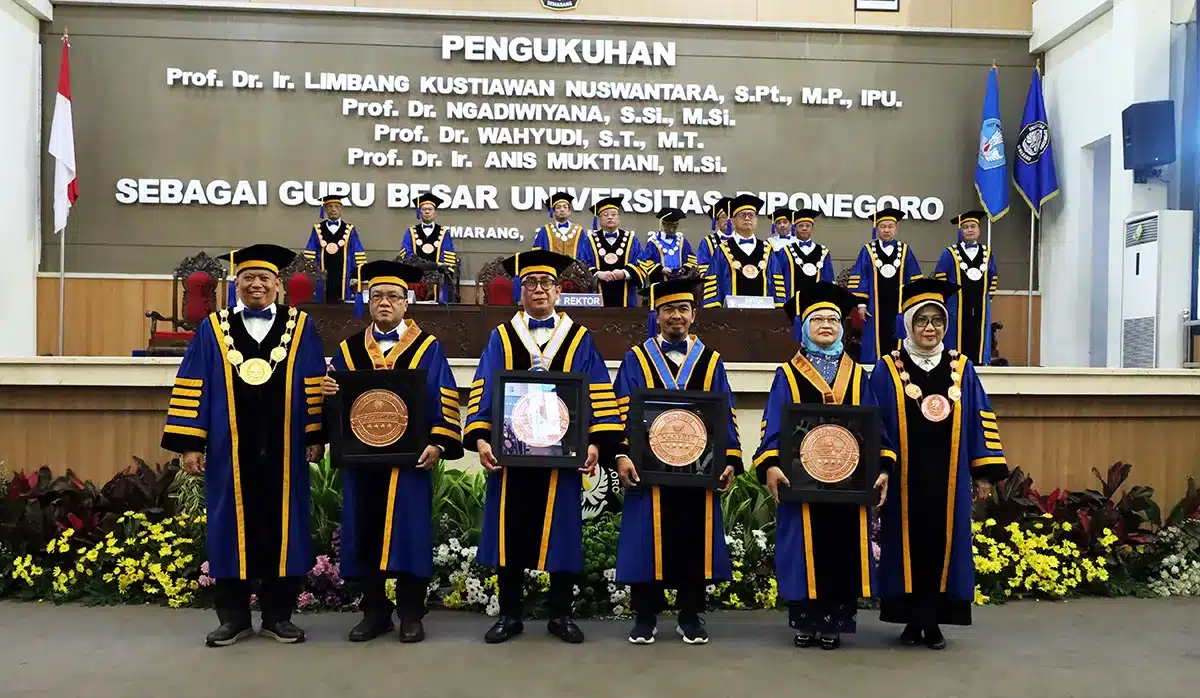
UNDIP, Semarang (27/1) – Opening a meaningful chapter at the beginning of 2026, Universitas Diponegoro (UNDIP) inaugurated 18 professors with diverse areas of expertise throughout January, further strengthening UNDIP’s position as a leading research university with international standing. On Tuesday, January 27, 2026, UNDIP once again held a Professor Inauguration Ceremony at the Prof. Sudarto, S.H. Building, officially inaugurating Prof. Dr. Ir. Limbang Kustiawan Nuswantara, S.Pt., M.P., IPU. from the Faculty of Animal and Agricultural Sciences; Prof. Dr. Ngadiwiyana, S.Si., M.Si. from the Faculty of Science and Mathematics; Prof. Dr. Wahyudi, S.T., M.T. from the Faculty of Engineering; and Prof. Dr. Ir. Anis Muktiani, M.Si. from the Faculty of Animal and Agricultural Sciences.
The Rector of UNDIP, Prof. Dr. Suharnomo, S.E., M.Si., expressed his appreciation to all newly inaugurated professors who are advancing to greater academic roles with strong dedication to science and research.
Prof. Dr. Ir. Limbang Kustiawan Nuswantara, S.Pt., M.P., IPU., an expert in the Evaluation of Dairy Ruminant Nutrition and Feed, explained that based on 2025 survey data, Indonesia’s milk production currently meets only 17.7% of national demand. In his presentation, entitled Engineering Rumen Conditions through Ration Formulation to Increase Dairy Production, he proposed strategies to meet milk demand through ration formulation, aiming to improve digestive efficiency and rumen microbial metabolism. Farmers can utilize feed ingredients rich in protein, fiber, and micronutrients—such as leguminous tree plants including Calliandra, Indigofera, and Gliricidia—as one strategy to increase milk production.
“I began this research in 1998 through degradability and fermentability tests of feed ingredients, and it has now reached the stage of feed formula testing with legume supplementation to obtain the best ration formulation. Ration formulation based on the synchrony index is a strategy to increase both milk production and its nutritional quality in dairy cattle,” Prof. Limbang explained.
Next, Prof. Dr. Ngadiwiyana, S.Si., M.Si., an expert in the Modification of Organic Compounds and Polymers, presented Transformation of Eugenol from Clove Oil into Functional Organic Polymers as Eco-Friendly Coating Materials to Support Sustainable Development. In line with the principles of green chemistry, he emphasized that using renewable biomass to produce sustainable polymers is a promising alternative. This work uses eugenol, the main phenolic compound in clove essential oil. Indonesia is the world’s largest clove producer, with an average annual production of 133.95 tons, yet the utilization of clove-based natural resources remains underdeveloped compared to other countries. Substituting synthetic polymers with eugenol-based polymers has significant potential to reduce CO₂ emissions, decrease fossil fuel use, and increase the utilization of renewable biological resources.
Prof. Ngadiwiyana explained, “Eugenol-based organic polymers possess antibacterial, antioxidant, and anticorrosive properties and are safe for use in the health and food industries. The use of organic polymers can reduce CO₂ emissions and decrease dependence on fossil fuels.”
Furthermore, Prof. Dr. Wahyudi, S.T., M.T., an expert in Control Systems and Instrumentation, presented innovations to improve the quality of life of persons with disabilities, particularly those with visual impairments. In his presentation entitled Integration of Control Systems and Artificial Intelligence in the Development of Assistive Devices for the Visually Impaired, Prof. Wahyudi explained the design of a head-mounted mobility assistive device for blind users. The device integrates time-of-flight cameras, web cameras, K-Means algorithms, Convolutional Neural Networks (CNN), and concurrent programming on a Raspberry Pi 4B to detect and classify obstacles and recognize surrounding objects.
The system converts obstacle data into spatial audio, enabling users to perceive their surroundings through sound direction and intensity. “This assistive device is still being developed to achieve faster processing, integration with an Inertial Measurement Unit (IMU) navigation system, and Optical Character Recognition (OCR) for object recognition,” he stated.
The next presentation, Supplementation Technology to Increase Milk Production and Dairy Cattle Health, was delivered by Prof. Dr. Ir. Anis Muktiani, M.Si., an expert in Dairy Ruminant Nutrition and Feed Supplement Science. Average milk consumption in Indonesia is 16.64 kg per capita per year, which is categorized as low by FAO standards, partly due to the high price of cow’s milk. Low milk consumption among children—especially those aged 0–2 years—is one of the factors contributing to 44% of Indonesian children experiencing growth problems (stunting, underweight, and wasting). Therefore, increasing the dairy cattle population and milk production through improved feed formulation is essential.
However, this effort is constrained by the high cost of concentrate feed ingredients. Supplementation technology offers solutions through the use of feed supplements and additives that can modulate nutrient metabolism and enhance dairy cattle’s immune systems. “Organic mineral supplements such as zinc lysinate (Zn-lysinate) and chromium picolinate (Cr-picolinate) have been shown to increase milk production by 23%. The addition of probiotics enriched with Zn, Cr, and Se can increase milk fat content by 49%. Supplementation with Zn and Cr minerals is more effective when combined with probiotics such as S. cerevisiae or A. oryzae, as well as herbal plants like papaya leaves and turmeric,” she explained.
With the inauguration of 18 new professors at Universitas Diponegoro, it is expected that the university’s scientific foundations will be further strengthened, supporting the development of the Tri Dharma of Higher Education and aligning with the vision of ‘Diktisaintek Berdampak’. (UNDIP/Public Communication/Titis)