


Semarang, UNDIP (23/6) – Who would have imagined that rainwater, which usually flows directly into drainage channels, could be transformed into high-quality water for a wide range of uses? This innovation has been developed by the Vocational School of Universitas Diponegoro (UNDIP) through the SV Zero Discharge Program. This integrated resource management system utilizes every drop of rainwater to create value for education, research, and environmental sustainability.
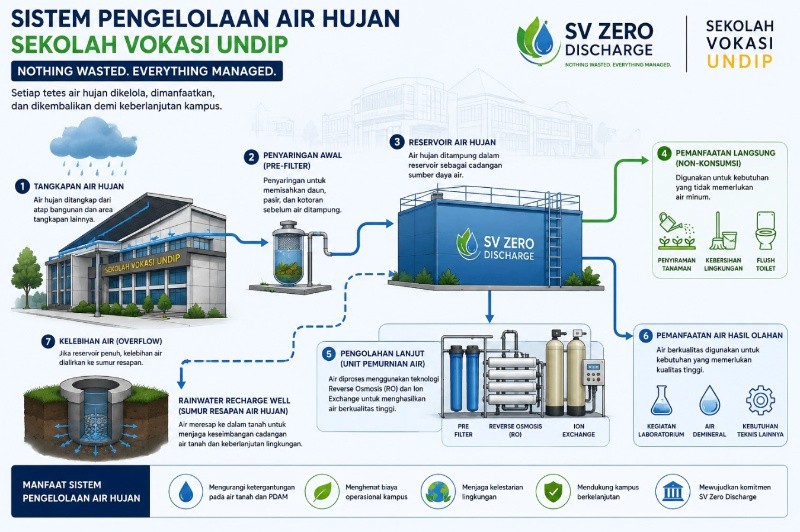
SV Zero Discharge is designed as a comprehensive rainwater management system covering collection, storage, utilization, and environmental recharge. Rainwater falling on building roofs and catchment areas is directed to reservoirs after passing through an initial filtration process that removes leaves, sand, and other impurities.
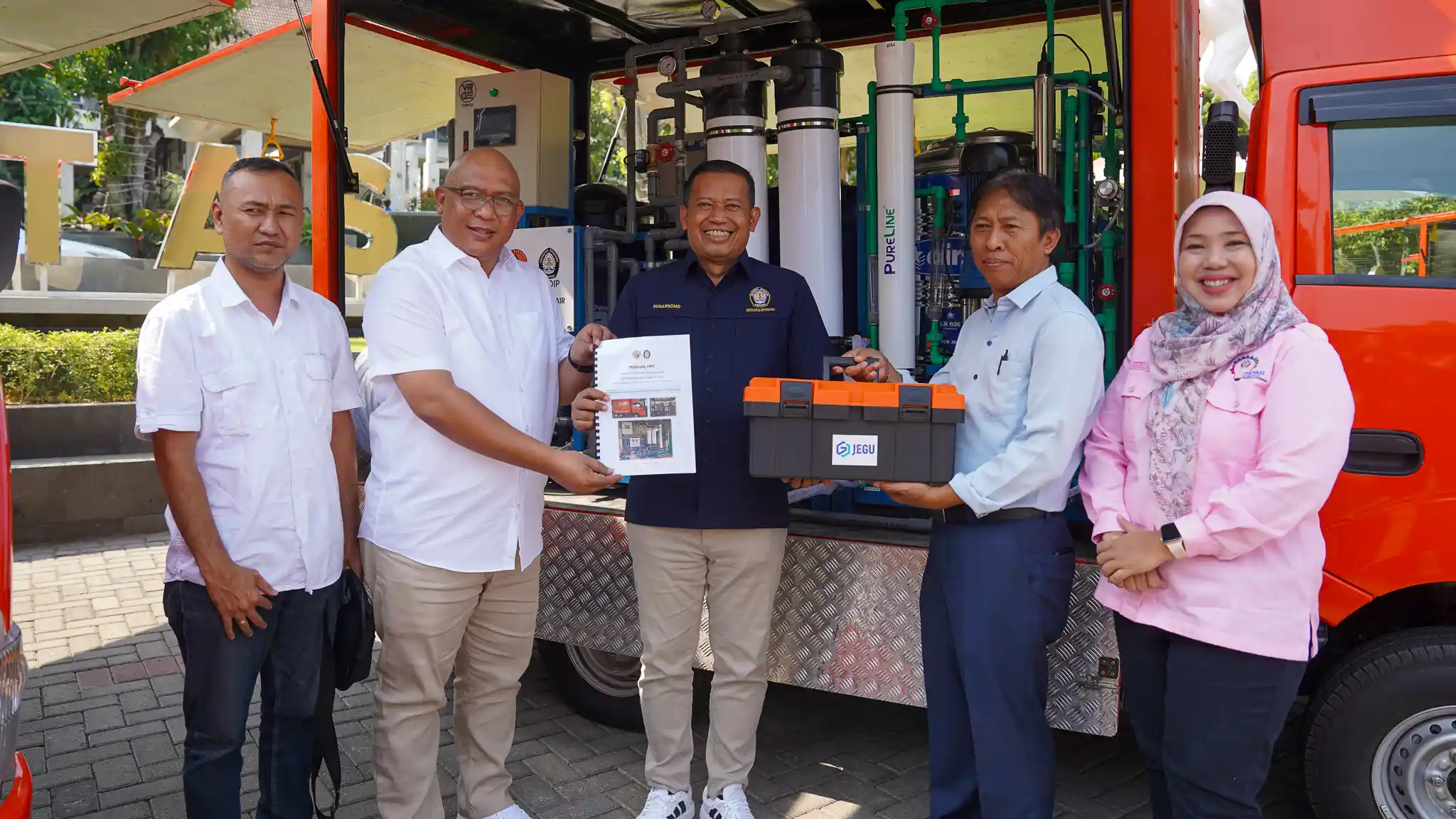
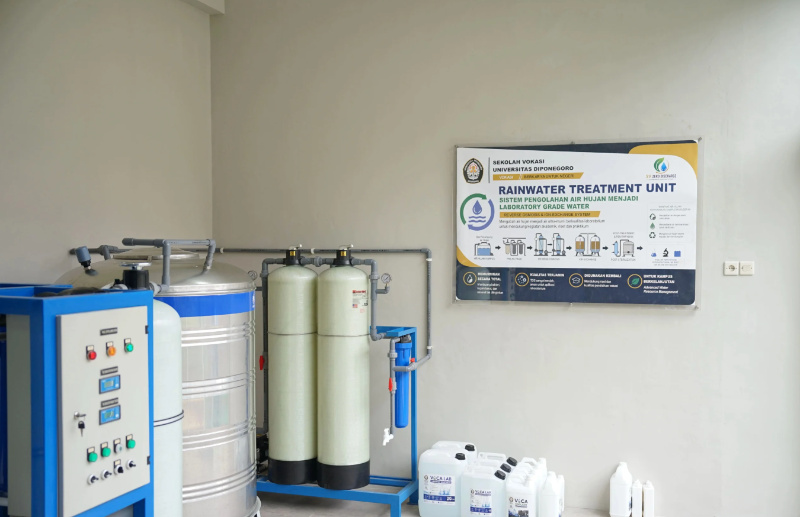
The collected water is then utilized according to specific needs. A portion is used for non-potable purposes such as landscape irrigation. In contrast, another portion undergoes filtration, reverse osmosis (RO), and ion exchange (IX) processes to produce VOCA LAB (Laboratory Grade Water) that meets laboratory-quality standards. The system has a capacity of approximately 15 liters per minute and can produce more than 1,100 liters of water in a single operational cycle.
The same technology is also used to produce VOCA BATTERY, water for battery applications, and VOCA COOLANT, radiator coolant water utilized in various laboratory and learning activities.
Another key advantage of the system is its application of water conservation principles. When reservoir capacity is reached, excess water is not discharged directly into drainage channels. Instead, it is directed into rainwater recharge wells, allowing it to infiltrate back into the ground and help maintain groundwater reserves. In this way, rainwater serves not only as an alternative water source but also as an effective tool for environmental conservation.
As part of its long-term development plan, each building within UNDIP’s Vocational School is expected to be equipped with a rainwater storage tank with a capacity of approximately 20 m³. During the rainy season, building water needs can therefore be met primarily through harvested rainwater, while groundwater will serve only as a backup source. For the production of laboratory-grade water, a dedicated storage tank with a capacity of around 3 m³ is supported by the rainwater harvesting system. In addition, the construction of an additional retention pond has been proposed to strengthen raw water availability during the dry season.
The Dean of UNDIP Vocational School, Prof. Dr. Ir. Budiyono, M.Si., explained that SV Zero Discharge represents a tangible implementation of solution-based learning. Students not only study water management theories in the classroom but can also directly observe how rainwater is processed into high-value products that support academic activities.
“We have developed a system that optimizes the use of rainwater, reduces dependence on groundwater, and at the same time preserves environmental balance. SV Zero Discharge is not merely a technological project; it is part of a broader transformation toward a culture of sustainability on campus,” he stated.
Through this approach, SV Zero Discharge not only produces high-quality water for educational and research purposes but also serves as a living laboratory, enabling students to learn directly from a sustainability system that operates every day. The program demonstrates that the concept of a sustainable campus goes beyond discourse and is implemented in real campus operations through the spirit of “Nothing Wasted. Everything Managed.”
By establishing SV Zero Discharge, UNDIP’s Vocational School provides students with hands-on learning opportunities in sustainable resource management. This innovation reflects UNDIP’s commitment to “Noble and Valuable UNDIP” through impactful research while contributing to the achievement of the United Nations Sustainable Development Goals (SDGs), particularly SDG 6 (Clean Water and Sanitation), SDG 9 (Industry, Innovation and Infrastructure), and SDG 13 (Climate Action). (Public Communication / Vocational School / Diyan, ed. Nurul)