
UNDIP, Semarang (13/1) – Environmental awareness has become an integral part of academic life at the Faculty of Social and Political Sciences (FISIP), Universitas Diponegoro. Amid the growing waste problem and sustainability challenges, FISIP affirms its role not only as a center for knowledge production but also as a space for cultivating awareness and responsible environmental practices.
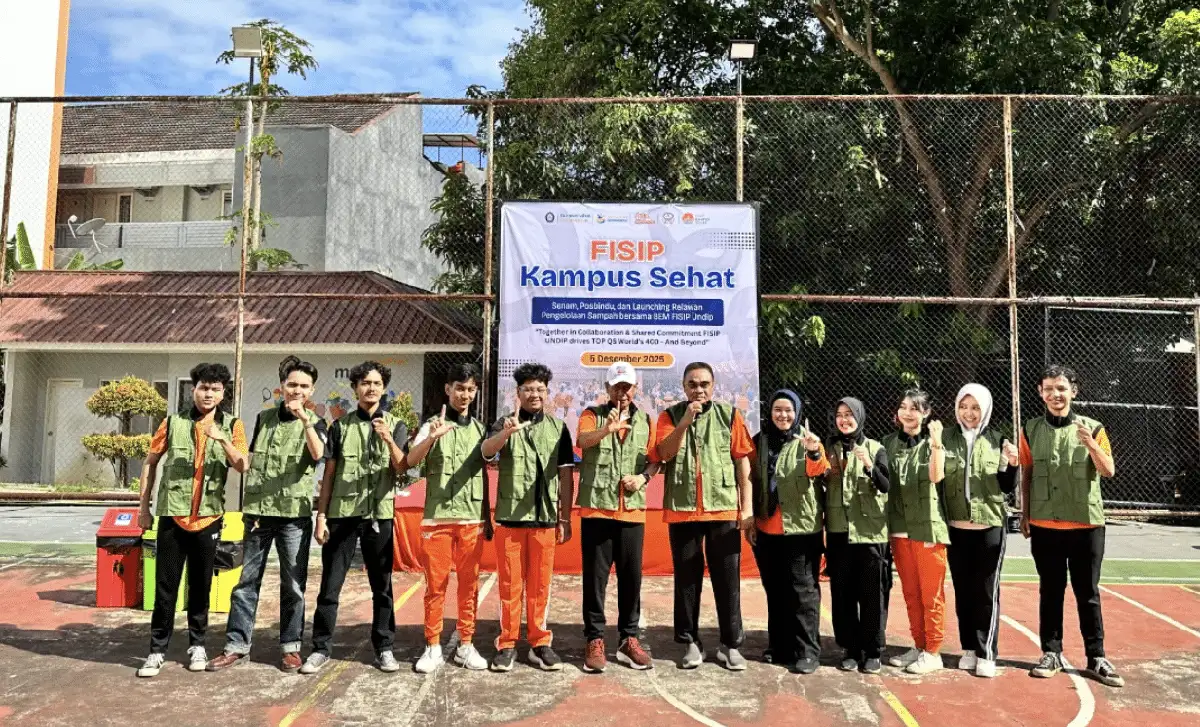
To realize this commitment, FISIP, in collaboration with the FISIP Student Executive Board (BEM FISIP), has established a Waste Management Volunteer Program as a strategic step toward creating a clean, healthy, and sustainable campus environment. The volunteer program was officially launched recently.
The Dean of FISIP UNDIP formally inaugurated the launch of the FISIP UNDIP Waste Management Volunteers, Dr. Drs. Teguh Yuwono, M.Pol.Admin., and was also attended by the Head of the Occupational Safety, Health, and Environment Technical Service Unit (UPT K3L) of Universitas Diponegoro, Dr. Bina Kurniawan, S.KM., M.Kes.
This program is a collaboration between the Healthy Campus Unit of FISIP UNDIP and BEM FISIP UNDIP, placing students at the forefront of efforts to drive behavioral change related to waste management within the campus environment.
In his remarks, the Dean of FISIP UNDIP, Dr. Drs. Teguh Yuwono, M.Pol.Admin., stated that waste management is not merely a technical issue but also reflects the academic community’s culture and awareness.
“The launch of the Waste Management Volunteers represents our shared commitment to protecting the environment. Waste issues are not only about where trash is disposed of, but also about how we change our habits and mindset. Students have a strategic role as agents of change, starting from their immediate surroundings,” he said.

He also emphasized that collaboration between the faculty and students is a major strength in driving sustainable change. “We hope this program will become a consistent and impactful collaborative movement,” he added.
Meanwhile, the Head of UPT K3L UNDIP, Dr. Bina Kurniawan, S.KM., M.Kes., expressed his appreciation for FISIP UNDIP’s initiative in involving students in waste management volunteer activities.
“FISIP UNDIP is the first faculty to launch a waste management volunteer program at the faculty level. Hopefully, this can inspire others, as it is a very positive initiative,” he explained.
The Vice Chair of BEM FISIP UNDIP 2025, Sartio Gilang, also delivered a message to all students in attendance. He emphasized that environmental movements cannot succeed without active student participation. “Amid increasing environmental challenges, students must be at the forefront of change—not only through ideas, but also through real action. Let us make this activity a new culture at FISIP: a culture of care, responsibility, and environmental stewardship,” Gilang stated.
In addition to the volunteer program launch, the event also featured a group morning exercise session and services from the Integrated Non-Communicable Disease Post (Posbindu PTM), allowing members of the academic community to undergo basic health checks and early detection of non-communicable disease risks.
The Head of the Healthy Campus Unit of FISIP UNDIP, Agne Yasa, S.I.Kom., M.A., explained that the activity is part of FISIP UNDIP’s efforts to build a campus community that is not only environmentally conscious, but also highly aware of health and fitness. “The exercise and Posbindu PTM activities are routine programs conducted by the Healthy Campus Unit for early health detection. Through these activities, we encourage all members of the FISIP academic community to understand their health conditions better and to make healthy lifestyles part of campus culture,” he explained.
With the launch of the Waste Management Volunteers, FISIP UNDIP reaffirms its commitment to continuously involving students in environmental sustainability initiatives. This program is expected to serve as an initial step toward fostering a more orderly, healthy, and environmentally responsible campus culture. (Public Communication/FISIP/Rifat, ed. Nurul)