
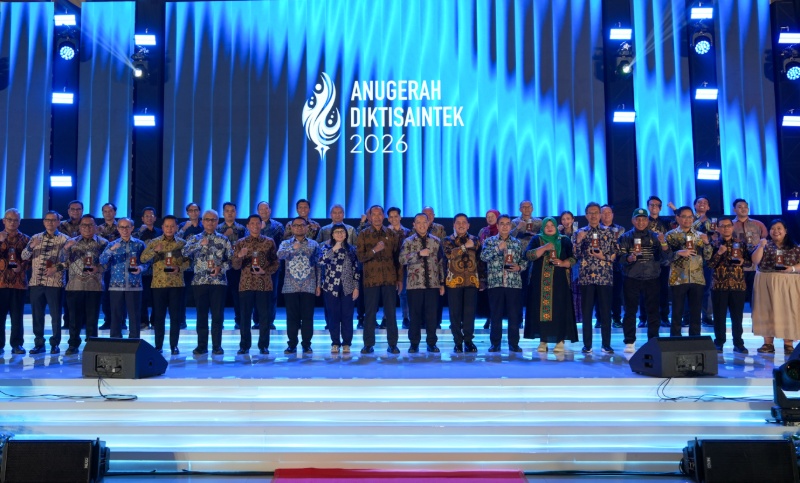
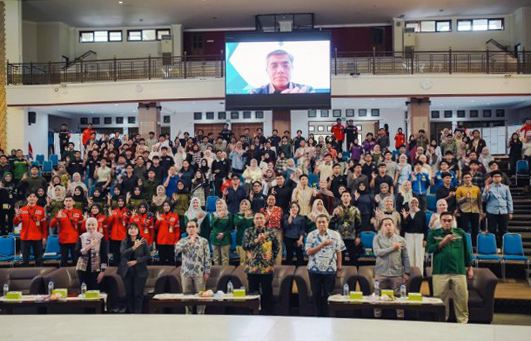
UNDIP, Semarang (21/6) – The National Occupational Safety and Health (OSH) Seminar was recently held under the theme “Optimizing the Role of Occupational Psychology in Building a Professional, Reliable, and Sustainable National OSH Ecosystem.” The seminar took place on Sunday, June 21, 2026, at the Prof. Sudarto, S.H. Building, Tembalang Campus, Universitas Diponegoro (UNDIP).
The National OSH Seminar was attended by Minister of Manpower of the Republic of Indonesia Prof. Yassierli, S.T., M.T., Ph.D.; UNDIP Vice Rector for Research, Innovation, Cooperation, and Public Communication Wijayanto, S.IP., M.Si., Ph.D.; Dean of the UNDIP Faculty of Public Health Prof. Dr. Budiyono, S.KM., M.Kes.; representatives of the Central Java Provincial Manpower and Transmigration Office; as well as students from various higher education institutions across Central Java and members of the general public.
The event began with an opening speech by the Minister of Manpower of the Republic of Indonesia, Prof. Yassierli, S.T., M.T., Ph.D., delivered online. In his presentation, he emphasized the importance of the five pillars of national OSH management amid modern challenges, including the rapid development of artificial intelligence (AI) and digital technology, which are transforming the dynamics of workplace safety. He also highlighted the critical need for comprehensive improvements to work systems to prevent workplace accidents.
The seminar was officially opened by the UNDIP Rector, represented by UNDIP Vice Rector for Research, Innovation, Cooperation, and Public Communication Wijayanto, S.IP., M.Si., Ph.D. In his remarks, he stated that the organization of the National OSH Seminar reflected UNDIP’s commitment to advancing knowledge and raising awareness of the importance of Occupational Safety and Health (OSH). He also expressed hope that the event would serve as a platform for collaboration among academics, government representatives, practitioners, and students to strengthen the culture of OSH and to produce competent human resources prepared to face challenges in the world of work.
The first speaker, M. Yusuf, S.T., M.Si., Director of OSH Testing Development at the Ministry of Manpower, delivered a presentation entitled “Bringing Occupational Psychology into the OSH Ecosystem in Indonesia.” He highlighted the continuously changing dynamics of the workplace, which can trigger work-related stress as employees and organizations adapt to new circumstances. According to him, workers’ mental health must not be overlooked in efforts to establish comprehensive workplace safety.
The second speaker, Gustina, S.K.M., M.Sc., Founder of HSE Solution Expert / Belajar HSE, provided an in-depth discussion on the practical implementation of OSH in the industrial sector. She reminded practitioners and prospective workers to be careful and comprehensive when formulating solutions to workplace risks so that such interventions do not create new negative impacts. Khoirunnisa N.A., S.K.M, moderated the session.
With the theme “Optimizing the Role of Occupational Psychology in Building a Professional, Reliable, and Sustainable National OSH Ecosystem,” the 2026 National OSH Seminar is expected to encourage a new level of public awareness and concern regarding workplace safety and health, particularly the role of occupational psychology in creating a professional and sustainable working environment.
The 2026 OSH Seminar was also complemented by special performances featuring Javanese traditional dance and Studio 8 of the UNDIP Faculty of Public Health, as well as a free photobooth, free health checks, healthy worker exercise sessions, and door prizes. The event was expected to provide insights and educate people from various backgrounds about the importance of workplace safety and health awareness, as well as the application of occupational psychology and the development of a professional and reliable OSH ecosystem in today’s workplace. (Public Communication/UNDIP)