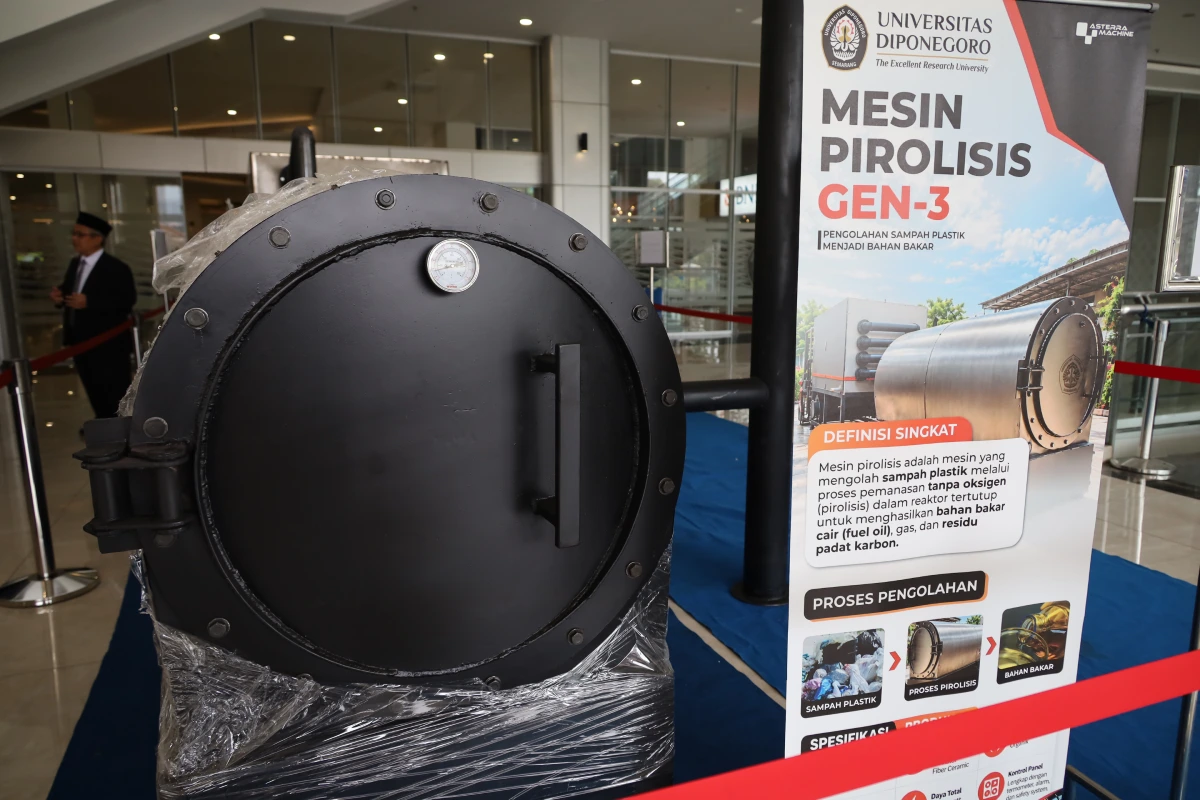

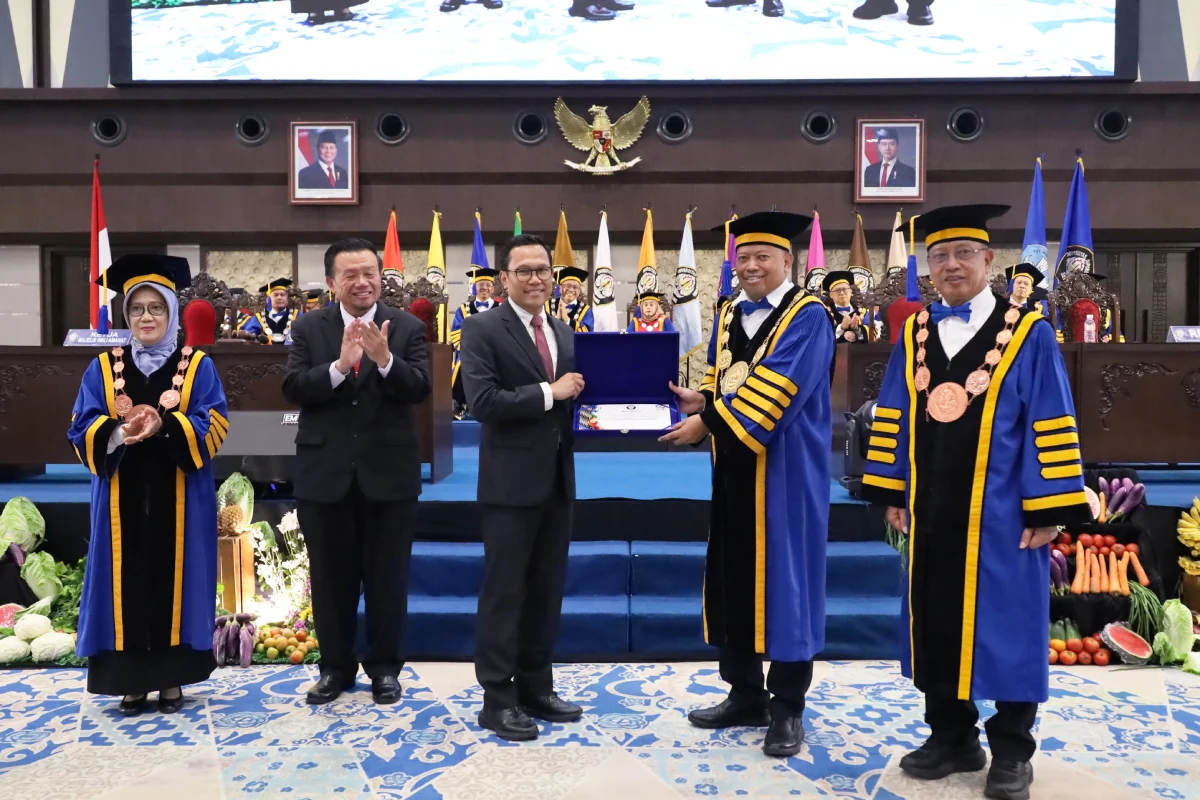
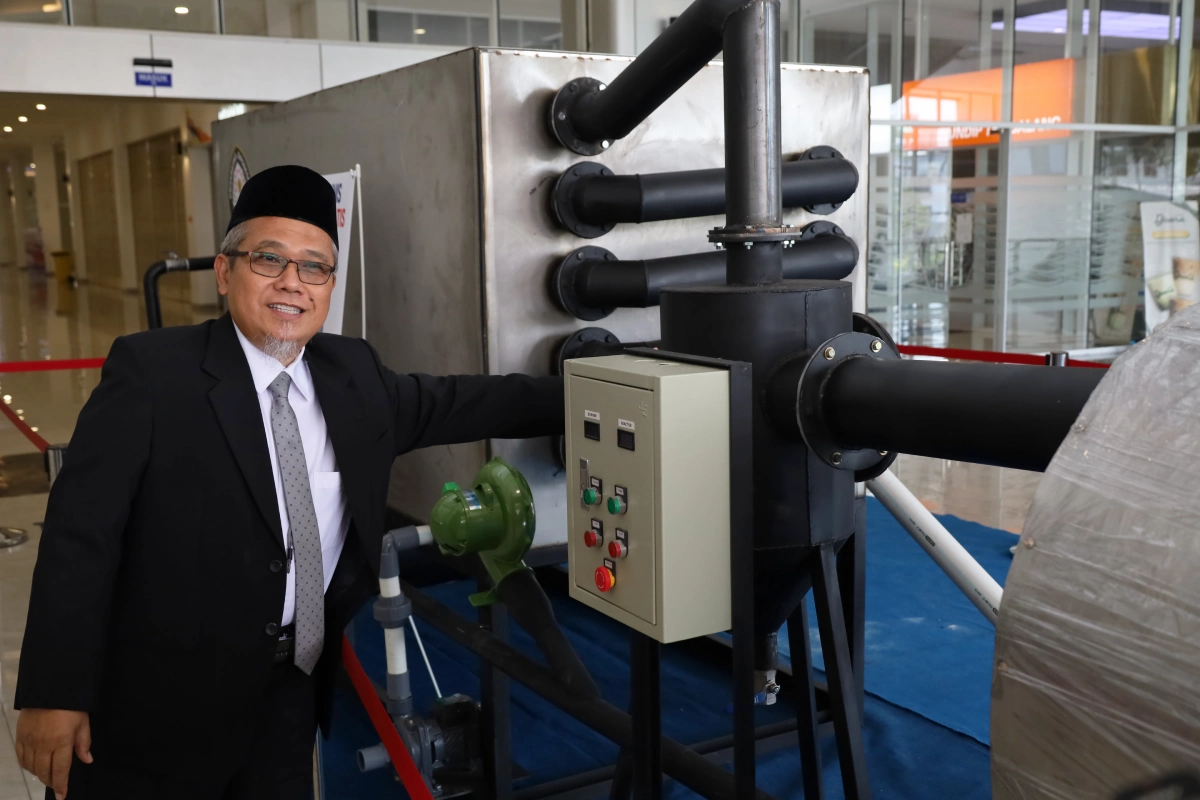
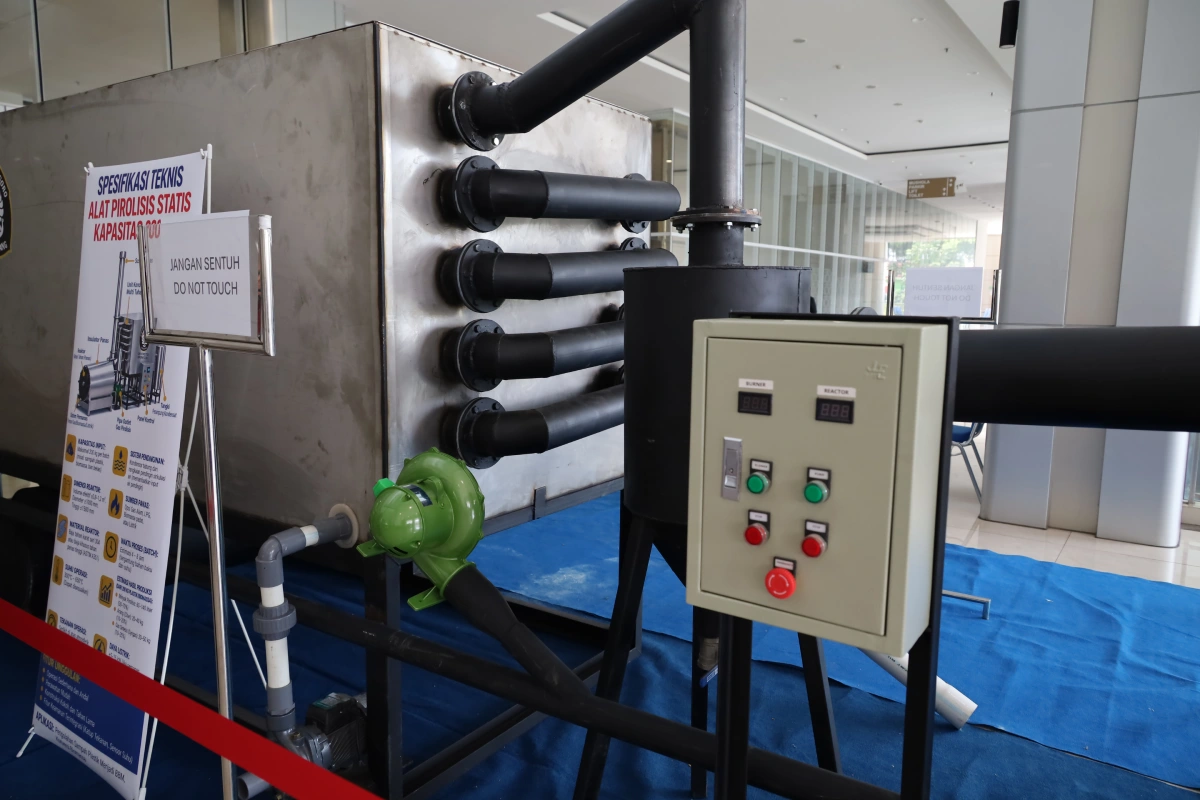
UNDIP, Semarang (16/10) – Plastic waste, which is difficult to decompose and continues to accumulate, has become an environmental challenge requiring concrete solutions. In response to this issue, Universitas Diponegoro (UNDIP) has introduced the third-generation “Dipofuel Static Pyrolysis Machine” (Gen 3), a technology that converts plastic waste into liquid fuel. The innovation was showcased during an exhibition held as part of the Scientific Oration series for UNDIP’s 69th Anniversary on Thursday, October 15, 2026, at the Muladi Dome, UNDIP Tembalang Campus, Semarang.
Developed by a research team led by Prof. Ir. Didi Dwi Anggoro, M.Eng., Ph.D., IPU., ASEAN Eng., a lecturer at the Department of Chemical Engineering, Faculty of Engineering, UNDIP, Dipofuel Gen 3 was designed to reduce waste accumulation while converting it into useful products. The machine operates via pyrolysis, in which plastic waste is heated without oxygen inside a closed reactor. Through this process, plastic waste can be converted into liquid fuel, synthesis gas, and solid carbon residue that can be further utilized.
One of the key advantages of Dipofuel Gen 3 is its increased processing capacity. Starting from the prototype, which could process only 5 kilograms of plastic, its capacity increased to 100 kilograms in the second generation and has now reached 200 kilograms per production cycle. Within approximately 4–8 hours of processing, the machine is projected to produce 60% liquid fuel, 20% combustible gas, and 20% solid wax. “The main advantage of this third generation is its significantly larger capacity. It started at 5 kilograms, then increased to 100 kilograms, and now it can process up to 200 kilograms in a single production cycle,” Prof. Didi explained.
To support this capacity, Dipofuel Gen 3 is equipped with a 1,000-liter reactor made of an iron plate with ceramic-fiber insulation, a biomass-fueled heating system, and temperature- and pressure-control panels with alarms and safety devices. The research team has also improved the multi-stage condensation system to optimize liquid fuel production. Meanwhile, the gas generated during pyrolysis is directed to the heating system via a blower to support combustion and reduce the need for firewood. These improvements are expected to increase energy efficiency and improve control of the processing system.
Despite its potential to produce alternative fuel, Prof. Didi emphasized that the main purpose of developing Dipofuel is not solely to generate economic profit, but to provide a solution to the problem of plastic waste. “From an economic perspective, it may not yet be fully profitable, but the main focus is on how we can solve the waste problem. For example, in Batang, Central Java, the equipment has already been used by local farmers to power irrigation pumps. We hope this technology can make life easier for communities on a broader scale,” he said.
UNDIP’s pyrolysis technology development has also begun to attract interest from various parties. In addition to its use by communities in Batang, potential applications have received responses from correctional institutions and Islamic boarding schools in East Java, as well as from a coal-fired power plant (PLTU) in South Sulawesi, which has expressed interest in possible collaboration on waste processing. Nevertheless, Prof. Didi acknowledged that implementing the technology on a broader scale will still require government support, adequate human resource capacity, and compliance with applicable regulations and licensing requirements.
Interestingly, the development of Dipofuel Gen 3, with an overall weight of approximately three tons, was completed in about two months. Following the anniversary celebrations, the machine is planned to begin operating at UNDIP’s Integrated Waste Processing Facility (TPST). Prof. Didi hopes that the innovation can serve as a pioneering prototype for plastic waste processing at the urban village level before being scaled up. “We hope this machine can become a pioneering prototype for waste processing, at least at the urban village level. In the future, its capacity still has the potential to be developed to the ton scale and applied both in communities and industry,” he said.
The introduction of Dipofuel Gen 3 during UNDIP’s 69th Anniversary reaffirms the university’s commitment to promoting research that goes beyond prototype development and is directed toward solutions relevant to society. Through continuous improvements in pyrolysis technology, UNDIP continues to explore opportunities to transform waste into useful products, in line with the spirit of ‘Noble and Valuable UNDIP’ and Diktisaintek Berdampak. (Public Communication/UNDIP/DHW & Agata)