


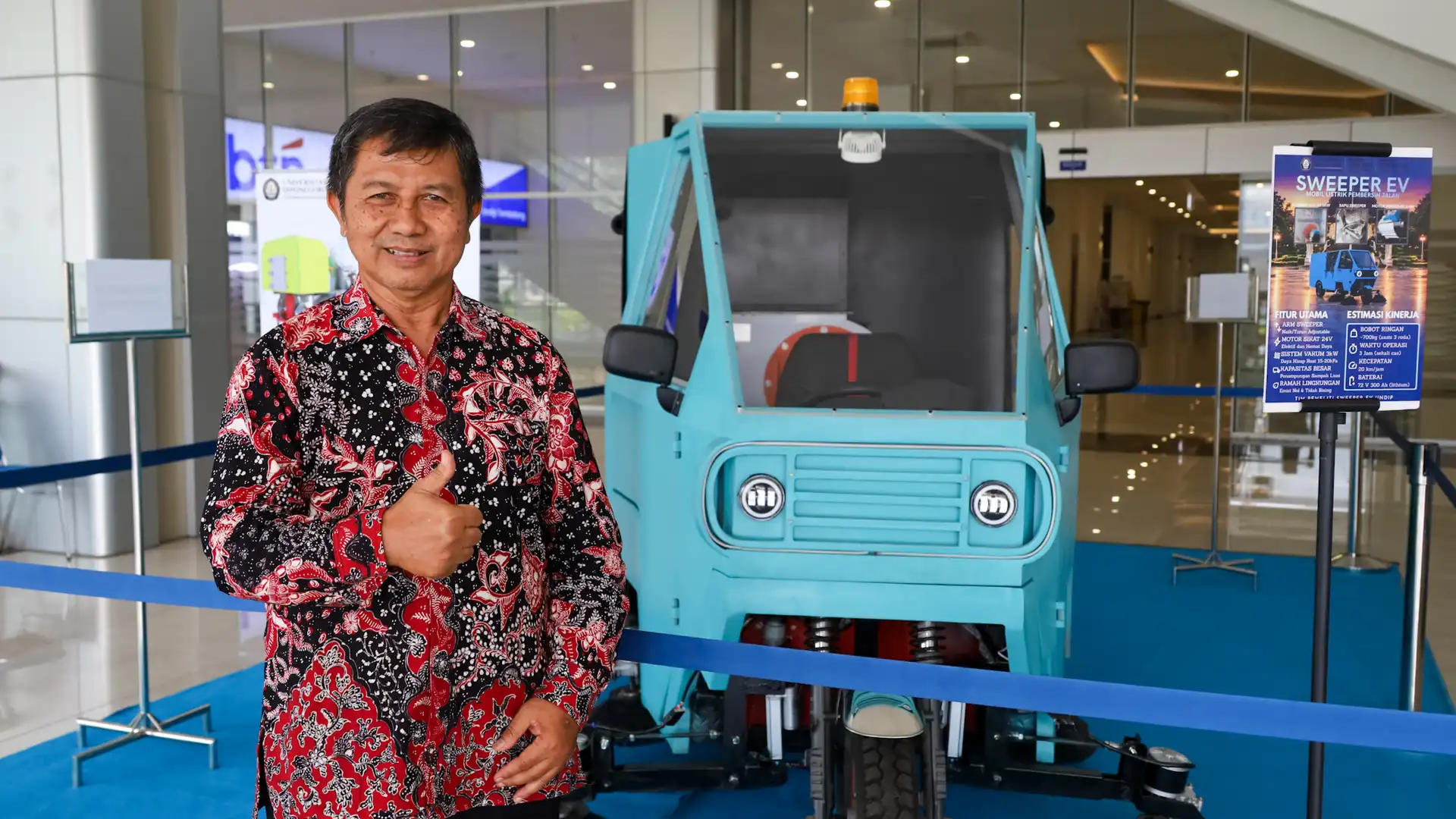
UNDIP, Semarang (16/10) – Street cleaning can now be carried out in a more practical and environmentally friendly way. Universitas Diponegoro (UNDIP) has introduced the “Sweeper EV”, an electric street-sweeping vehicle designed to improve cleaning efficiency while reducing fossil fuel use. The innovation, developed by a research team led by Prof. Ir. Sulistyo, M.T., Ph.D., from the Department of Mechanical Engineering, Faculty of Engineering, UNDIP, was also showcased during UNDIP’s 69th Anniversary celebration at the Muladi Dome on the UNDIP Tembalang Campus on Thursday, October 15, 2026.
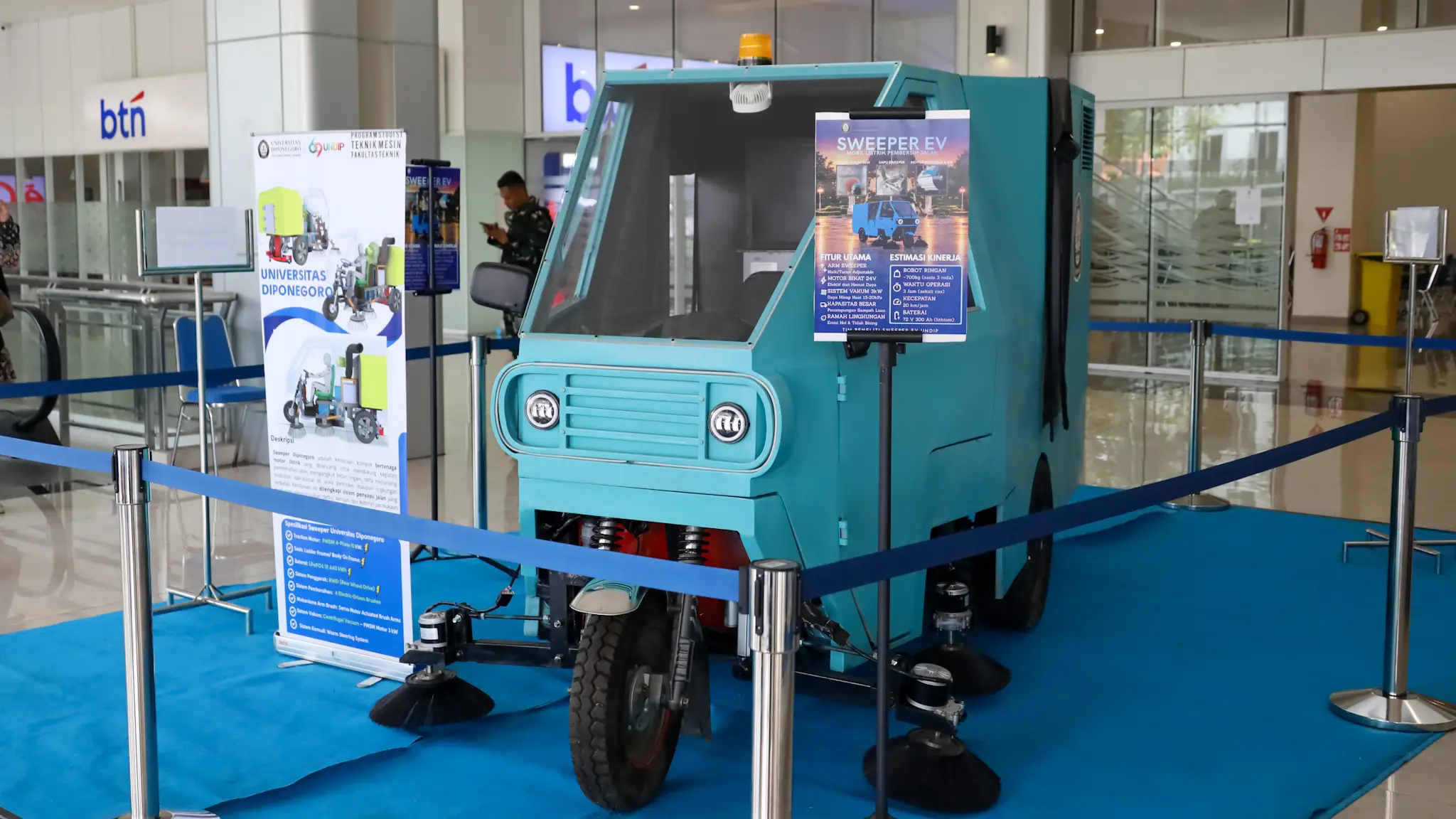
The Sweeper EV was developed to address cleaning challenges in campus areas, urban environments, and public facilities by integrating a sweeping and waste-suctioning system into a compact, three-wheeled vehicle. All of its systems are battery-powered, including both the vehicle propulsion and cleaning equipment.
Prof. Sulistyo explained that the prototype was developed to support more independent and sustainable campus cleanliness. Sweeper EV technology can reduce reliance on manual labor and replace conventional cleaning vehicles that are noisy and emit emissions.
“We designed a street sweeping vehicle with a battery system that can be recharged using electricity. One of its advantages is that, during operation, the vehicle produces no CO₂ emissions from an exhaust pipe, making it more environmentally friendly while also generating less noise,” he explained.
In terms of technology, the Sweeper EV is equipped with four electric brushes mounted on the vehicle’s right and left sides. The brushes direct waste toward the center, where it is then collected using a 3 kW vacuum system with suction pressure of approximately 15–20 kPa. The system is designed to handle street waste, including dry leaves, small twigs, dust, and other lightweight debris.
“There are four sweeping units, with two on the right and two on the left. The height of the brushes can be raised or lowered as needed. The brush rotation speed and vacuum suction power can also be adjusted to low, medium, or high settings depending on the condition of the road surface being cleaned,” Prof. Sulistyo explained.
These adjustable settings allow operators to adapt the vehicle’s performance to different cleaning needs, including when handling dry leaves and twigs. With this system, the cleaning process is expected to become more efficient and coordinated, without relying on separate sweeping and waste-collection methods.
The development of Sweeper EV technology also addresses common challenges encountered in street cleaning. Small metal objects, such as nails or iron fragments, could interfere with the suction mechanism if they enter the system. To address this issue, the research team is preparing to add a magnet trap.
“The magnetic system will function to capture metal objects before they enter the suction channel. This way, waste can still be vacuumed while the vacuum blower components are better protected from the risk of clogging or damage caused by foreign objects that could obstruct the flow of waste,” he said.
The development of this feature forms part of the technical evaluation process to ensure that the vehicle is increasingly ready for use under various road conditions.
In addition to its road-cleaning capability, the Sweeper EV also prioritizes operational efficiency. The three-wheeled electric vehicle is equipped with a 5 kW motor and a 72-volt, 300 Ah lithium battery. Weighing approximately 700 kilograms, the Sweeper EV is estimated to operate for up to three hours on a single charge at around 20 kilometers per hour. Its compact size allows the vehicle to access neighborhood roads and areas with limited access. Its electric power system also makes the vehicle significantly quieter than conventional fuel-powered vehicles.
The presence of the Sweeper EV at UNDIP’s 69th Anniversary demonstrates the contribution of university research in addressing community needs through an integrated and efficient street waste management solution that can also reduce the workload of cleaning personnel. With ongoing improvements to its technical safety features, this environmentally friendly electric vehicle innovation developed by Indonesian researchers reaffirms UNDIP’s commitment to providing green technologies that support urban modernization. (Public Communication/UNDIP/DHW & Agata)