


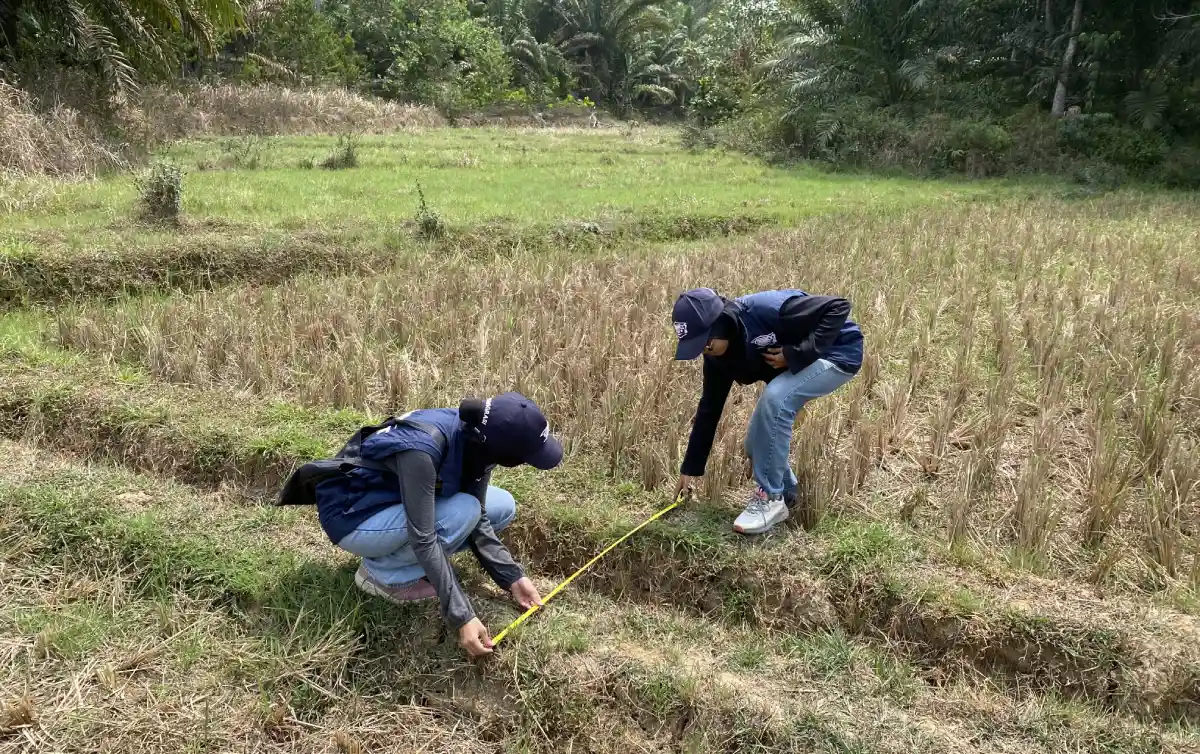
UNDIP, Kikim, Lahat Regency (1/10) – Efforts to strengthen agricultural resilience in transmigration areas continue to be realized through the planned utilization of Solar-Powered Water Pumps (PATS). As an initial step toward meeting community irrigation needs, Team 1 of the Universitas Diponegoro Patriot Expedition Team (TEP UNDIP) conducted a follow-up survey in Marga Mulya Village, East Kikim District, Lahat Regency, on Saturday (12/9).
The activity, attended by approximately 20 participants, focused on gathering information regarding agricultural land conditions, water availability, and water storage facilities currently used by the community. During the activity, Head of Marga Mulya Village, Edi Sumanto, together with Village Secretary Jazuli, explained the conditions and various challenges residents face in meeting their agricultural water needs.
Edi Sumanto explained that the area of rice fields in Marga Mulya Village has declined significantly, from approximately 100 hectares to only around 50 hectares that can still be utilized. This condition is largely influenced by limited water supply, meaning that every year some rice fields do not receive adequate irrigation. “From around 100 hectares, now only about 50 hectares remain because of water problems. Every year, there are rice fields that do not receive water,” Edi said.
Water availability issues have also affected the development of organic agriculture in the village. The community previously held organic rice certification, but limited market access and a lack of sustained support prevented the product from developing sustainably. The certification could not be renewed because the product no longer met the required quality standards.
Meanwhile, the village government has gradually constructed several reservoirs using village funds, depending on budget availability. However, the existing reservoirs have not yet fully met the community’s water needs.
Several reservoirs have been successfully utilized, with one occasionally used as a fishing site by local youth groups. However, during the dry season, water levels decline significantly, leaving the reservoir beds dry and cracked. Other reservoirs face technical problems, such as leakage, that prevent them from retaining water for the required period despite several repair attempts.
According to Edi, the development of water storage facilities needs to be planned more carefully because groundwater sources are limited. He hopes that every sub-village in Marga Mulya Village will have a properly functioning reservoir, particularly to support irrigation needs during the dry season. “We hope that every hamlet will have a reservoir that can truly store water. If we rely only on wells, there will come a time when the water source may decrease or dry up,” he explained.
Environmental conditions and changes in land use have also become a concern. The expansion of oil palm plantations around the area is considered to have affected the village’s water system. As a result, the community faces flooding during the rainy season and agricultural water shortages during the dry season.
Through the follow-up PATS survey conducted by TEP UNDIP Team 1, these conditions have become important considerations in designing an irrigation system that meets community needs. The use of solar energy is expected to provide an alternative solution for water pumping systems while improving access to water sources for agricultural land.
The survey activity focused not only on the technical aspects of PATS, but also served as an opportunity to directly understand the needs and social conditions of the local community. The survey results are expected to provide a foundation for formulating more sustainable water management support for the people of Marga Mulya Village.
This initiative supports the achievement of the Sustainable Development Goals (SDGs), particularly SDG 2 (Zero Hunger) through strengthening village food security, SDG 6 (Clean Water and Sanitation) through sustainable management of irrigation water resources, and SDG 7 (Affordable and Clean Energy) through the utilization of environmentally friendly solar-powered technology. (Public Communication/UNDIP)