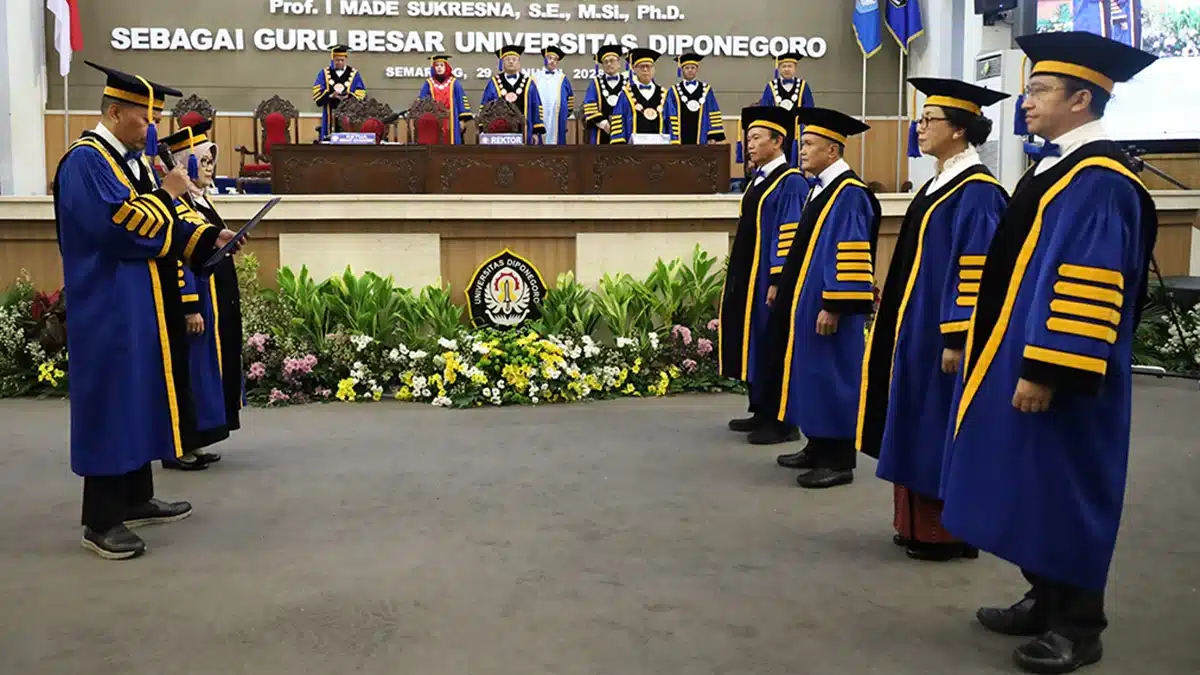




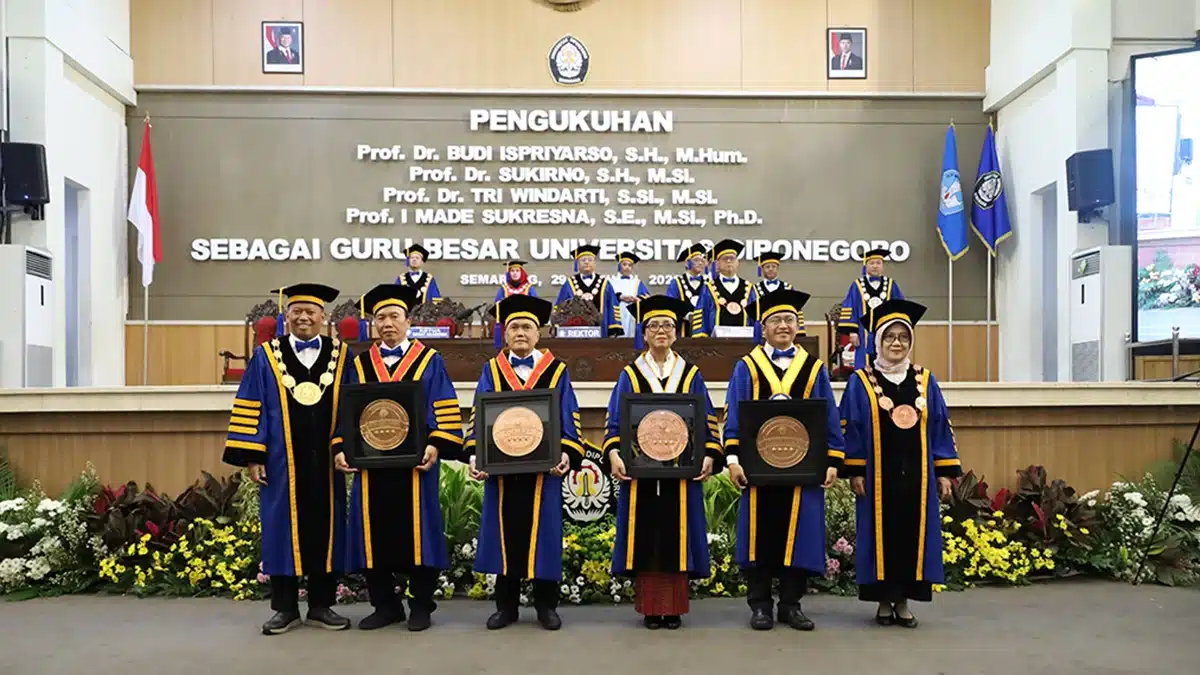
UNDIP, Semarang (29/1) – Universitas Diponegoro (UNDIP) once again inaugurated four professors as part of the continuing series of the Inauguration Ceremony of 18 Professors of Universitas Diponegoro at the beginning of 2026, which is being held from January 26 to January 30, 2026, at the Sudarto, S.H. Building, Tembalang, Semarang.
Thursday, January 29, 2026, marked the fourth day of the Professor Inauguration Ceremony, during which four professors were officially inaugurated: Prof. Dr. Budi Ispriyarso, S.H., M.Hum. and Prof. Dr. Sukirno, S.H., M.Si. from the Faculty of Law; Prof. Dr. Tri Windarti, S.Si., M.Si. from the Faculty of Science and Mathematics; and Prof. I Made Sukresna, S.E., M.Si., Ph.D. from the Faculty of Economics and Business.
Opening the scientific session, Prof. Dr. Budi Ispriyarso, S.H., M.Hum., an expert in Tax Law, delivered a lecture entitled Reforming the Tax Court toward Greater Independence and Justice. He explained that judicial institutions are a central pillar of law enforcement, tasked with adjudicating cases, upholding justice, and safeguarding Indonesia’s constitutionalism. One such judicial body is the Tax Court, which has the authority to examine and adjudicate tax disputes. The Tax Court is regulated under Law Number 14 of 2002 and was established to improve upon the previous institution, the Tax Dispute Settlement Agency (BPSP). However, in practice, its performance has not yet met expectations.
Many parties have urged immediate reforms to the current Tax Court system. In response, the government initiated Tax Court reforms in 2023, involving fundamental changes to its status and supervision. These reforms repositioned the Tax Court as a special court within the Administrative Court system (PTUN). Organizational, administrative, and financial supervision was transferred from the Ministry of Finance to the Supreme Court, shifting from a dual-roof system to a one-roof system, in line with Constitutional Court Decision Number 26/PUU-XXI/2023.
Prof. Budi Ispriyarso emphasized that further policies are needed to achieve the reform goals, including revising Law Number 14 of 2002 to remove provisions inconsistent with judicial independence and the rule of law. Institutional improvements should include establishing Tax Courts at the provincial level, creating a specialized tax chamber at the Supreme Court, increasing the number of Tax Court judges and Tax Supreme Court justices, drafting procedural law for the Tax Court as a special PTUN court, completing the one-roof organizational restructuring, and enhancing digitalization through an e-Tax Court system.
Next, Prof. Dr. Sukirno, S.H., M.Si., an expert in Customary Law and Legal Anthropology, delivered a lecture entitled Building Protection for Indigenous Peoples and Their Rights Based on Diversity and Equality. He explained that Indigenous Peoples (Masyarakat Hukum Adat/MHA) existed long before the establishment of the Republic of Indonesia. Current recognition of MHA and their rights has not provided adequate protection due to the state’s legal unification policy, which negates diversity and equality. Recognition of MHA and customary land rights remains conditional on the existence and implementation requirements.
He highlighted practical issues, such as the difficulty faced by Indigenous Belief Communities, including the Baduy people, in obtaining marriage certificates due to excessive administrative requirements. As a result, many Baduy families have been unable to obtain marriage certificates since 2006, causing the state to classify their children as born out of wedlock.
Prof. Sukirno explained that Pancasila and the 1945 Constitution provide a strong legal foundation for protecting Indigenous Peoples. Concepts such as the rule of law, equality before the law, legal pluralism, and human rights further strengthen this protection. He argued that lawmakers must develop a simultaneous understanding of Indigenous Peoples as distinct, minority, and vulnerable communities. Excessive requirements should not burden the protection of their rights, and affirmative action is necessary to achieve substantive equality. He cited Law Number 8 of 2016 on Persons with Disabilities as a comparative reference, noting its affirmative action provisions, including employment quotas in public institutions. Another comparison was the Philippines, which has both constitutional and statutory protections through the Indigenous Peoples’ Rights Act (IPRA) of 1997, which goes beyond mere recognition to ensure protection and welfare. Prof. Sukirno recommended developing a legal policy grounded in diversity and equality, revising related legislation, and promptly enacting a dedicated Indigenous Peoples Law.
Subsequently, Prof. Dr. Tri Windarti, S.Si., M.Si., an expert in Biomaterial Synthesis for Bone Implantation, delivered a lecture entitled Calcium Phosphate Cement for Increasing Bone Density in Osteoporosis. She explained that osteoporosis is a condition characterized by microarchitectural bone damage due to decreased osteoblastic activity and increased bone resorption, leading to porous, fragile bones prone to fractures. Osteoporotic fractures can lead to chronic pain, disability, loss of independence, and premature death. When pharmacological and non-pharmacological interventions are ineffective, increasing bone density through injectable bone cement becomes necessary. Calcium phosphate cement (CPC) meets the criteria for filling osteoporotic bone due to its biocompatibility, bioconductivity, bioinductivity, and potential use as a local drug delivery system.
Prof. Tri Windarti noted that her research on CPC development began in 2007, initially focusing on the synthesis of calcium phosphate compounds, including hydroxyapatite (HA) and β-tricalcium phosphate (β-TCP). Subsequent research combined HA with active compounds such as chitosan, polyeugenol, and curcumin to produce CPC with antioxidant and antibacterial properties. To further enhance performance, HA was structurally modified with SiO₂ (HA-SiO₂) and combined with cerium-modified β-TCP (β-TCP/Ce) to improve structural stability. The addition of CeO₂ provided antioxidant and antibacterial activity, resulting in CPC with favorable chemical and surface properties, antibacterial activity, and good biocompatibility with pre-osteoblast MC3T3E1 cells.
Future research will optimize CPC as a local drug delivery system by incorporating anti-resorptive and bone-forming agents. Anti-resorptive agents slow bone resorption, while bone-forming agents stimulate new bone formation. The antioxidant activity of CeO₂ will control high levels of reactive oxygen species (ROS). This approach is expected not only to increase bone density but also to restore osteoblastic function, promote new bone tissue formation, enhance mechanical strength, and reduce fracture risk.
In his lecture, Prof. I Made Sukresna, S.E., M.Si., Ph.D., an expert in Industrial Marketing, presented A Model for Optimizing Value among Business Partners in Industrial Marketing in Indonesia. He explained that academics and marketing practitioners widely agree that value is a central concept in marketing, as reflected in the American Marketing Association’s definition of marketing as activities, institutions, and processes for creating, communicating, delivering, and exchanging offerings that have value for customers, clients, partners, and society. This principle also applies to industrial marketing, which focuses on business-to-business (B2B) transactions rather than individual consumers. Customer value is generally defined as perceived benefits minus the costs incurred to achieve customer objectives. Customer value has been a foundational concept in B2B marketing for more than two decades, with its popularity rising significantly since 2000 until today.
Prof. I Made Sukresna discussed value optimization models for both sellers and buyers as business partners in industrial marketing. He proposed that parties with weaker bargaining power—typically small and medium enterprises—should adopt transactional exchange strategies in the early stages of business relationships. Conversely, stronger parties—typically large enterprises—should focus on relational value-in-use strategies. During the adaptation phase, SMEs should employ expectation-based or interdependence strategies, while larger firms should adopt togetherness or exchange strategies. These strategic shifts depend on changes in relative power dynamics and may evolve further with the adoption of digital technologies, a topic warranting further research. (UNDIP/Public Communication/As3)