




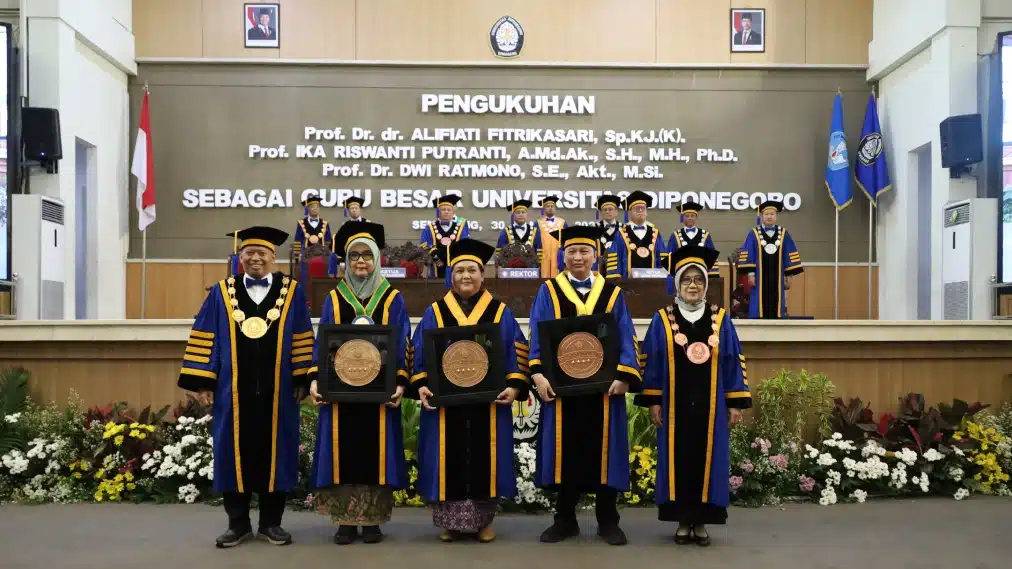
UNDIP, Semarang (30/01) – Universitas Diponegoro (UNDIP) inaugurated 18 Professors at the beginning of 2026. This inauguration reflects the strengthening role of higher education institutions in advancing knowledge and addressing the nation’s strategic challenges. On Friday (30/1), UNDIP inaugurated three Professors from the fields of psychiatry, international law, and forensic accounting, each presenting scholarly contributions relevant to contemporary challenges in mental health, global legal dynamics, and fraud prevention across organizations.
The Rector of Universitas Diponegoro, Prof. Dr. Suharnomo, S.E., M.Si., congratulated the newly inaugurated Professors and expressed his hope that their scholarly expertise would not remain confined to laboratory-scale research, but would generate tangible benefits for society at large.
The first professor inaugurated was Prof. Dr. dr. Alifiati Fitrikasari, Sp.K.J.(K) from the Faculty of Medicine, was appointed as Professor in the field of Consultation-Liaison Psychiatry (CLP). In her inaugural lecture entitled The Potential of Probiotics as Adjuvant Therapy for Depression, Prof. Alifiati highlighted depression as one of the leading causes of mental disability and global disease burden. She emphasized that the treatment of depression continues to face numerous challenges, including resistance to antidepressants, non-adherence to medication, and stigma toward pharmacological therapy.
Through an interdisciplinary approach, Prof. Alifiati examined the relationship between stress, gut microbiota balance, and mood disorders. Her research demonstrated that certain probiotics have the potential to serve as adjuvant therapy to support more comprehensive treatment of depression, including in patients with comorbid chronic physical illnesses or other psychiatric disorders. This approach opens new perspectives in psychiatric practice, offering a more holistic approach and a focus on improving patients’ quality of life.
“Depression is a mental disorder with a high global burden and involves complex biological dysfunctions. Because standard therapies do not always yield optimal outcomes, additional approaches are required. Probiotics have the potential to be developed as adjuvant therapy for depression, including in patients with comorbid chronic physical diseases, within a comprehensive and long-term therapeutic approach,” Prof. Alifiati stated.
The second Professor inaugurated was Prof. Ika Riswanti Putranti, A.Md.Ak., S.H., M.H., Ph.D., from the Faculty of Social and Political Sciences, appointed as a Professor in International Law. In her inaugural lecture entitled Transnational Legal Process in the Era of Mega-FTAs and Disruptive Technologies: Balancing Global Norms and Indonesia’s National Interests,” Prof. Ika discussed the transformation of international trade law architecture amid the proliferation of Free Trade Agreements (FTAs) and the emergence of Mega-FTAs. She highlighted the limitations of the World Trade Organization (WTO) in responding to emerging issues such as digital trade, e-commerce, environmental standards, and disruptive technologies, including artificial intelligence and biotechnology.
Using the Transnational Legal Process (TLP) framework, Prof. Ika explained how global norms can be internalized into national legal systems without undermining state sovereignty. A case study of Indonesia’s participation in the RCEP agreement illustrated that Indonesia is not merely a norm taker, but also a norm entrepreneur in shaping regional and global legal governance, particularly in the fields of digital economy and future technologies.
“Through the transnational legal process framework, global norms from Mega-FTAs do not operate mechanically, but are internalized into national law through interaction and interpretation by various actors. This process provides space for Indonesia not only to receive rules, but also to shape the direction of global norm implementation in alignment with national interests and development objectives,” Prof. Ika explained.
The third professor inaugurated was Prof. Dr. Dwi Ratmono, S.E., Akt., M.Si., from the Faculty of Economics and Business, appointed as Professor in the field of Occupational Fraud. In his inaugural lecture entitled An Integrative Fraud Risk Management Model for Organizations, Prof. Dwi emphasized that fraud, particularly corruption, remains a serious challenge for many organizations in Indonesia. Existing models of fraud mitigation are often considered insufficiently comprehensive to address the growing complexity of fraud practices.
Prof. Dwi introduced an integrative Fraud Risk Management (FRM) model encompassing prevention, detection, and follow-up measures, and developed across multiple levels—individual, organizational, industry, and national. The model also incorporates technological approaches, including digital forensics, big data, and data analytics, to strengthen sustainable fraud detection and prevention systems.
“The increasing number of fraud cases and the magnitude of resulting losses demand the implementation of an integrative fraud risk management model, so that risks can be minimized early and losses to both business organizations and government institutions can be reduced,” Prof. Dwi stated.
The inauguration of these three Professors underscores UNDIP’s commitment to advancing adaptive, interdisciplinary knowledge with tangible societal impact. Through expertise in mental health, international law, and forensic accounting, UNDIP continues to contribute to addressing global challenges while strengthening national development based on research and innovation (UNDIP/Public Communication/Hng)