





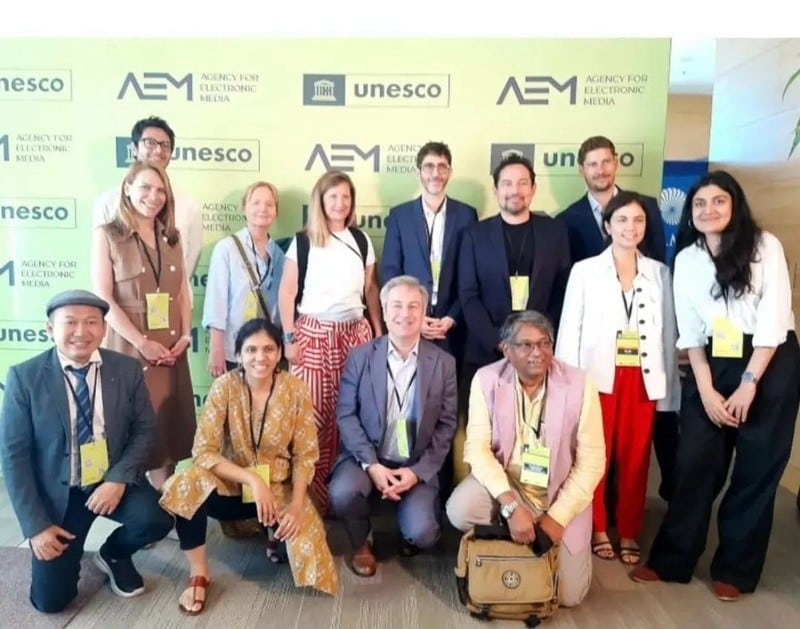
UNDIP, Semarang (13/2) – Universitas Diponegoro (UNDIP) has once again reaffirmed its commitment to strengthening global digital space governance through its participation in a UNESCO forum as part of the Internet for Trust (I4T) Global Knowledge Network. This involvement took place at the 2026 International Conference on Digital Platform Governance, organized by UNESCO at the University of Pretoria, Pretoria, South Africa.
At the international forum, UNDIP was represented by Wijayanto, Ph.D., Vice Rector for Research, Innovation, Collaboration, and Public Communication, who participated as an online speaker.
In his presentation, Wijayanto, Ph.D., presented research findings on policy mapping for digital platform governance in three Southeast Asian countries—Indonesia, Singapore, and the Philippines. The research was an international collaboration between Universitas Diponegoro, the Director of the Civic Tech Lab at the National University of Singapore (NUS), and the Asian Media Information and Communication Centre (AMIC) Philippines, with UNDIP serving as the project leader.
The study highlighted both shared and country-specific challenges in regulating the increasingly complex and cross-border digital platform ecosystem. In general, the research identified several common challenges across the three countries, including the use of vague and subjective regulatory terms that allow multiple interpretations; the emergence of increasingly organized influence operation networks; gaps between low digital and media literacy levels and the agenda of expanding digital inclusion; and challenges in stakeholder coordination within a multi-stakeholder governance framework.
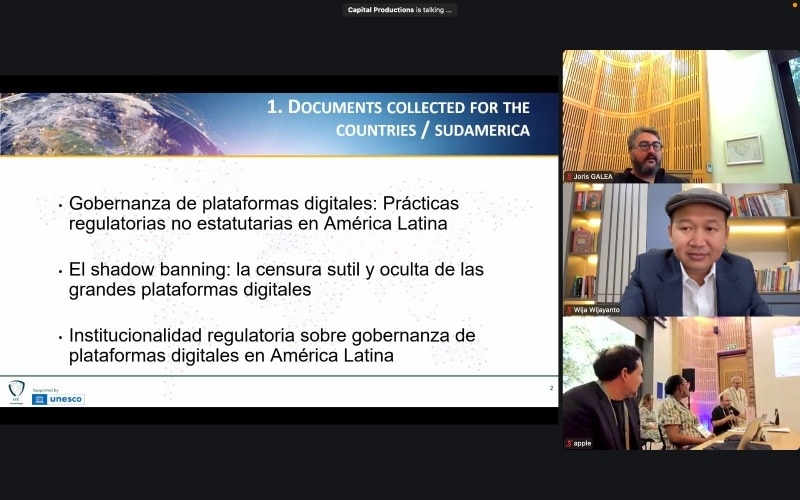
Wijayanto, PhD, speak (via zoom meeting) at the 2026 International Conference on Digital Platform Governance, organized by UNESCO at the University of Pretoria, Pretoria, South Africa.
In addition, each country faces specific challenges. In Indonesia, the regulatory approach still emphasizes control or repression rather than corrective and restorative approaches, accompanied by a tendency toward increased information control and significant challenges arising from linguistic diversity. In the Philippines, key issues include overlapping institutional authorities, decentralized regulatory frameworks, and a fragmented regulatory landscape. Meanwhile, in Singapore, a high reliance on centralized authority and limited participatory governance poses risks of excessive removal of legally permissible content.
UNDIP’s participation in this forum is part of its active contribution to the Internet for Trust Global Knowledge Network, a network of experts and institutions from various regions worldwide that supports the implementation of UNESCO Guidelines for the Governance of Digital Platforms. This network promotes evidence-based, collaborative digital platform governance oriented toward public interest and the protection of human rights.
Currently, UNDIP is leading a strategic project to develop the UNESCO Digital Platform Governance Implementation Guidelines for the Southeast Asian context. These guidelines are designed as practical tools for governments, regulators, digital platforms, academics, and civil society to translate UNESCO principles into transparent, accountable, and inclusive policies and practices.
The development of the Implementation Guidelines will involve various stakeholders in Indonesia, Singapore, and the Philippines, in line with UNESCO’s whole-of-society approach, which underpins UNESCO’s Internet for Trust framework. Universitas Diponegoro is scheduled to host a key meeting in early April this year to bring together regional stakeholders to develop and test the guidelines.
Through its leadership of this regional project, UNDIP strengthens its position as an Indonesian academic actor in global policy discourse while making a tangible contribution to the development of democratic, equitable, and public-interest-oriented digital platform governance at both regional and international levels. This activity also demonstrates UNDIP’s contribution to SDG 16 – Peace, Justice, and Strong Institutions at the national and global levels. (Public Communication/UNDIP/Research Team, ed. Nurul)