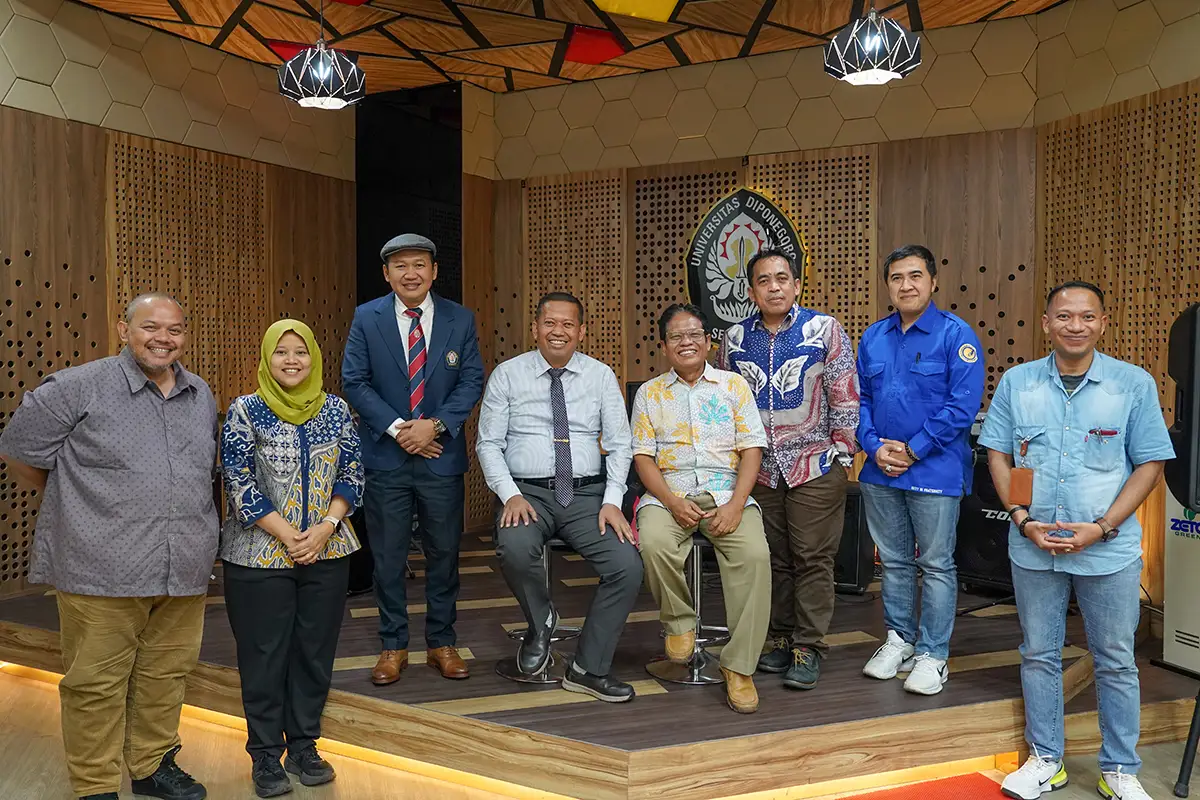
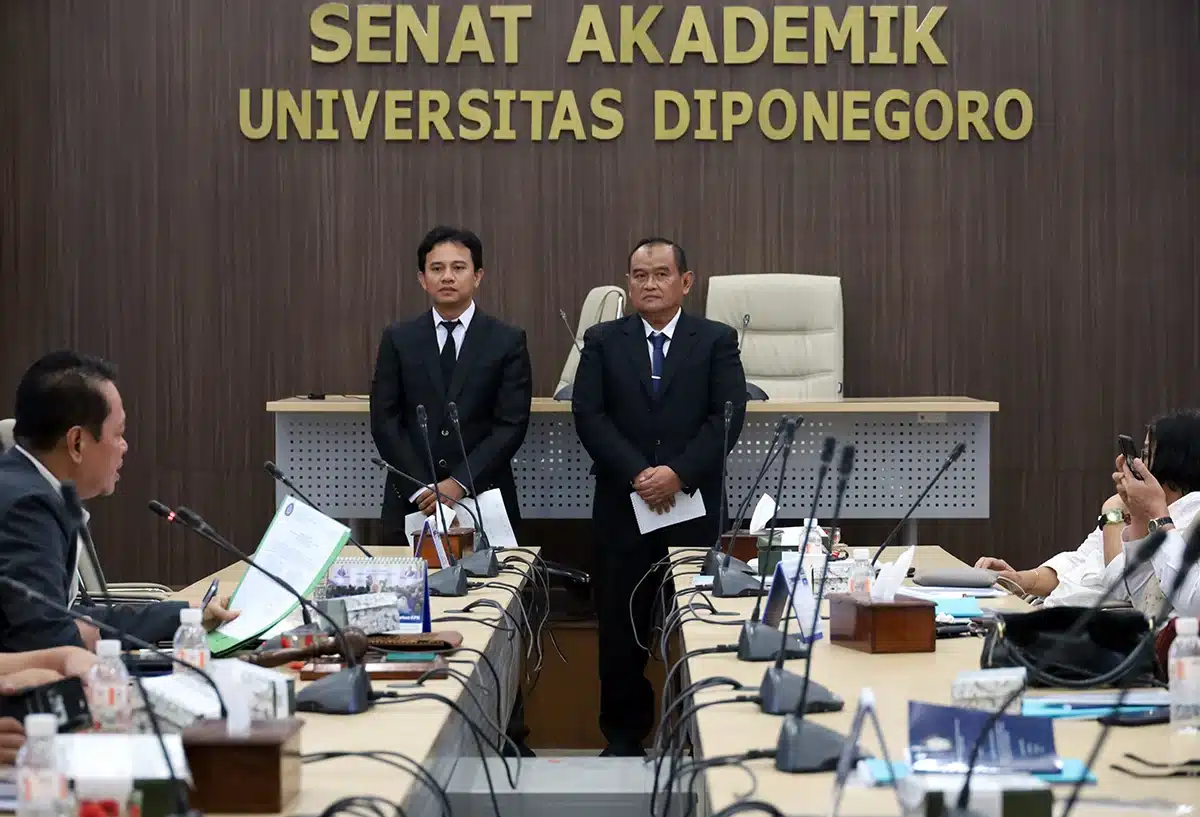
UNDIP, Semarang (4/5) – Universitas Diponegoro (UNDIP) once again held scientific paper presentations by two professor candidates, organized by the UNDIP’s Board of Professors on Monday, May 4, 2026, at 09:00 AM in the Academic Senate Meeting Room, 3rd Floor of the SA-MWA Building, UNDIP Tembalang Campus. The two professor candidates were Ir. Sutopo, M.Sc., Ph.D., from the Faculty of Animal and Agricultural Sciences, and Prihantoro, S.S., M.A., Ph.D., from the Faculty of Humanities.
In the first session, Ir. Sutopo, M.Sc., Ph.D., presented a scientific paper titled “Improving the Genetic Quality of Local Livestock through Selection of Characteristics Using Molecular Markers.” He explained that improving the genetic quality of Indonesia’s local livestock is important for preserving genetic resources while supporting national livestock productivity.
One of the main focuses of his study is Bali cattle, a domesticated breed originating from the wild banteng (Bos javanicus). Bali cattle possess strong genetic adaptability, and their genetic traces are found in several Indonesian local cattle breeds through crossbreeding with Zebu, Ongole/PO, and European cattle lines.
In addition to Bali cattle, Ir. Sutopo also highlighted the genetic potential of Indonesia’s local chickens, particularly the Cemani chicken. This breed is characterized by fibromelanosis, a condition that causes black pigmentation across almost all body tissues, as well as by specific molecular markers in the D-loop and ND3 genes.
In dairy cattle research, he further discussed the role of the Toll-like Receptor 4 (TLR4) gene, which is associated with milk production and resistance to mastitis. These findings open the door to using Single Nucleotide Polymorphisms (SNPs) as genetic markers to produce Friesian Holstein cattle that are more productive, disease-resistant, and better adapted to tropical environments.
Meanwhile, in the second session, Prihantoro, S.S., M.A., Ph.D., presented a scientific paper titled “CORTEX: A Corpus Data Retrieval System for Digital Humanities.” In his presentation, he explained that corpus linguistics has evolved not only as an academic field but also as an essential component of language technology in everyday life.
According to him, various technologies based on Natural Language Processing (NLP), such as machine translation, text-to-speech systems, artificial intelligence, and text analysis for public policy, demonstrate the growing importance of language data in the digital ecosystem. Corpus linguistics also contributes to data-driven education, technological innovation, and more accurate policymaking.
Prihantoro explained that corpus data processing has long been supported by tools such as CQPweb, Sketch Engine, LancsBox, and WordSmith. However, data interpretation still heavily depends on researchers’ expertise, requiring considerable time, precision, and deep understanding. Through the concept of CORTEX, he introduced an AI-based corpus query system that not only displays data but also assists users in reading, understanding, and interpreting analytical results more effectively.
CORTEX is also viewed as a strategic step toward strengthening national scientific independence. The system represents an effort to build domestic language technology capacity while supporting digital transformation, human resource development, and mastery of science and technology. The presentations by these two professor candidates demonstrate UNDIP’s contribution to advancing interdisciplinary knowledge, ranging from innovations in local livestock genetics to strengthening technology-based digital humanities. (Public Communication/UNDIP/Dhany)