
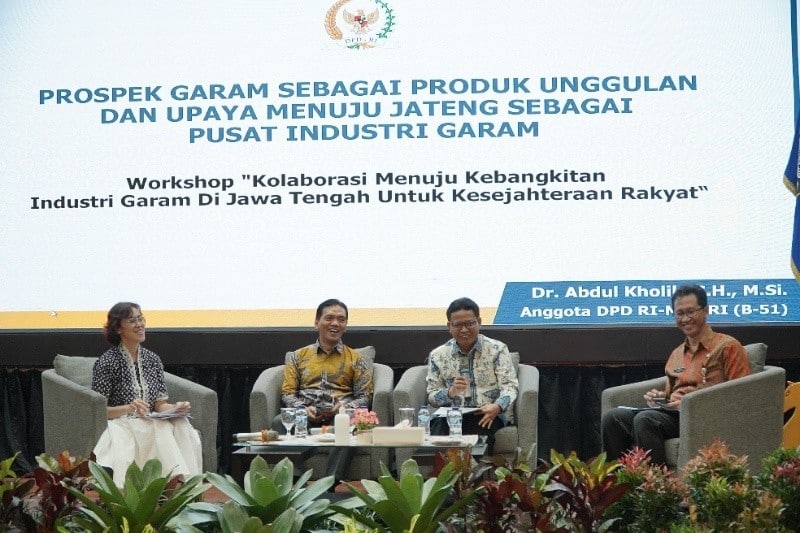
UNDIP, Semarang (December 4, 2025) – The Faculty of Social and Political Sciences (FISIP) of Universitas Diponegoro (UNDIP) held a workshop titled Salt Self-Sufficiency Actor Forum in Central Java. The seminar aimed to bring together various stakeholders to achieve independence and sustainability in the salt industry in Central Java.
The event was opened by the Dean of UNDIP’s Faculty of Social and Political Sciences, Dr. Teguh Yuwono S., M. Pol. Admin., who, in his remarks, highlighted UNDIP’s strategic role as an academic institution committed to studying social and policy issues. He also expressed his hope that this workshop would become a productive collaborative forum between academics, the government, and industry actors to strengthen national salt resilience.
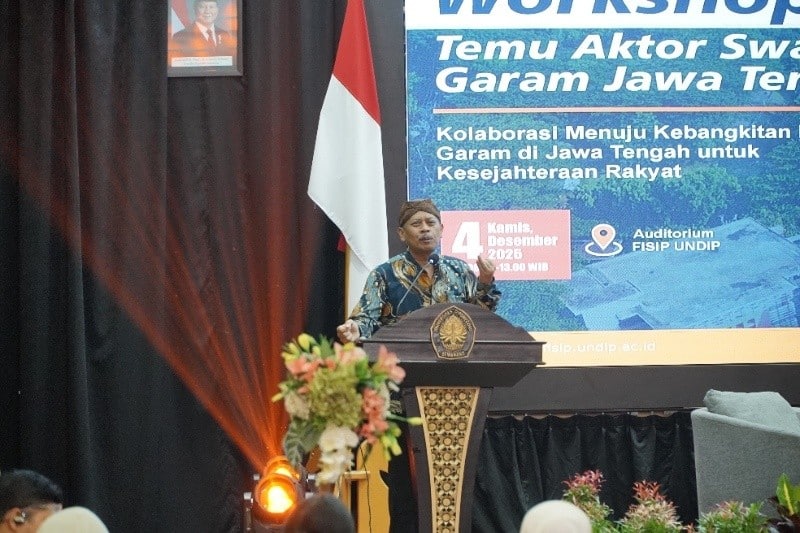
A professor at UNDIP delivered the second remark, Prof. dr. Achmad Zulfa Juniarto, M.Si.Med., Sp.And(K)., M.M.R., Ph.D., who emphasized in his presentation that salt is an essential component of food security that must be managed properly and sustainably. He underscored the need for strong synergy between the government, academics, industry, and salt farmers to ensure the sustainability of the salt industry.
In the keynote speech session, Endi Faiz Effendi, S.Pi., MA., Head of the Marine and Fisheries Office of Central Java Province, stated that the salt industry in Central Java has enormous potential and that this activity marks a significant step forward in advancing the sector in the region.
The next session featured presentations from several speakers. Dr. Abdul Kholid, S.H., M.Si., Senator of the Regional Representative Council (DPD RI), began by discussing Existing Conditions and the Commitment to Support Advancing the Salt Industry in Central Java. He highlighted development challenges in Central Java, including overpopulation (38.23 million people), the lack of leading regional products, and insufficient infrastructure connectivity. To address these issues, he called on religious community organizations such as NU and Muhammadiyah to support the promotion and increased consumption of locally produced Central Java salt.
The next speaker, Ir. A. Koswara, M.P., Director General of Marine Management at the Ministry of Marine Affairs and Fisheries (KKP), participated virtually via Zoom meeting. He delivered a presentation titled National Salt Self-Sufficiency Policy and Support for Central Java. He explained that the government has issued Presidential Regulation No. 17 of 2025, titled “Accelerating the Development of the National Salt Industry.” This policy includes intensification, extensification, and technological strategies to address limited land availability and boost national salt production. Currently, national salt production centers are distributed across 10 provinces and 57 regencies/municipalities.
From the perspective of regional-owned enterprises (BUMD), Untung Juanto, S.T., M.M., President Director of PT SPJT, presented The Readiness of BUMD to Become a Key Player in the Salt Industry in Central Java. PT SPJT, which operates in infrastructure, manufacturing, and construction services, established a salt factory on June 24, 2025. The factory uses domestically produced machinery procured through a mini-competition mechanism on the e-catalog, supported by LKPP. Its products include Garam Podang, Java Salt, and Saltpro, with a planned production capacity of 200,000 tons per year. Salt farmers supply raw materials from Pati, Rembang, Jepara, and Demak. PT SPJT also plans to build another factory in Brebes next year.
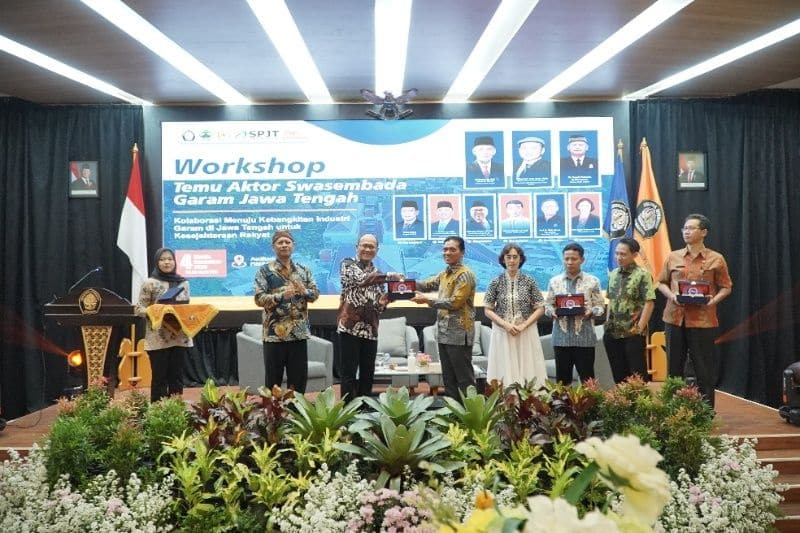
The presentation continued with remarks from Ir. Lilik Harnadi, Head of the Division of Marine Affairs, Coastal Areas, and Small Islands. He stated that Central Java has 6,420 salt farmers and was the third-largest salt-producing province in Indonesia in 2024, contributing 31.26%. However, several challenges remain, including dependence on weather, suboptimal coordination among relevant agencies, inadequate infrastructure for production roads and pond irrigation channels, siltation of water canals, fluctuating salt prices, and variations in salt quality.
Following the presentations, the event continued with an interactive discussion and Q&A session between participants and speakers, yielding a range of constructive insights into the direction of salt industry development in Central Java. The event is expected to serve as FISIP UNDIP’s contribution to strengthening the salt industry in the region. (Public Communication/ FISIP/Rif’at, ed. Nurul)