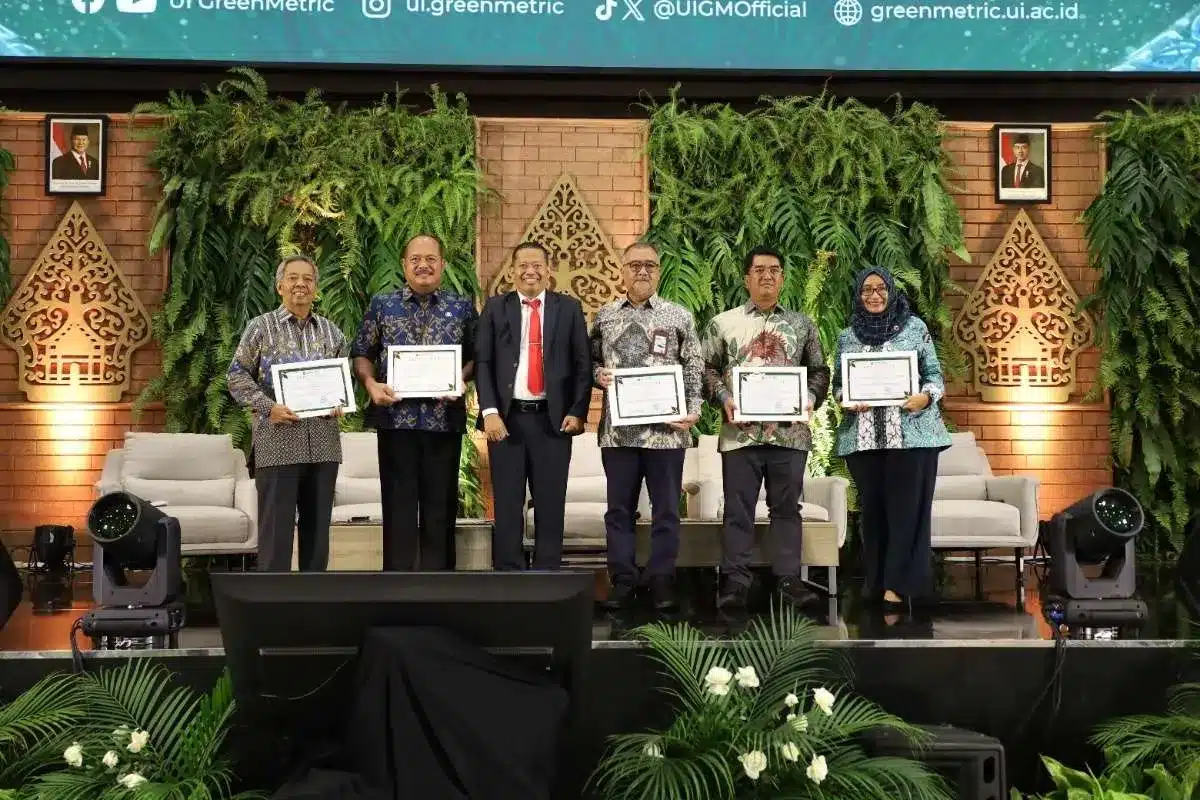
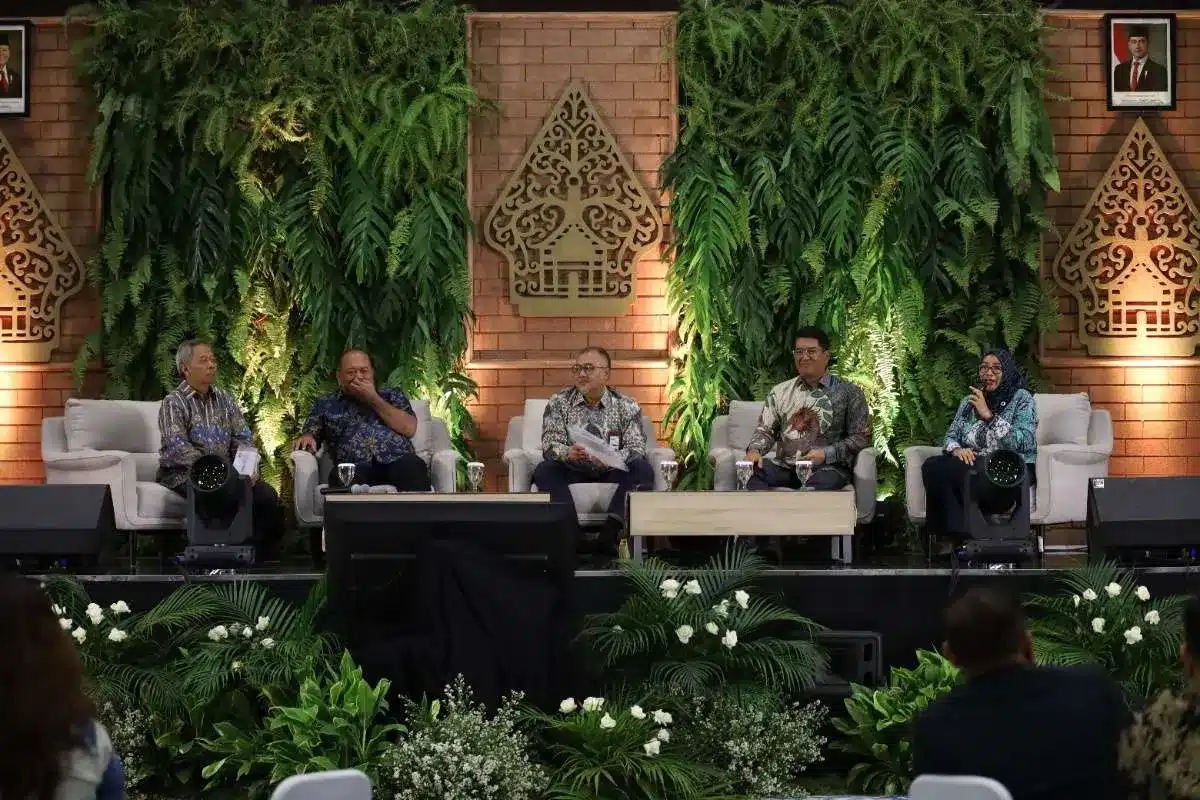
UNDIP, Semarang (December 17, 2025) – Climate change is no longer merely an environmental issue but a multidimensional challenge that demands active involvement from all elements of the nation. This message emerged during the National Talkshow titled “Towards Indonesia Net Zero Emission: Shared Roles in Addressing the Impacts of Climate Change”, held as part of The 2025 UI GreenMetric Indonesia Awarding series at the Muladi Dome, Universitas Diponegoro, Tembalang Campus, on Tuesday, December 16, 2025.
Carrying the overarching theme “Green and Sustainable Campus: Supporting Indonesia’s Net Zero Emission and Shaping the Next Generation of Sustainability Leaders,” the talk show served as a forum for reflection and consolidation of ideas on the strategic role of universities in driving the transition toward low-carbon, sustainable development.
Opening the discussion, Ir. Ary Sudijanto, M.S.E., Deputy of PPI at the Ministry of Environment and Forestry (KLHK), explained that today’s climate change is the direct result of human activities rather than natural processes. Thus, the global agenda focuses on limiting global temperature rise to no more than 1.5°C by the end of this century. He reminded participants that the crisis is already real, with 2024 the hottest year on record and increasing hydrometeorological disasters, including the potential for tropical cyclones.
Reviewing the outcomes of the Global Stocktake at COP28 in Dubai, Ary noted that global emission-reduction efforts have made progress but remain insufficient, as temperature projections still hover around 2.4°C. This situation underscores the need for strengthened commitments and collective action by all stakeholders.
A perspective on best practices was shared by Rector of Universitas Indonesia, Prof. Dr. Ir. Heri Hermansyah, S.T., M.Eng., IPU, who outlined UI’s experience in building a sustainable campus ecosystem through clean energy integration, waste management, water conservation, low-emission transportation, and green campus governance as tangible contributions to addressing climate change.
“Participation in sustainability rankings such as UI GreenMetric is not merely about achieving a position,” he emphasized, “but serves as an evaluation tool and a driver for improving campus performance so it aligns with global standards and the SDGs, while ensuring that scientific knowledge creates real impact for society and the environment.”
Furthermore, Dr. A.P. Ir. Sujarwanto Dwiatmoko, M.Si., Assistant for Economy and Development of Central Java Provincial Secretariat, stressed that Central Java is highly vulnerable to the impacts of climate change—such as floods, landslides, extreme weather, and tidal flooding—due to shifting rainfall patterns, rising temperatures, and environmental degradation.
He conveyed the Central Java Provincial Government’s commitment to reducing greenhouse gas emissions, increasing carbon absorption, rehabilitating forests and coastal areas through programs like Mageri Segoro. He emphasized the importance of multi-stakeholder collaboration—particularly with universities—through research, green technology innovation, and human resource development to support the province’s Net Zero Emission targets.
On this occasion, Professor of Environmental Management and Former Rector of UNDIP, Prof. Drs. Sudharto Prawata Hadi, MES, Ph.D., urged participants to view the climate crisis as an issue of intergenerational justice that requires transforming development paradigms. He stressed that sustainability should no longer be positioned as a compromise between economic and environmental interests but must place ecology as the fundamental foundation. According to him, the concept of strong sustainability demands recognition of ecological limits that cannot be negotiated, as nature is not merely a resource but a life-support system for humanity.
In this context, Prof. Sudharto highlighted the strategic role of universities in producing future leaders with scientific literacy, social sensitivity, and the moral courage to make decisions oriented toward long-term sustainability. Caring for the Earth, he noted, is an expression of responsibility to future generations and an investment in civilization. When ecosystems are managed sustainably and healthily, he believes the impacts of disasters can be naturally mitigated because nature has its own capacity for restoration.
The discussion proceeded dynamically under the moderation of Prof. Dr.-Ing. Wiwandari Handayani, S.T., M.T., MPS, Head of the Department of Urban and Regional Planning at UNDIP, underscored the importance of cross-sector collaboration. The talk show emphasized that achieving Net Zero Emissions requires hexahelix synergy among government, universities, businesses, communities, the media, and non-governmental organizations, with campuses serving as hubs of knowledge and innovation.
Through this forum, UNDIP not only served as the host of the 2025 UI GreenMetric Indonesia Awarding but also reinforced its commitment as an agent of change—promoting green campus practices, science-based policies, and the nurturing of young leaders ready to address the challenges of the climate crisis for a sustainable, Net Zero Emission Indonesia. (Public Communication/UNDIP/DHW)