

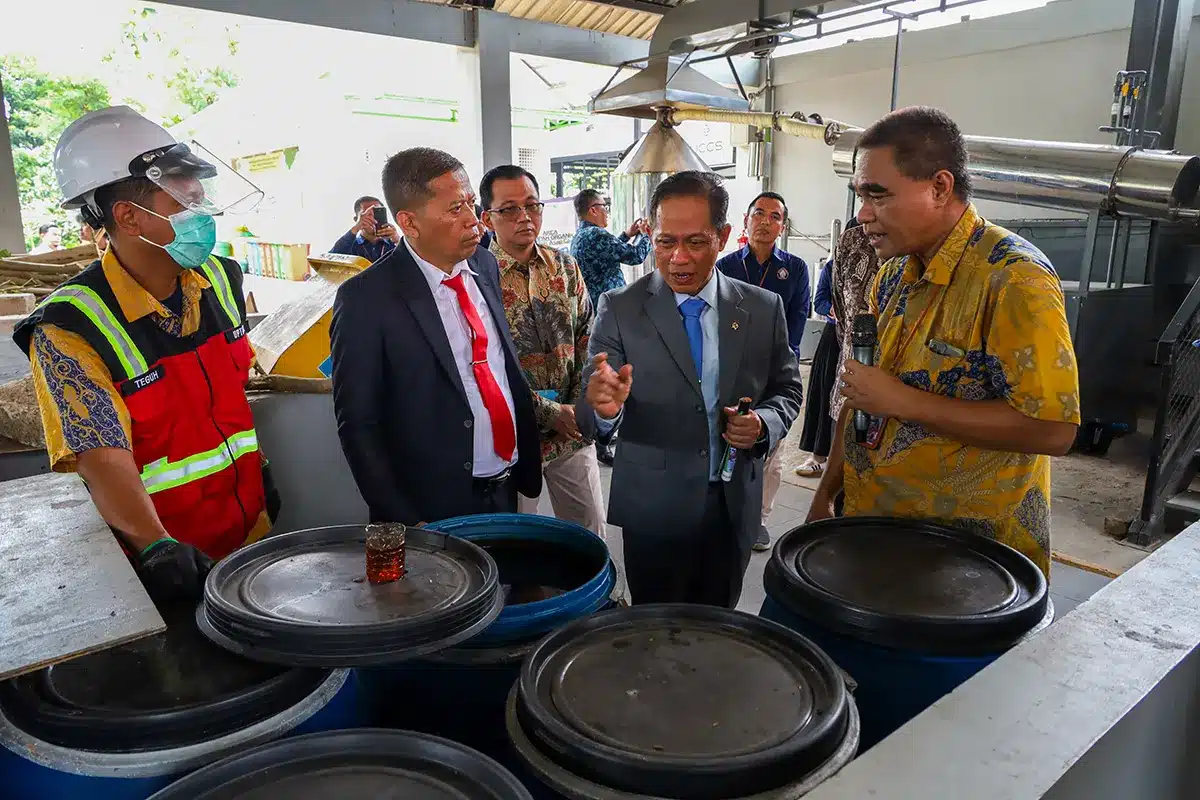
UNDIP, Semarang (December 16, 2025) – The Integrated Waste Processing Facility (TPST) of Universitas Diponegoro received a visit from the Minister of Environment/Head of the Environmental Control Agency (BPLH) on Tuesday, December 16, 2025. The visit coincided with the international UI GreenMetric ranking event, which this year was hosted by Universitas Diponegoro.
Accompanied by the Rector of UNDIP, the Head of UI GreenMetric, and the Head of UNDIP’s Occupational Safety, Health, and Environment (K3L) Unit, the Minister directly observed various waste management innovations developed by the university. One innovation that garnered special attention was the catalytic pyrolysis machine, a technology capable of converting plastic waste into liquid fuel and gas. The solid residue, or wax, produced by the pyrolysis process also has economic value. Beyond inorganic waste processing, the Minister also reviewed organic waste management efforts at TPST UNDIP.
The visit signifies the central government’s recognition that UNDIP’s waste management innovations are highly relevant to national needs, particularly in environmental planning and management. The Minister noted that these innovations should not stop at the research stage but must be scaled up for broader use.
The Minister emphasized that his office would support the development of research outputs through collaboration with the Central Java Provincial Government and industrial zones. This effort includes refining innovation designs, securing patents, and encouraging adoption by both the government and the private sector.
“I want us, together with the Central Java Provincial Government, to scale up these research outputs. Once again—let’s move beyond research. Let’s scale up; don’t stop at the research stage. Indonesia needs extensive support and scientific analysis to solve its environmental challenges. I will soon invite the UNDIP Rector, along with leaders from the seven industrial zones in Central Java, to finalize these innovation designs so they can be patented, and the government or private sector can procure them,” explained Dr. Hanif Faisol Nurofiq, Minister of Environment/Head of BPLH.
UNDIP Rector welcomed the directive and reaffirmed UNDIP’s commitment to advancing innovation toward industrial-scale implementation. UNDIP also aims to implement a zero-waste system on campus, eliminating its contribution to the municipal landfill in Semarang.
“I believe the Minister’s input is excellent. We must scale up immediately and enter the industrial sphere. We should move beyond the laboratory scale. We also commit that UNDIP will no longer send waste to Semarang’s temporary disposal sites. We used to produce one ton, and now it’s zero. Hopefully, we can soon expand our efforts to support surrounding communities—not only by managing UNDIP’s waste but also by addressing waste from surrounding areas and other regencies. We are currently collaborating with the Pemalang Regency Government, and hopefully, the results will be good. After that, we will scale up further and implement it elsewhere,” said Prof. Dr. Suharnomo, S.E., M.Si.
By engaging provincial government partners, universities, and leaders of industrial zones, the transformation of research outputs into ready-to-use technologies is expected to accelerate. This strategy not only enhances the commercial value of innovations but also delivers real benefits for the environment, communities, and regional economic growth. (Public Communication/UNDIP/Ninok Hariyani)