
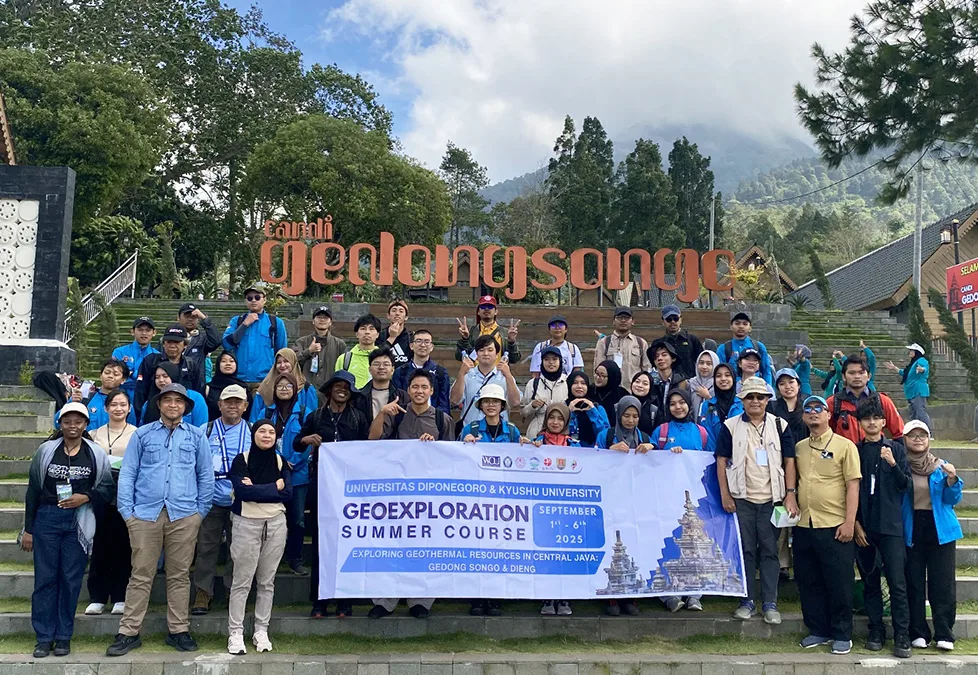
UNDIP, Semarang (September 5, 2025) – The Geophysics Laboratory, Department of Physics, Faculty of Science and Mathematics, Universitas Diponegoro (UNDIP), in collaboration with Kyushu University (Japan) and supported by BMKG and BRIN, officially launched the Summer Course Geoexploration 2025. This activity forms part of the Faculty of Science and Mathematics UNDIP World Class University (WCU) Program, aimed at strengthening international academic networks—particularly between Universitas Diponegoro, Kyushu University, and partner institutions worldwide.
This prestigious academic program, titled “Exploring Geothermal Resources in Central Java: Gedong Songo Field Study,” was conducted on September 1–5, 2025, at Universitas Diponegoro, Semarang, and at the Gedong Songo Geothermal Field on Mount Ungaran, in a hybrid format (onsite and online).
This year, the program attracted 278 participants from around the world. A total of 31 participants attended onsite, comprising 20 Indonesian students and 11 Japanese students, while 247 participants joined online. The online participants represented diverse nationalities: 127 from Indonesia, 15 from Japan, 1 from France, 2 from Nigeria, 2 from Nepal, 1 from South Africa, 1 from Pakistan, 3 from Ethiopia, and 1 each from Germany, Afghanistan, Cameroon, and India. This diversity highlights the Summer Course as a global platform for knowledge exchange and international collaboration in renewable energy studies, particularly geothermal exploration.
The event commenced at Universitas Diponegoro with official opening remarks delivered by the Head of the UNDIP Physics Department, representatives from Kyushu University, the Dean of the Faculty of Science and Mathematics, and Prof. Dr. Ir. Hadiyanto, Director of Reputation, Partnerships, and Global Connectivity of Universitas Diponegoro, who formally inaugurated the program. In their remarks, university leaders emphasized the importance of renewable energy research and encouraged young researchers to contribute to geothermal innovation actively.
The opening continued with a series of academic lectures. Prof. Dr. Eng. Agus Setyawan, S.Si., M.Si., from the Geophysics Laboratory, opened with a presentation titled “Overview of Mount Ungaran,” providing geological, tectonic, and volcanic histories as a basis for understanding the geothermal potential. Assoc. Prof. Jun Nishijima from Kyushu University delivered a lecture on the “Gravity Method for Geothermal Exploration”, explaining how gravity anomalies provide insights into subsurface structures and geothermal reservoir potential.
The third session, presented by Dr. Eng. Udi Harmoko, S.Si., M.Si., from the Geophysics Laboratory, focused on “Geomagnetics for Geothermal Exploration”, explaining how geomagnetic surveys detect hydrothermal alteration and subsurface structures that are critical to geothermal systems. This session was followed by Yoga Aribowo, M.T., from Geological Engineering, who discussed “Geology and Geochemistry”, emphasizing the role of surface geology and hydrothermal indicators in identifying geothermal resources.
The final lecture was delivered by Dr. Agustya, S.T., M.T. from BRIN on “Passive Seismic for Geothermal Exploration”, describing passive seismic acquisition methods and their applications in detecting subsurface activity. The first day provided a strong theoretical foundation before participants proceeded to field activities.
On the second day, participants visited the Gedong Songo Geothermal Area on the slopes of Mount Ungaran. The site is well known for fumaroles, hot springs, and hydrothermal alteration zones, offering participants real-world experience akin to an open-air geothermal laboratory.
Participants were divided into several groups to collect geological and geochemical data. Activities included radon tracers, rock outcrop observations, structural mapping, and hot spring water sampling for geochemical analysis. Meanwhile, the geomagnetic team conducted magnetic field intensity measurements to identify anomalies associated with geothermal activity.
This session proved highly beneficial for international participants, who gained hands-on experience with geothermal manifestations in Indonesia while collaborating directly with Indonesian counterparts.
Field activities continued on the third day, focusing on passive seismic surveys using SRI (Seismograf Rakyat Indonesia) instruments from PT Protech Engineering and gravity surveys supported by BMKG. The seismic team installed portable SRI units to record natural seismic signals. These data will later be analyzed using HVSR (Horizontal-to-Vertical Spectral Ratio) and passive seismic tomography methods to reveal subsurface structures.
Simultaneously, the gravity team conducted detailed gravity measurements using gravimeters. By identifying subsurface density variations, gravity surveys helped delineate potential geothermal reservoirs. The third day provided invaluable hands-on experience operating geophysical instruments in real field conditions, while highlighting logistical challenges in data acquisition on steep terrain.
The fourth day focused on data processing. Participants returned to classrooms and laboratories to analyze the field data they had collected.
- The passive seismic team processed raw signals, performed spectral analyses, and developed preliminary subsurface models.
- The gravity team applied key corrections, including drift, tidal, free-air, Bouguer, and topographic corrections, before building two-dimensional models.
- The geomagnetic team conducted data filtering, daily corrections, and reduction to the pole (RTP) to generate interpretable anomaly maps.
This phase emphasized not only technical data-processing aspects but also the value of cross-cultural collaboration. Discussions among participants from various countries fostered dynamic exchanges of methods, perspectives, and interpretations.
The program concluded with team presentations. Each group showcased their processed data and interpretations from passive seismic, gravity, and geomagnetic surveys, demonstrating how integrated geophysical methods contribute to understanding geothermal potential in Gedong Songo. Some groups even presented preliminary subsurface models indicating possible geothermal reservoirs beneath the Ungaran area.
The final session featured participant reflections. Representatives from Indonesia and Japan shared their experiences, emphasizing academic enrichment, cultural exchange, and the collaborative spirit fostered through the program. Organizers also expressed their commitment to expanding this initiative into broader international research collaborations in geothermal exploration.
This activity forms part of the WCU Program at the Faculty of Science and Mathematics. It aligns with the spirit of ‘Noble and Valuable UNDIP’ in synergy with the Diktisaintek Berdampak program. (Public Communication/UNDIP/FSM Team)