

UNDIP, Demak (14/1) – Bedono Village in Sayung Subdistrict, Demak Regency, is one of the coastal areas most severely affected by tidal flooding and abrasion along the northern coast of Java. Over the past two decades, tidal floods have inundated homes, public facilities, and residents’ living spaces, forcing most of the population to relocate. A total of 268 households were relocated between 1999 and 2007, leaving only a small number of families who chose to remain. Bedono’s shoreline continues to retreat year after year, making the village a vivid illustration of rapid environmental change along the northern coastal corridor (Pantura).

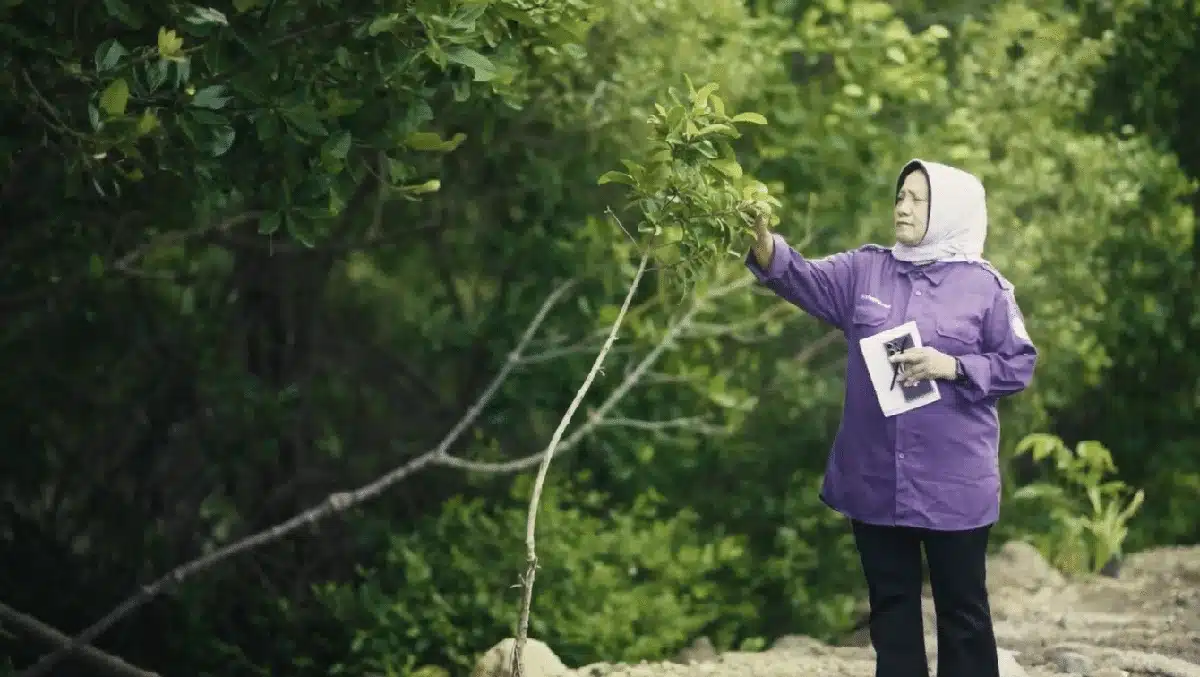
Amid these conditions, one family continues to remain in Tambaksari Hamlet—the family of Pasijah, widely known as Mak Jah. Together with her husband and child, Mak Jah lives in the last occupied house in the hamlet. Daily tidal surges directly impact the area surrounding her home, prompting her to plant mangroves as a natural protective barrier.
Mangroves not only reduce wave energy and slow coastal erosion, but also serve as habitats for birds, fish, and blue swimming crabs, helping to sustain the coastal ecosystem. Mak Jah’s resilience in nurturing mangroves and enduring environmental change has made her story a powerful symbol of coastal community resilience.
Bedono has since evolved into a living laboratory that provides benefits for education and scientific research. Since 2022, the Faculty of Science and Mathematics (FSM) of Universitas Diponegoro, through the Cluster for Paleolimnology (CPalim), has designated Bedono as a living lab to develop ecosystem-based solutions, or Nature-Based Solutions (NbS).
This initiative is led by Prof. Dr. Tri Retnaningsih Soeprobowati, M.App.Sc., Professor at FSM UNDIP and Founder of CPalim. Through the living lab approach, Bedono has become a shared learning space for academics, local communities, government, and other stakeholders to strengthen coastal social–ecological resilience.

According to Prof. Tri Retnaningsih, Mak Jah’s spirit and resilience in caring for mangroves provide an important inspiration that conservation and environmental change mitigation efforts must be carried out together with local communities and involve multiple stakeholders. This collaborative approach opens dialogue among academics, local communities, and government institutions to formulate sustainable coastal adaptation strategies.
The story of Bedono demonstrates that environmental crises are not merely technical issues, but also concern living spaces, local knowledge, and the social–ecological sustainability of coastal communities. FSM UNDIP hopes that the Bedono living lab will inspire similar initiatives in other coastal regions and strengthen cross-sector collaboration to promote resilience and sustainable development for the future of the northern coast of Java (Pantura). (Public Communication/FSM/ed. Nurul)
Source: FSM Official Website