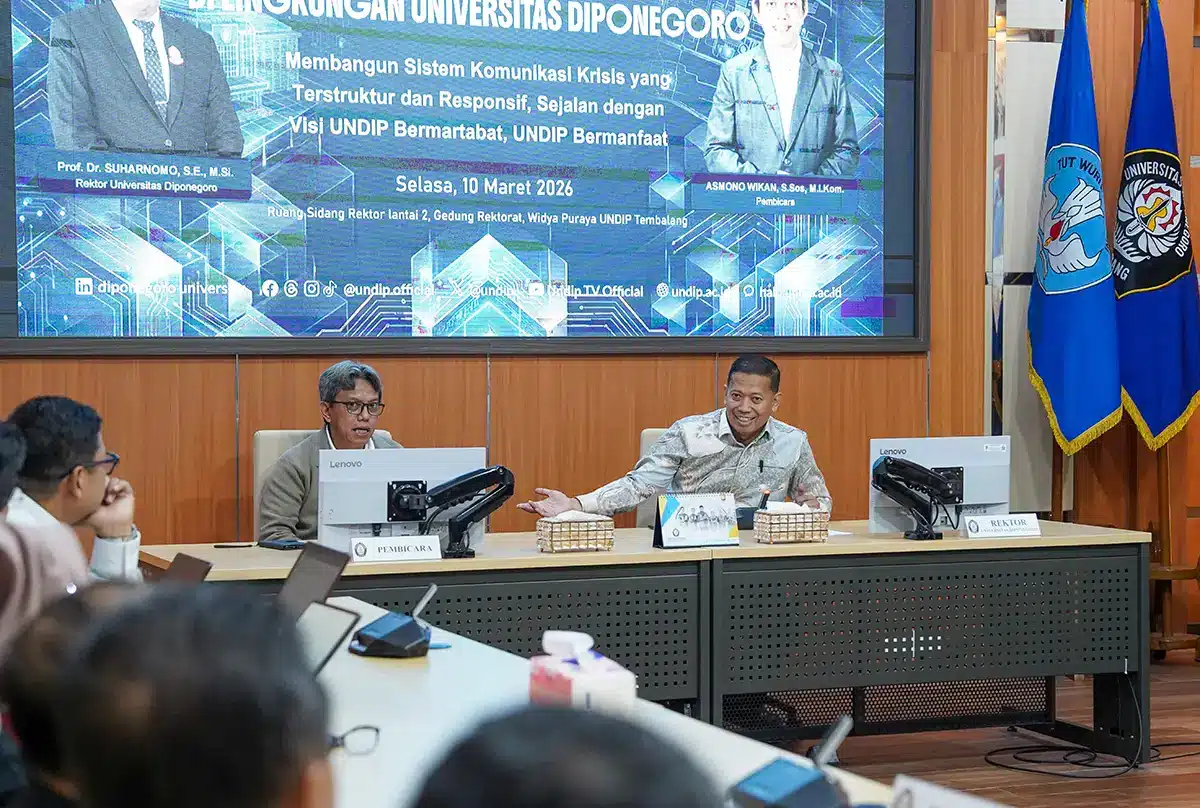



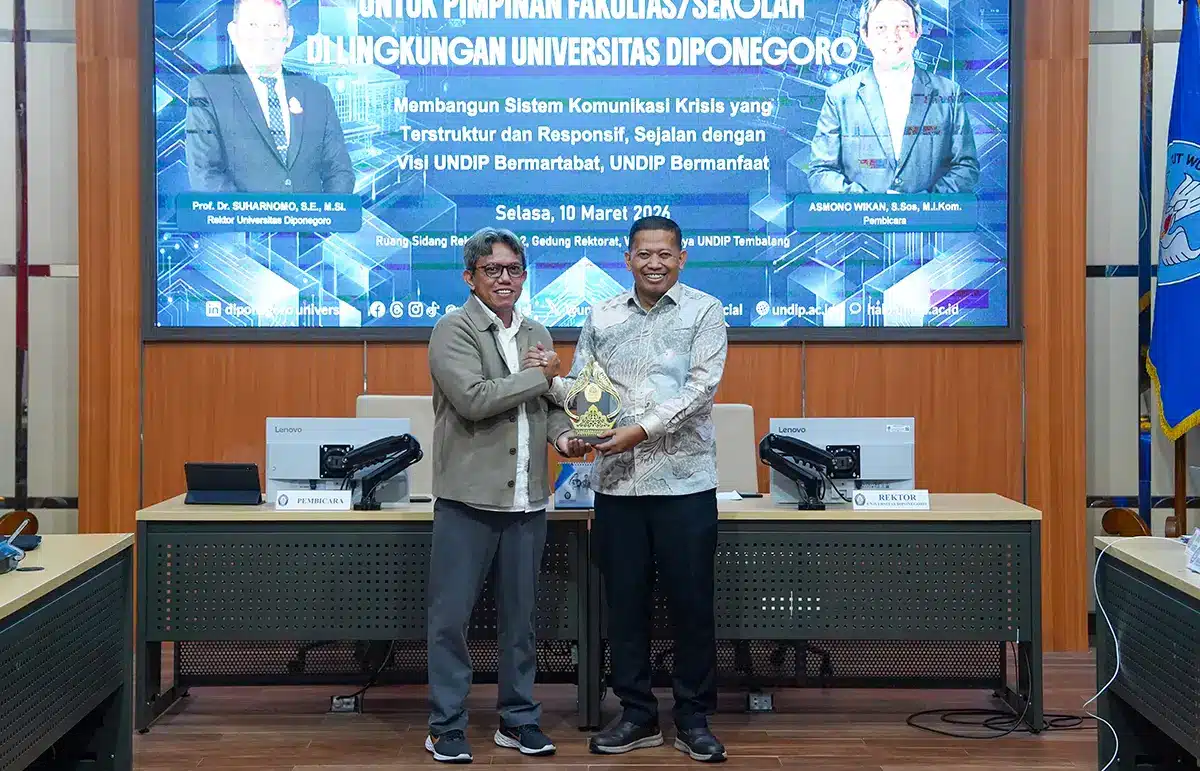
UNDIP, Semarang (10/3) – Universitas Diponegoro (UNDIP) organized a Crisis Communication Workshop for Faculty and School Leaders on Tuesday, March 10, 2026, at the Rector’s Meeting Room, 2nd Floor of the Widya Puraya Building, UNDIP Tembalang Campus. The workshop was attended by Deans of faculties and schools as well as leaders of institutional units within UNDIP, as part of efforts to strengthen institutional communication governance amid increasingly complex public information dynamics.
As a university striving to become a World-Class University, UNDIP faces increasingly dynamic public communication challenges in the era of information transparency and rapid development of digital media. In such circumstances, issues arising within the campus environment can quickly attract public attention if not properly managed.
In his opening remarks, UNDIP Rector Prof. Dr. Suharnomo, S.E., M.Si. emphasized the importance of learning from experience and best practices in public communication for faculty leaders when dealing with potential crises within higher education institutions.
“Through this workshop, we hope to gain valuable experience and insights on how to respond to communication crises. Each situation certainly has different characteristics, but learning from practitioners’ experiences and perspectives will greatly help us understand how to respond appropriately,” said the Rector when opening the workshop.
Meanwhile, the Vice Rector for Research, Innovation, Collaboration, and Public Communication, Wijayanto, S.IP., M.Si., Ph.D., highlighted that in the era of social media, almost any event can quickly escalate into a crisis if not anticipated properly. Therefore, university leaders must be prepared to manage public communication wisely and in a coordinated manner.
“In the era of social media and the internet, almost any event can quickly develop into a crisis if it is not handled properly. That is why communication readiness among institutional leaders is crucial in maintaining institutional stability and reputation,” he explained.
The workshop featured Asmono Wikan, S.Sos., M.I.Kom., CEO of PR Indonesia Group and a public relations practitioner, as the main speaker. He presented various case studies on crisis communication management, including those from major corporations and universities.
In his presentation, he emphasized the importance of institutional preparedness in facing the dynamics of public communication in the digital era. He explained that crisis communication is not only about delivering information to the public but also about maintaining public trust through appropriate responses.
“In a crisis, institutions need one voice in managing communication. Differences in messages or opinions conveyed to the public can create confusion and increase the risk of poor decision-making,” Asmono Wikan said.
The workshop also served as a discussion forum for faculty leaders to understand better the dynamics of crisis communication that may arise at any time, as well as the importance of coordination among institutional units when responding to issues emerging in the public sphere.
Through this workshop, faculty leaders are expected to develop a shared understanding of crisis communication response mechanisms, including coordination among units and the importance of delivering a unified institutional message.
“At present, the Directorate of Media Networking, Community, and Public Communication (Jejak) has developed crisis communication management guidelines, which are still being refined by a team of professional experts. In the future, these guidelines are expected to help UNDIP coordinate more effectively whenever a crisis occurs,” said Nurul Hasfi, Director of the Directorate of Media Networking, Community, and Public Communication.
Through this initiative, Universitas Diponegoro reaffirms its commitment to strengthening professional, transparent, and responsive institutional communication governance. These efforts are expected to safeguard the university’s reputation and strengthen public trust in UNDIP as a noble and valuable university. (UNDIP/Public Communication/Hng)