


UNDIP, Semarang (23/2) – Universitas Diponegoro (UNDIP) is one of the universities actively engaged in community service through its Thematic Community Service Program (KKN-T). Upholding the principle that knowledge and innovation must have a direct impact on society, UNDIP strives not only to produce graduates who have achieved academic excellence but also to become a noble and valuable university for the community.
Through the 2025/2026 Thematic Community Service program, UNDIP aims for each participant to contribute meaningfully to the development of the villages where the service takes place. The program focuses on areas facing relatively complex challenges, particularly those surrounding UNDIP. Continuous development efforts are expected to have a positive impact on neighboring regions.
One example is UNDIP KKN-T 26 Team, located in Mluweh Village, East Ungaran, Semarang Regency. Led by Prof. Dr. Widowati, S.Si., M.Si., with supervising lecturers Dr. Drs. Jafron Wasiq Hidayat, M.Sc., and Satriyo Adhy, S.Si., M.T., the team focuses on waste management and processing issues through educational approaches.
Carrying the theme “Community Empowerment Through Educational Programs and Waste Management Innovation to Support a Clean and Healthy Environment,” UNDIP KKN-T 26 Team aims to help address waste-related issues in Mluweh Village. One of the main problems identified is the lack of Temporary Waste Collection Sites (TPS), which makes it difficult to manage domestic and non-household waste effectively.
This limitation has led to low public awareness regarding proper waste processing, especially waste segregation and disposal. Many residents still dispose of waste along riverbanks and in strategic locations such as vacant land near rivers, around bridges, and in drainage channels.
Additionally, some residents burn waste, which creates new problems, particularly health issues such as respiratory infections. Therefore, increased awareness and effective education for younger generations are crucial to fostering better behavioral change in the future.
Group 2 of UNDIP KKN-T 26 Team, consisting of Naufalivanty Rakhmanindita, Taqy Abdurrasyid, Radhon Fayyadhsayya Albasith, Adelia Saraswati, Meiza Zefanya Natasha, Muhammad Zidny Zulfikar, Muhammad Arif Rahman, Keyla Azzura, and Dita Irza Nugraha, agreed to conduct education and outreach for children aged 9–10 years on proper waste segregation and management.
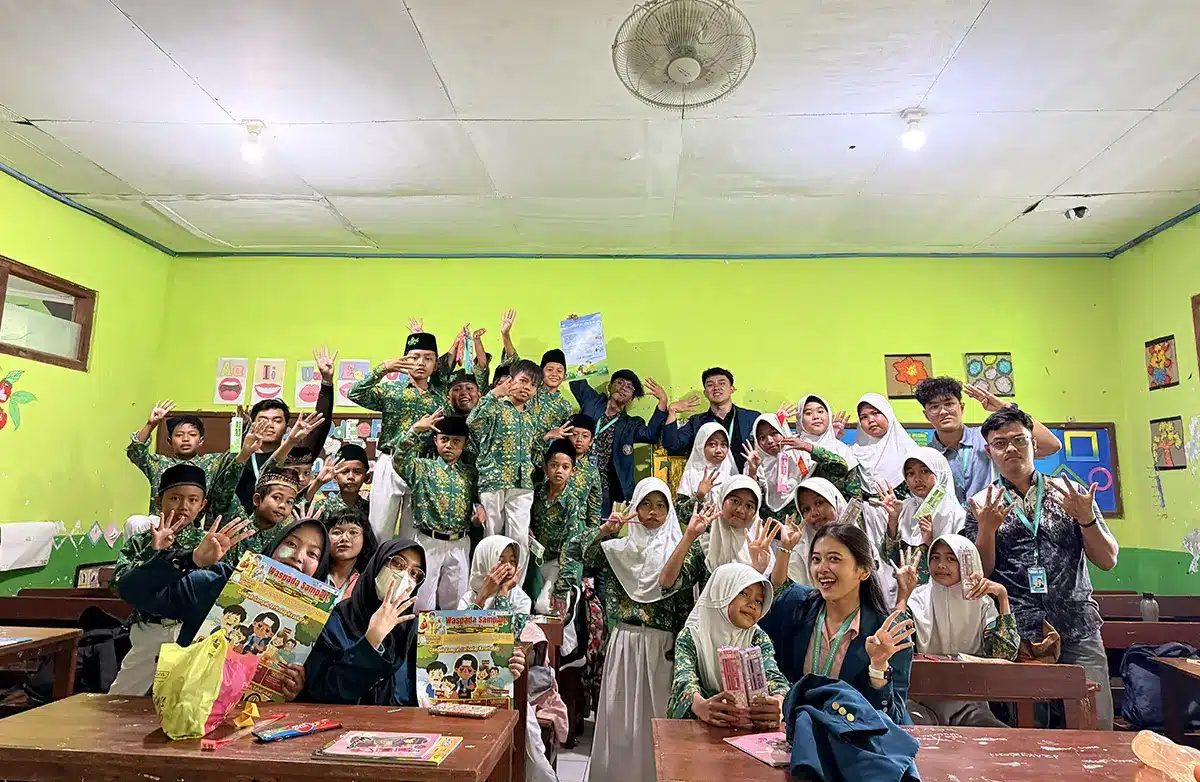
The target audience was fourth-grade students of MI Mluweh. Prior to implementation, the team obtained permission from the school principal, Nur Farida, S.Pd.I., and coordinated with Mrs. Hartini, the fourth-grade homeroom teacher. The activity was carried out on Tuesday, January 20, 2026, involving 35 students. The team delivered materials on the segregation of organic, inorganic, and hazardous (B3) waste, as well as the health impacts of improper waste management.
Muhammad Arif Rahman from the Faculty of Science and Mathematics (Physics) and Adelia Saraswati from the Faculty of Medicine (General Medicine) presented the sessions. In addition to lectures, students participated in interactive games that incorporated questions on the material, making the learning process engaging and enjoyable.
Mrs. Hartini, the home teacher, expressed hope that her students would gain early exposure to proper waste management practices, emphasizing that behavioral change often begins with knowledge. “So that the children understand how to sort and manage waste properly, and we hope that the activities from UNDIP KKN-T 26 Team inspire them to keep their environment clean and healthy—especially with the fun games included in the session,” she said.
As part of the program, the UNDIP KKN-T 26 Team students also installed two infographics on the school’s notice board to ensure the information reached all students and school members. It is hoped that early education for MI Mluweh students will gradually improve waste management behavior in Mluweh Village, as younger generations become equipped with the proper knowledge to create a cleaner, healthier environment. (Public Communication/UNDIP/KKN-T 26 Team)