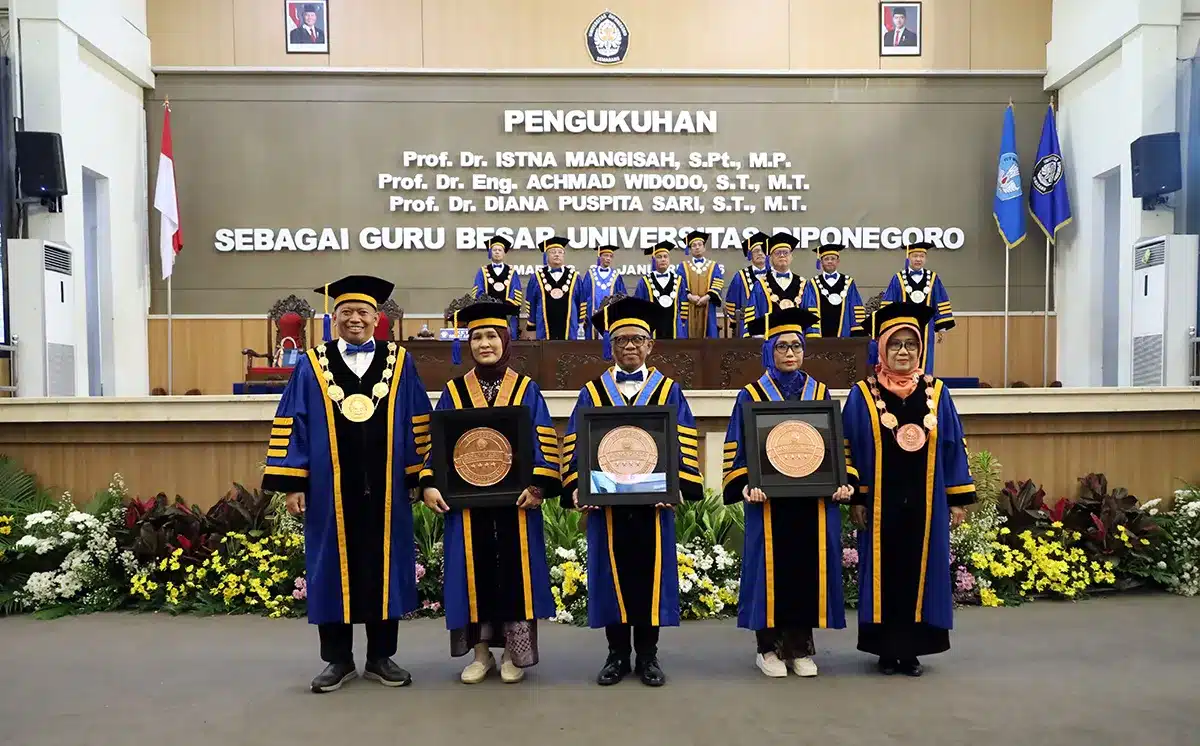
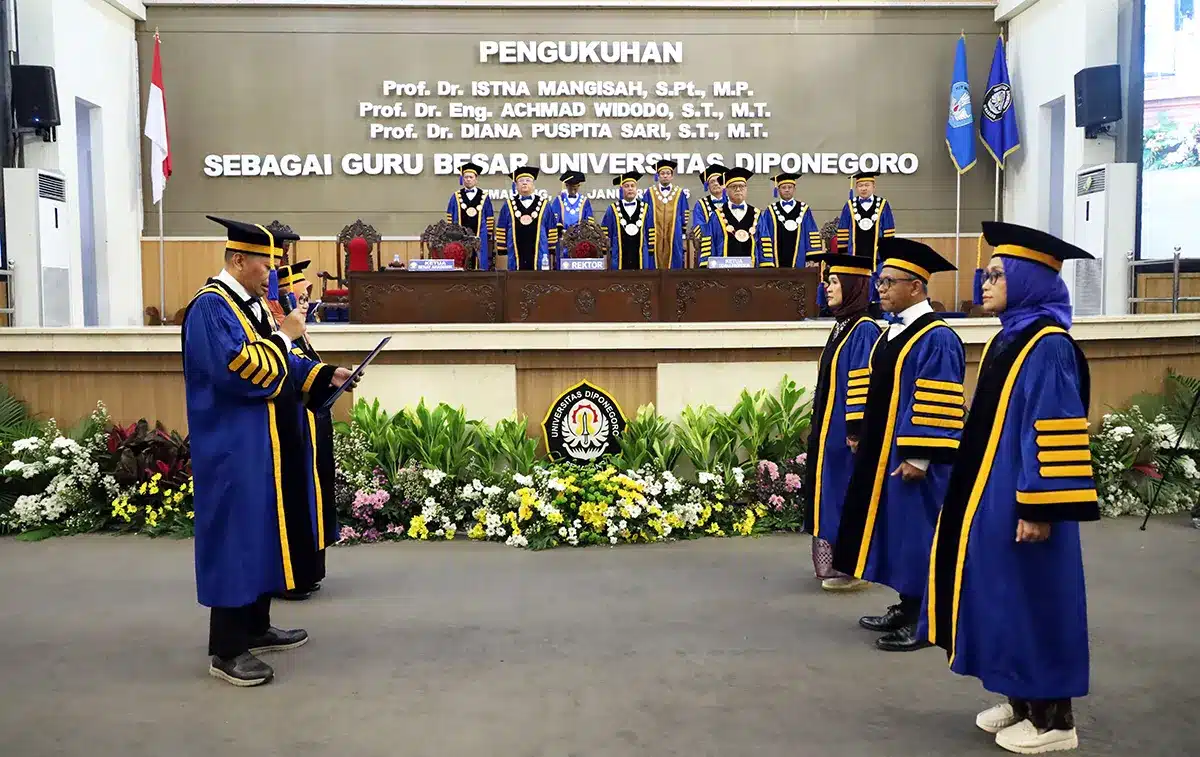
UNDIP, Semarang (28/1) – Universitas Diponegoro (UNDIP) today officially inaugurated three (3) Professors as part of the Inauguration Ceremony of 18 UNDIP Professors, which is being held from January 26 to January 30, 2026, at the Prof. Sudarto, S.H. Building, UNDIP Tembalang Campus. On this third day of the ceremony, the newly inaugurated professors were Prof. Dr. Istna Mangisah, S.Pt., M.P. (Faculty of Animal and Agricultural Sciences), Prof. Dr.-Eng. Achmad Widodo, S.T., M.T. (Faculty of Engineering), and Prof. Dr. Diana Puspita Sari, S.T., M.T. (Faculty of Engineering).
During the inauguration ceremony, each professor delivered a scientific oration. Prof. Dr. Istna Mangisah, S.Pt., M.P., an expert in the Evaluation of Nutrition and Feed for Broiler Poultry, presented her scientific address entitled Encapsulation of Natural Feed Additives as a Solution for Safe, Healthy, and Sustainable Poultry Meat Production. She explained that population growth and increasing public awareness of food safety are driving poultry production systems to focus not only on quantity but also on quality and sustainability.
Poultry is a strategic source of animal protein; however, the long-term use of Antibiotic Growth Promoters (AGPs) poses risks of residue and antimicrobial resistance, prompting a shift toward natural feed additives such as probiotics, prebiotics, synbiotics, phytobiotics, and acidifiers. These additives function by improving gut health, microbial balance, nutrient efficiency, and immune systems, thereby maintaining production performance without harmful residues. Encapsulation methods, such as spray drying and freeze drying, enhance the stability, viability, and bioavailability of natural feed additives, thereby improving their effectiveness in enhancing poultry health and performance.
Prof. Istna added that the utilization of Indonesia’s local biological resources as raw materials for natural feed additives further strengthens the direction of sustainable poultry development. “The integration of gut health, innovation in natural feed additives, and encapsulation technology represents a new direction for modern poultry production that contributes to public health and food security,” she stated.
Meanwhile, Prof. Dr.-Eng. Achmad Widodo, S.T., M.T., an expert in Vibration and Machine Diagnostics, delivered a scientific address entitled Machine Learning-Based Diagnosis and Prognosis for the Maintenance of Future Engineering Systems. He explained that modern industrial development is characterized by increasing complexity in engineering systems and growing demands for reliability and operational continuity, particularly in the energy and manufacturing sectors. Minor disturbances in machinery and industrial equipment can have significant impacts on costs, safety, and production sustainability, rendering conventional reactive maintenance approaches inadequate.
To address these challenges, the development of diagnosis and prognosis technologies based on machine learning and artificial intelligence was presented as a strategic solution for future engineering system maintenance. This approach leverages big data generated by modern industrial systems—both sensor-based and historical non-sensor data—to detect faults early, diagnose failure causes, and accurately predict the remaining useful life of assets using machine learning methods.
Research results indicate that the developed diagnostic and prognostic systems can identify machine performance degradation at an early stage with high reliability. “This technology paves the way for a transformation from reactive maintenance to predictive maintenance, and further toward prescriptive and ultimately cognitive maintenance, where machines not only predict failures but also recommend the best actions based on risk, cost, and safety,” Prof. Achmad Widodo explained.
Furthermore, Prof. Dr. Diana Puspita Sari, S.T., M.T., an expert in Sustainable Supply Chains, presented a lecture entitled Sustainable Supply Chain Management as a Pillar for Achieving Industrial Competitive Advantage. She highlighted that supply chains in Indonesia face major challenges due to global uncertainty, climate crises, demands for international sustainability standards, logistical inefficiencies, high energy consumption, and weak waste management from upstream to downstream. In this context, Sustainable Supply Chain Management (SSCM) is a strategic approach that simultaneously addresses economic, environmental, and social challenges by integrating sustainability principles across all supply chain stages.
Its implementation includes sustainable product design, raw material selection, low-emission production and distribution processes, and end-of-life management through circular economy practices and reverse logistics, supported by technologies such as IoT, AI, big data, and blockchain. However, implementation in Indonesia is still constrained by data fragmentation, limited technological capacity among SMEs, low sustainability literacy, and minimal cross-stakeholder collaboration. Therefore, future development must prioritize integrated, cross-disciplinary approaches and multi-stakeholder partnerships to strengthen national industrial competitiveness.
“The emergence of various challenges in implementing SSCM necessitates a transdisciplinary approach and strong policy support to ensure that Indonesia’s industrial transformation proceeds efficiently, resiliently, inclusively, and sustainably,” Prof. Diana Puspita Sari concluded.