





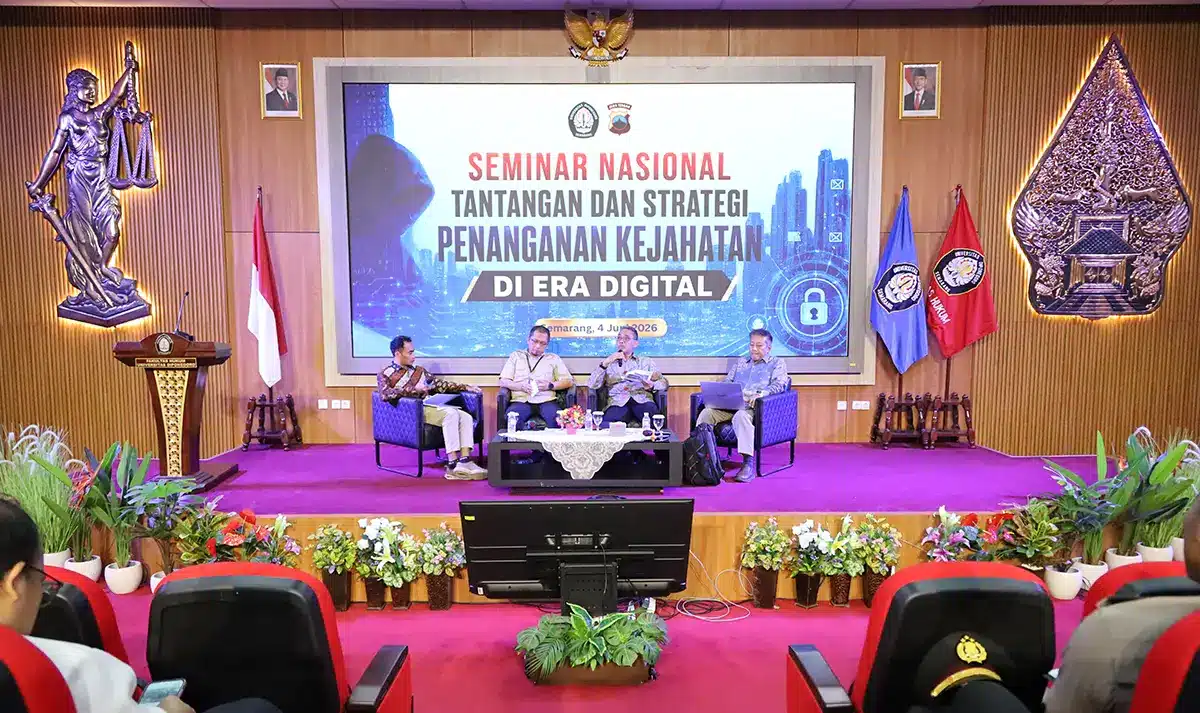
UNDIP, Semarang (4/6) – The Police Studies Center under the Institute for Research and Community Service (LPPM) of Universitas Diponegoro (UNDIP), in collaboration with the Central Java Regional Police (Polda Jawa Tengah), successfully organized a National Seminar titled “Challenges and Strategies for Addressing Crime in the Digital Era.” The seminar was held on Thursday, June 4, 2026, at the Fiat Justisia Hall, 3rd Floor, Prof. Samiadji Suryocaroko Building, Faculty of Law, UNDIP Tembalang. Conducted in a hybrid format, the event was attended by deans from across UNDIP, the Vice Rector for Human Resources, Information Technology, Legal Affairs, and Organization, legal experts serving as speakers, and guests.
The seminar was officially opened by the Central Java Regional Police, represented by Kombes Polisi Siti Rondhijah, S.Si., M.Kes., Director of Community Development, who delivered remarks on behalf of the Chief of Police of Central Java. She outlined the socio-technological nature of cybercrime and emphasized the importance of shifting law enforcement strategies toward primary prevention and extensive cross-sector collaboration.
“Law enforcement in the digital era must not focus solely on prosecution. We must strengthen prevention, education, digital literacy, and public protection through four strategic agendas,” stated Kombes Polisi Siti Rondhijah as she officially opened the forum.
Echoing this perspective, Prof. Dr. Adian Fatchur Rochim, S.T., M.T., Vice Rector for Human Resources, Information Technology, Legal Affairs, and Organization, highlighted the significant gap between the rapid evolution of cyber threats and organizations’ ability to adapt to them.
“From discussions with the Cyber Directorate, today’s crimes often utilize technologies that emerged five years ago. Isolated individuals no longer carry out cyberattacks but frequently involve organized criminal networks using artificial intelligence, cloud computing, social engineering, ransomware, identity theft, and large-scale personal data exploitation,” he explained.
Prof. Adian further stressed that combating digital crime requires a comprehensive approach that addresses technological, sociological, and regulatory dimensions. He outlined three strategic pillars essential for building a resilient cybersecurity framework.
“Digital crime cannot be addressed through technology alone. We need three interconnected pillars: technological capability, stronger regulations and law enforcement, and enhanced public digital literacy. No matter how advanced our security technologies are, humans remain the last line of defense in cybersecurity.”
The opening session continued with remarks by Prof. Dr. Ing. Ir. Suherman, S.T., M.T., Head of LPPM UNDIP, who emphasized the institution’s commitment to interdisciplinary applied research to develop equitable technology governance.
“LPPM UNDIP views the acceleration of cybercrime as a real challenge requiring data-driven academic intervention and measurable policies. Through the Police Studies Center, we facilitate this strategic collaboration with the Central Java Regional Police to integrate perspectives from science and technology, criminology, and substantive legal instruments in securing Indonesia’s cyberspace,” he stated.
The opening ceremony concluded with a keynote address by Kasespim Lemdiklat Polri, Komjen Pol. Prof. Dr. Chryshnanda Dwilaksana, M.Si., Head of the Police Education and Training Institute (Lemdiklat Polri). He presented a blueprint for transforming future policing through the concepts of AI Policing and Smart Policing Harmony. While advocating for the adoption of artificial intelligence as a strategic law enforcement tool, he emphasized that humanity and ethical values must remain at the core of policing. He introduced the operational framework known as “Asta Siap” (Eight Readiness Pillars), covering software readiness, command centers, public service models, networking, strategic partnerships, human resources, logistics infrastructure, and budget management.
During the expert presentation sessions, Kombes Pol. Himawan Sutanto Saragih, S.H., S.I.K., S.T., M.H., Director of Cybercrime Investigation at the Central Java Regional Police, delivered a presentation titled “Cybercrime Law Enforcement in the Digital Era.” He discussed the evolution of cybercrime from conventional forms, such as carding, to AI-based offenses, and highlighted the complexities of handling electronic evidence in criminal investigations.
The legal perspective was further explored by Prof. Dr. Pujiyono, S.H., M.Hum., Professor of Criminal Law at the Faculty of Law, UNDIP, through his presentation “The Design of Indonesia’s National Criminal Code (KUHP) in Preventing and Addressing Digital Crime.” He emphasized the increasing number of cybercrime cases and the challenges of criminalizing new offenses in the borderless environment of cyberspace.
The final speaker, Dr. Edmon Makarim, S.Kom., S.H., LL.M., a digital law expert from the University of Indonesia, delivered a presentation titled “The Evolution of Cybercrime and Personal Data Protection from the Victim’s Perspective.” He critically examined international cybercrime conventions, arguing that legal accountability remains asymmetrical, with criminal liability often disproportionately placed on users.
In conclusion, the collaborative National Seminar served not only as a forum for academic discussion but also as a platform for formulating a draft of strategic national policy recommendations that integrate legal frameworks and technological architecture. The continued synergy between the Police Studies Center of LPPM UNDIP and the Central Java Regional Police is expected to provide a strong foundation for legal certainty, the protection of citizens’ privacy rights, and the development of a secure, just, and ethical digital ecosystem in Indonesia.(Public Communication / UNDIP / Riri)