
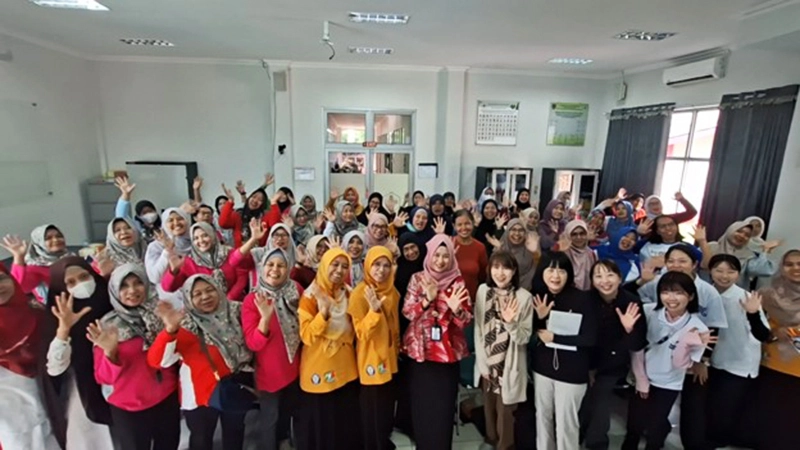
UNDIP, Semarang (6/9) – The Department of Nursing, Faculty of Medicine, Universitas Diponegoro (UNDIP), in collaboration with the School of Health Science, Faculty of Medicine, Kagoshima University, Japan, conducted an “International Community Service” program at Rowosari Community Health Center (Puskesmas Rowosari), Semarang City. The program was carried out in two stages, with the first stage held on Thursday, August 20, 2026, and the second on September 3, 2026. Both stages focused on health education for older adults and monitoring the growth and development of infants and young children.
The first stage focused on education and training for community health workers on holistic interventions for older adults with non-communicable diseases, particularly diabetes mellitus management and chair yoga. The community health workers then facilitated the older adults in practicing chair yoga. In addition, the older adults were taught origami by exchange students from Kagoshima University in Japan.
The older adults were also provided with free health checkups conducted by faculty members. Information on the management of diabetes mellitus was delivered directly by Prof. Yatsushiro Rika of Kagoshima University, Japan. She explained the early symptoms of diabetes mellitus and ways to manage the disease. She also shared insights into how Japan empowers its older population, given the country’s large elderly population. Meanwhile, the chair yoga session was delivered by Elis Hartati, S.Kep., M.Kep.
The program was officially opened by Dr. Anggorowati, S.Kp., M.Kep.Sp.Mat., Head of the Department of Nursing, Faculty of Medicine, Universitas Diponegoro. She expressed hope that the community service program would help residents recognize the causes of non-communicable diseases, particularly diabetes mellitus, at an early stage. Head of Rowosari Community Health Center, drg. Nugraheni Panca Indriyawati, also delivered a warm welcome on the first day. She expressed her appreciation for the program, which helped the Rowosari Community Health Center provide health education to residents of Rowosari and surrounding areas.
The second stage of the “International Community Service” program focused on screening and monitoring the growth and development of infants and young children. Unlike the previous stage, this activity focused on children aged 6 to 72 months. Developmental screening was conducted using the KPSP developmental screening form, with assessments focusing on fine motor skills, gross motor skills, language, and personal-social development. The children’s cheerful enthusiasm added to the event’s lively atmosphere. Faculty members also provided residents with opportunities to consult about their children’s growth and development.
The entire “International Community Service” program has now been completed. The program received positive responses from both residents and students. One of them was Honoka, a student from the School of Health Science, Faculty of Medicine, Kagoshima University, Japan. She said that participating in the program gave her new insights through direct interaction with residents within healthcare services. She also added that she learned a great deal about parenting practices in Indonesia.
Through the “International Community Service” program, the two institutions hope the initiative will not end here but instead serve as a starting point for meaningful and sustainable change, particularly in addressing non-communicable diseases such as diabetes mellitus and in monitoring the growth and development of infants and young children. (Public Communication/UNDIP)