


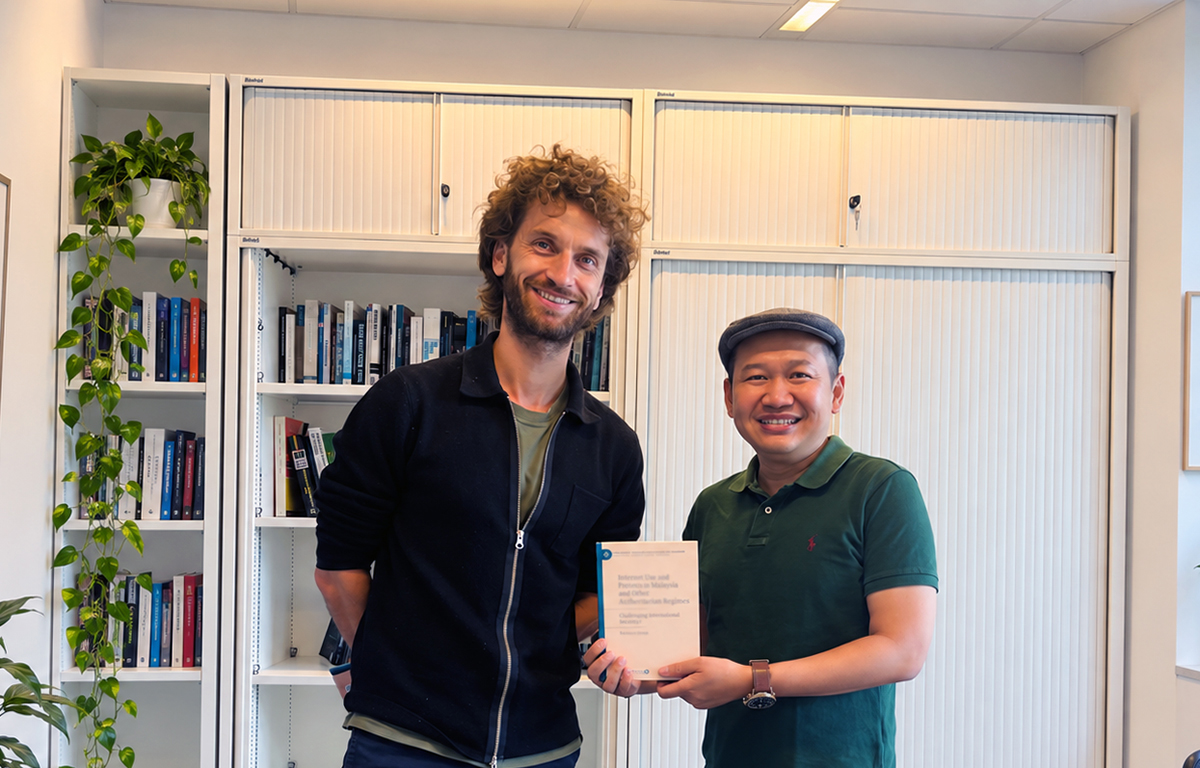
UNDIP, Amsterdam (10/9) – Universitas Diponegoro (UNDIP) continues to strengthen its internationalization efforts and global academic networks. UNDIP Vice Rector for Research, Innovation, Cooperation, and Public Communication, Wijayanto, met with researcher Kris Ruijgrok in Amsterdam, the Netherlands, on August 31, 2026, to discuss strengthening research collaboration and joint academic publications.
The meeting was part of UNDIP’s strategy to expand partnerships with international academics and researchers while strengthening several key indicators in the QS World University Rankings (QS WUR), particularly Academic Reputation, Citations per Faculty, and International Research Network (IRN).
International research collaboration is an important strategy for improving the quality, visibility, and impact of research while expanding UNDIP’s global academic networks. Meetings and collaborations with international researchers are expected to go beyond ceremonial activities and develop into substantive partnerships that produce joint research and joint publications.
The meeting in Amsterdam was also strategically significant as it took place in one of Europe’s leading academic and research hubs. The University of Amsterdam (UvA) is one of the world’s leading research universities. In the QS World University Rankings 2027, UvA ranks 60th globally, making stronger networks and collaboration with academics working within Amsterdam’s international research environment an important part of UNDIP’s efforts to expand its global academic connectivity.
Collaboration Has Produced Three International Publications
The meeting between Wijayanto and Kris Ruijgrok did not mark the beginning of a new collaboration. Their academic partnership has already resulted in three international publications, demonstrating the continuity and productivity of their international research network.
The first publication was titled “The Infrastructure of Domestic Influence Operations: Cyber Troops and Public Opinion Manipulation Through Social Media in Indonesia,” published in 2024 in The International Journal of Press/Politics. The article examines the infrastructure, networks, and practices of cyber troops in Indonesia’s domestic influence operations and public opinion manipulation through social media.
The second publication, “Towards the Comparative Study of Domestic Influence Operations: Cyber Troops and Elite Competition in Indonesia, the Philippines and Thailand,” was published online in 2025 and included in the journal’s 2026 volume of Political Communication. The article was developed through a comparative study of domestic influence operations, the role of cyber troops, and the dynamics of political elite competition in Indonesia, the Philippines, and Thailand.
The latest outcome of their collaboration is the article “Influence Operations 2.0: The Evolution of Social Media Manipulation in Southeast Asia,” published in 2026 in Information, Communication & Society. The article advances understanding of the transformation of influence operations and social media manipulation in Southeast Asia.
These three publications are strategically significant not only for advancing knowledge but also for supporting UNDIP’s internationalization agenda. In the QS World University Rankings (QS WUR), joint publications are an important element in measuring the International Research Network (IRN).
The IRN indicator not only assesses the existence of international collaboration but also evaluates the continuity and strength of research networks. One important concept within this indicator is sustained research partnerships, which are international research partnerships maintained over time and that produce joint research outputs.
Under the methodology, one important measure is a research partnership that has produced at least three joint publications in the past five years. Therefore, the three international joint publications produced by Wijayanto and Kris Ruijgrok during 2024–2026 demonstrate the formation of a sustained research partnership that strengthens the International Research Network (IRN) indicator in QS WUR.
This track record demonstrates that the academic network they have established has gone beyond meetings, discussions, or formal cooperation, evolving into joint research and publications that yield tangible, sustainable academic outcomes.
New Research Agenda
During the meeting on August 31, 2026, Wijayanto and Kris Ruijgrok discussed plans to continue and expand their collaboration through several new research agendas.
One of the main topics discussed was research into the role of cyber troops and digital influence operations in weakening political opposition groups. The research will examine how political actors use digital technology, social media, and online communication networks to shape public opinion, build political narratives, and weaken groups or actors outside the circles of power.
The two researchers also discussed a research agenda on digital repression against civil society. The study will explore various forms of pressure against civil society organizations and critical groups in the digital space, including information manipulation, digital attacks, intimidation, surveillance, and restrictions on civil liberties.
Both agendas will be developed through collaborative research and joint academic writing. The initiative is expected not only to produce publications in reputable international journals but also to expand research collaboration networks and increase academic impact through publication visibility and citations.
According to Wijayanto, strengthening international collaboration must be an important part of the university’s strategy to improve research quality and its global academic reputation.
“International collaboration is not merely about meetings or formal partnerships. The most important thing is how these networks produce joint research, joint publications, and tangible academic impact. Through sustained collaboration, we can expand our international research network, increase publication visibility, strengthen citations, and ultimately build UNDIP’s academic reputation at the international level.”
He added that issues such as digital influence operations, cyber troops, and digital repression require cross-country and interdisciplinary perspectives.
“These issues cannot be understood solely from the perspective of a single country. We need dialogue and collaboration with researchers from different countries to understand how these phenomena develop in different contexts and to enrich Indonesia’s contribution to global academic debates.”
Supporting UNDIP’s Internationalization and QS WUR Strategy
For UNDIP, strengthening international networks through collaborations that produce joint research and joint publications is a strategic step toward improving several indicators in the QS World University Rankings.
Sustained collaborations such as this have the potential to strengthen the International Research Network, increase publication visibility, expand citation opportunities, and support improvements in Academic Reputation and UNDIP’s position in international rankings.
Beyond building networks, the collaboration with Kris Ruijgrok underscores the importance of ensuring international partnerships deliver measurable, sustainable outcomes. The three joint international publications produced during 2024–2026 provide a foundation for continued research collaboration, the expansion of collaborative networks, and the development of subsequent publications.
The meeting in Amsterdam on August 31, 2026, provided momentum to sustain the research partnership by developing joint research and writing agendas on cyber troops, digital influence operations, the weakening of political opposition, and digital repression against civil society.
Through targeted and sustained international activities, UNDIP continues to build substantive partnerships with academics and researchers worldwide. The strategy is expected to strengthen UNDIP’s position within international academic networks, enhance its academic reputation, expand the impact of its publications and citations, and support the university’s goal of becoming a globally recognized institution.
The Amsterdam meeting was one of UNDIP’s concrete steps toward strengthening academic diplomacy through international collaboration grounded in results, sustainability, and tangible impact on advancing knowledge and the university’s reputation. (Public Communication/UNDIP)