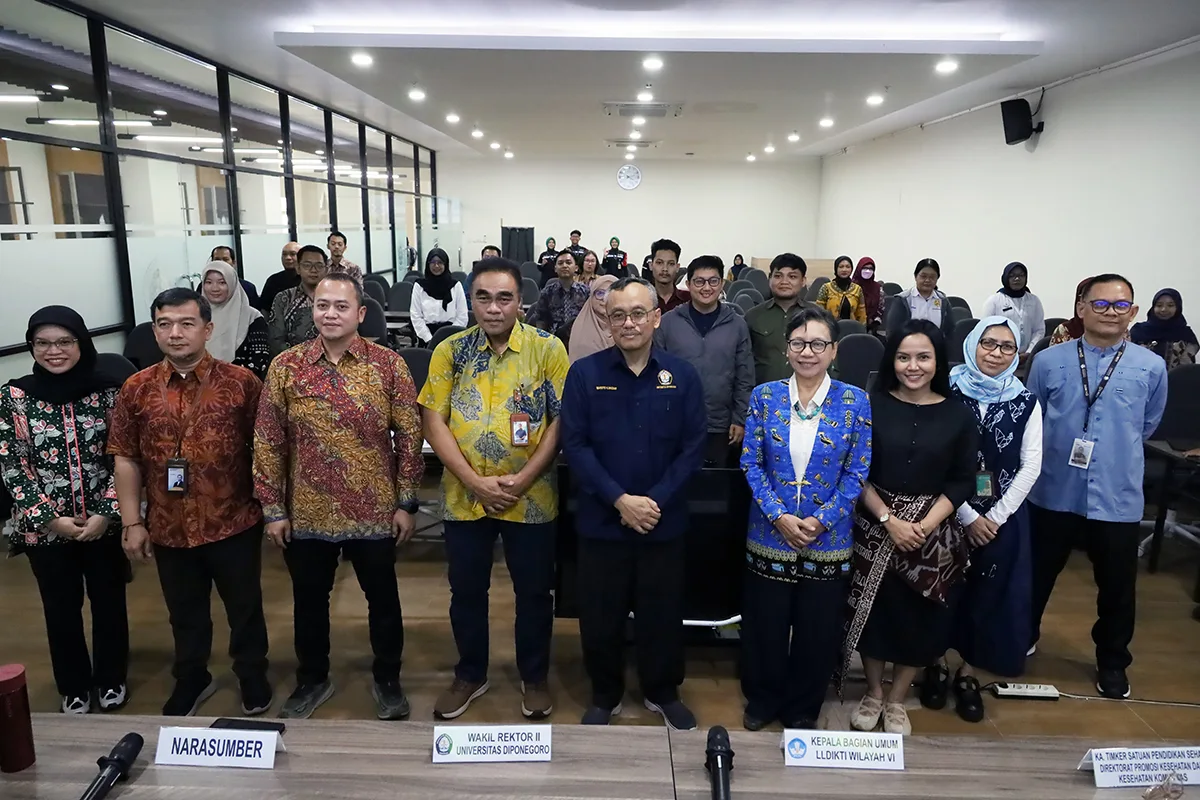





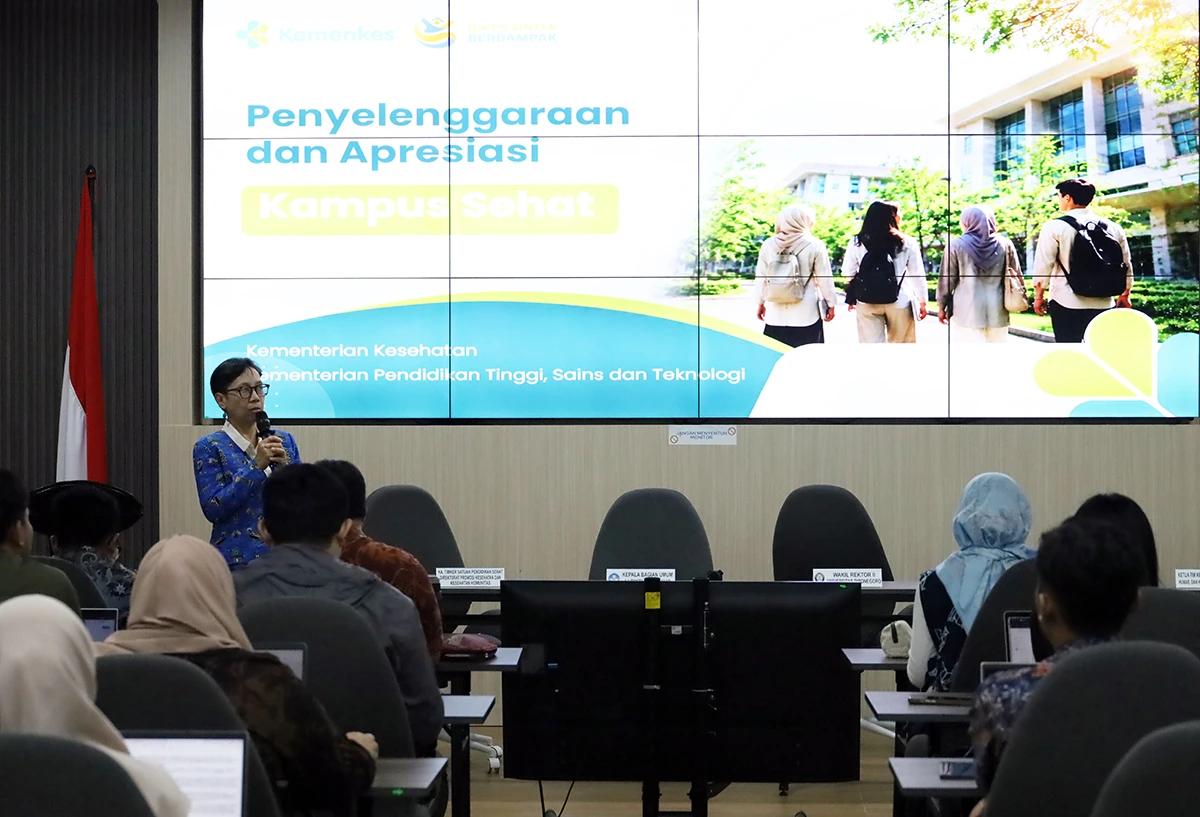
UNDIP, Semarang (13/9) – Universitas Diponegoro (UNDIP), through its Occupational Safety, Health and Environmental Unit (K3L), hosted a Healthy Campus Assistance Program for Higher Education Institutions and a pilot test of the Healthy Campus Information System on Thursday, September 10, 2026, at the Meeting Room on the 4th Floor of the Directorate of Library, UNDIP Press, and Archives Building, UNDIP Tembalang Campus. Organized in collaboration with the Ministry of Health of the Republic of Indonesia and the Ministry of Higher Education, Science, and Technology (Kemdiktisaintek), the activity aimed to strengthen self-assessment and help higher education institutions develop improvement plans based on actual campus conditions.
The forum brought together representatives of higher education institutions, government officials, and Healthy Campus experts. Participants included Nur Fatayani, S.Pd., M.K.M., Head of the Healthy Educational Institutions Working Team at the Directorate of Health Promotion and Community Health, Ministry of Health; Prof. Dra. R.A. Yayi Suryo Prabandari, M.Si., Ph.D., a Health Promoting University consultant and Asian Development Bank (ADB) consultant from Universitas Gadjah Mada; Eko Budi Prasetyo, S.I.Kom., Head of the Cooperation Working Team at the Secretariat of the Directorate General of Higher Education; and Syachrudin, S.Kom., M.T.I. from Kemdiktisaintek. The pilot test also involved representatives from 15 higher education institutions, allowing user feedback to be collected before the system is implemented more widely.
Opening the event, UNDIP Vice Rector for Planning, Finance, Assets, Business, and General Affairs, Dr. Warsito Kawedar, S.E., M.Si., Akt., emphasized that a Healthy Campus should be part of everyday habits rather than merely a visibly clean environment. He said UNDIP continues to encourage behavioral change and environmental management innovation, including waste sorting and processing waste into compost and maggot feed.
“For us, cleanliness alone is not enough. There must be innovation and cultural change. Members of the campus community need to become accustomed to caring for the environment, sorting waste, and making healthy living part of their daily routines,” he said.
He also highlighted health challenges that are not always physically visible. Facilities for physical activity and a healthy environment continue to be strengthened, but greater attention and resources are still needed to support mental health. “The physical aspects can be relatively improved, but non-physical health is an area that needs to be continuously strengthened. Therefore, this forum is important so that we can gain knowledge and learn from best practices that can be adopted to improve services on campus,” he said. These efforts complement UNDIP’s promotive and preventive programs, ranging from health screenings and Posbindu PTM to strengthened environmental management through the UNDIP Zero Waste program.
Similar support was expressed by the Head of the General Affairs Division of LLDIKTI Region VI Central Java, Adhrial Refaddin, S.IP., M.P.P. He said a Healthy Campus should not be understood merely as the availability of clinics or health services, but as an ecosystem that integrates physical and mental health, safety, comfort, and the well-being of the academic community. “This is not a new performance indicator, but rather a space to integrate various higher education activities so that campuses become healthier while also creating an impact on society,” he said. LLDIKTI Region VI is also ready to encourage collaboration and the sharing of best practices among higher education institutions in Central Java.
Meanwhile, Nur Fatayani explained that the Healthy Campus Information System was developed to provide higher education institutions with a platform for self-assessment and the formulation of improvement plans. “Through this system, higher education institutions can assess for themselves the extent to which Healthy Campus indicators have been met, identify areas that need to be strengthened, and prepare follow-up actions. This pilot test is also important for gathering feedback from higher education institutions so that the system becomes easier to use and more relevant to conditions in the field,” she explained. The Ministry of Health hopes that the assessment can eventually be conducted regularly as part of efforts to strengthen health governance in higher education.
From the higher education perspective, Eko Budi Prasetyo emphasized that the large campus population makes health a strategic issue. More than nine million students and 300,000 lecturers are active in higher education institutions. At the same time, physical and mental health conditions directly affect concentration, productivity, a sense of safety, and the continuity of students’ studies.
“This information system should serve as a tool for collective learning and improvement, rather than merely a means of fulfilling reporting requirements. Assessment helps campuses understand their conditions, determine priorities, and monitor follow-up actions over time,” he said. The Healthy Campus framework covers commitment and policy, health education, physical and mental health services, a safe and inclusive environment, and health-oriented research and community service.
Elaborating on the framework, Prof. Yayi Suryo explained that a Healthy Campus must be developed through the involvement of the entire campus community. Leadership commitment, the presence of a dedicated team or person in charge, access to health services, a safe environment, and health literacy are key elements.
Prof. Yayi also added that the self-assessment was designed not merely to produce rankings but to help higher education institutions identify their starting points and develop realistic improvements within their available resources.
The assessment instrument comprises 45 standards, consisting of 23 basic standards and 22 advanced standards, with a five-star recognition scheme and a total weight of 1,000 points. Higher education institutions can conduct periodic self-assessments using a system developed by Kemdiktisaintek. “Every campus is actually starting from a position where something is already in place. The assessment helps identify what is already working well and what is still lacking, and then use those findings as a basis for determining follow-up actions,” she explained.
During the technical session, Syachrudin guided participants through a hands-on trial of the Healthy Campus Information System, from higher education institution registration and profile completion to self-assessment and comprehensive assessment with supporting data. Through the dashboard, higher education institutions can identify areas that are already strong and those that still require improvement.
Through this pilot test, UNDIP is strengthening its efforts toward more measurable, adaptive, and sustainable Healthy Campus management, ensuring that the campus environment not only supports academic activities but also promotes the health, comfort, and productivity of its entire community. (Public Communication/UNDIP/DHW)