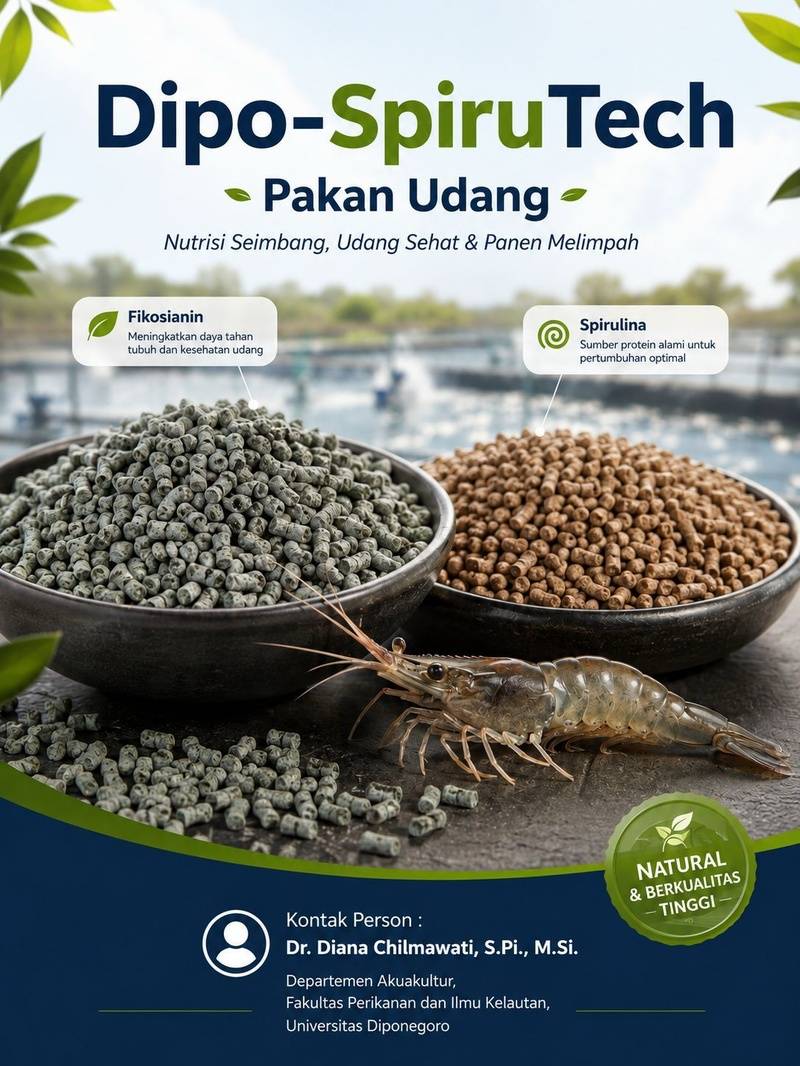


UNDIP, Semarang (12/7) – A research team from the Department of Aquaculture, Faculty of Fisheries and Marine Sciences, Universitas Diponegoro (FPIK UNDIP), is developing and validating Dipo-SpiruTech technology, an innovative functional feed based on Spirulina platensis for whiteleg shrimp (Litopenaeus vannamei) farming. In addition to offering a more affordable alternative to imported feed ingredients, this innovation is expected to reduce shrimp mortality in intensive aquaculture systems, where mortality remains relatively high.
The research, conducted throughout 2026, is part of a downstreaming program aimed at advancing the Technology Readiness Level (TRL) from level 6 to level 7 through operational testing in intensive aquaculture systems. The activities are being carried out at the Natural Feed Laboratory of FPIK UNDIP and at an intensive shrimp-farming facility operated by the research partner PT Ghana Utamadi Dhuniara.

The research is led by Dr. Diana Chilmawati, S.Pi., M.Si., together with a multidisciplinary team consisting of Prof. Dr. Ir. Dedi Jusadi, M.Sc.; Prof. Dr. Ir. Nyoman Widiasa, S.T., M.T.; Ir. Suminto, M.Sc., Ph.D.; Pranata Candra Perdana Putra, S.Pi., M.Ling.; and Dr. Asep Ridwanudin, S.Pi., M.Sc.
The research was initiated in response to global challenges facing the shrimp farming sector, particularly increasing pressure from climate change, which triggers fluctuations in temperature, salinity, and water quality. These conditions increase the risk of disease outbreaks such as Vibrio spp., Acute Hepatopancreatic Necrosis Disease (AHPND), and Infectious Myonecrosis Virus (IMNV). As a result, shrimp mortality rates in intensive farming systems remain high, negatively affecting national productivity.
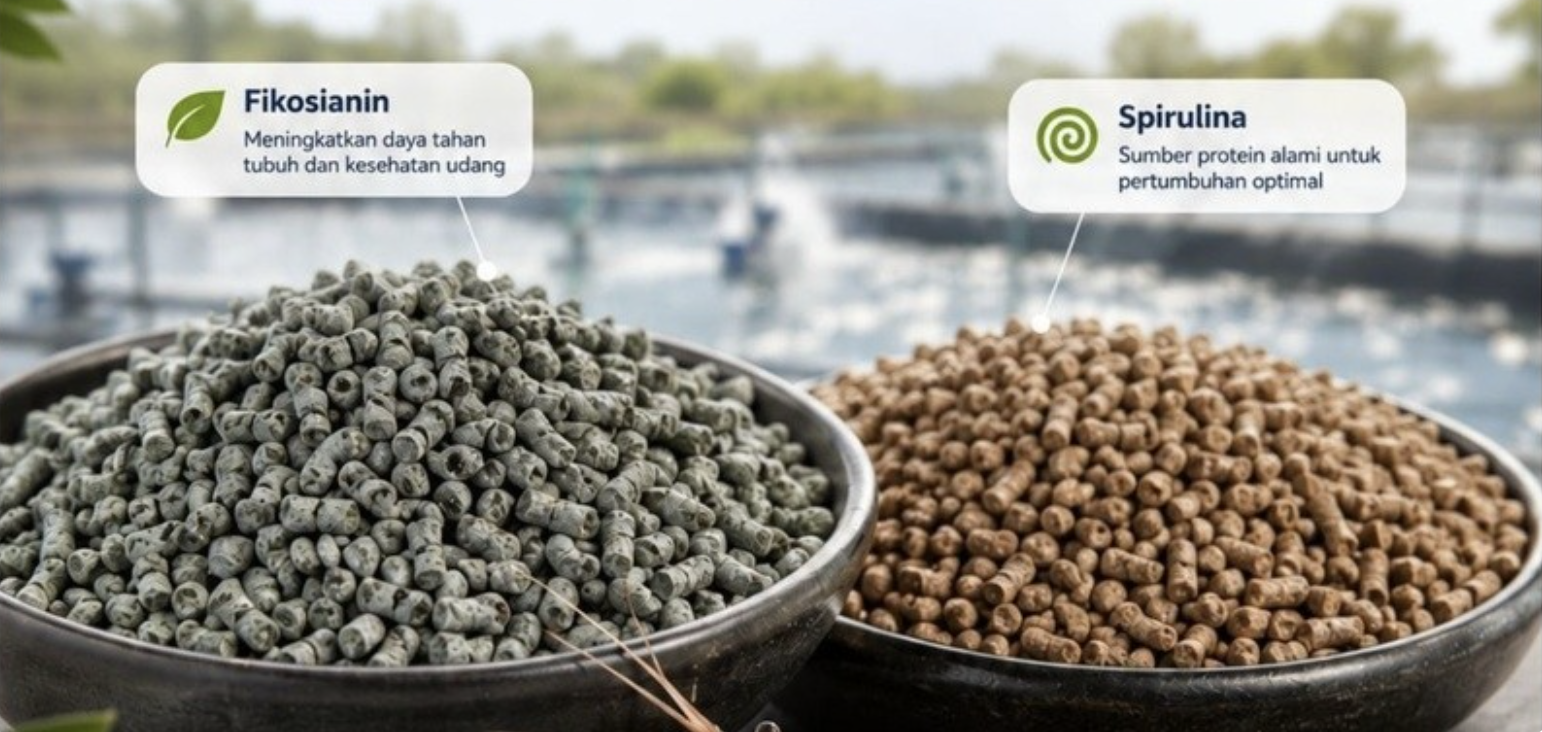
At the same time, Indonesia’s feed industry continues to rely on imported raw materials, leading to higher production costs. In response to these challenges, the UNDIP research team developed Dipo-SpiruTech, a functional feed based on pure Spirulina platensis biomass and phycocyanin powder, building on ongoing research that has yielded patented cell-washing technology and various innovations in microalgae cultivation.
The research stages are being carried out systematically, starting from the production of high-quality Spirulina biomass, formulation of Dipo-SpiruTech feed with varying doses of Spirulina supplementation, laboratory testing, and implementation in intensive aquaculture systems.
Throughout the study, the team monitors growth parameters such as weight, length, Specific Growth Rate (SGR), Feed Conversion Ratio (FCR), and Survival Rate (SR). Physiological and immunological analyses are also conducted, including Total Hemocyte Count (THC), Differential Hemocyte Count (DHC), phenoloxidase activity, as well as water quality evaluations covering temperature, salinity, dissolved oxygen, pH, ammonia, nitrite, and alkalinity. These data provide the scientific basis for ensuring that improvements in shrimp performance are genuinely attributable to the effectiveness of the functional feed being developed.
Head of the research team Dr. Diana Chilmawati, S.Pi., M.Si., explained that the study represents an important stage in the downstreaming process of research developed over the past several years.
“Dipo-SpiruTech is not merely a feed product, but an innovation platform based on local biological resources designed to strengthen the resilience of Indonesia’s shrimp farming industry. We aim to demonstrate that high-quality Spirulina biomass produced at UNDIP can improve immunity, maintain shrimp survival rates, and reduce reliance on imported raw materials. Through pond-scale validation, we hope this technology can soon enter the commercialization stage and provide tangible benefits to shrimp farmers,” said Dr. Diana.
Research team member Pranata Candra Perdana Putra, S.Pi., M.Ling., added that the study does not focus solely on increasing productivity, but also considers environmental sustainability and the blue economy.
“Climate change is an unavoidable challenge in shrimp farming. Therefore, feed innovations must improve the ability of cultured organisms to adapt to environmental stress. Through Dipo-SpiruTech, we integrate nutrition, shrimp health, production efficiency, and environmental sustainability so that the resulting technology is truly applicable to the needs of the national aquaculture industry,” he said.
The implementation of this research is expected to deliver tangible benefits to communities, particularly shrimp farmers in Indonesia. The use of Spirulina-based functional feed is projected to improve production efficiency, reduce mortality rates by approximately 20 percent, enhance growth performance, and increase shrimp resilience to disease pressure and changes in environmental quality.
In addition to providing economic benefits through increased pond productivity, the innovation also creates opportunities to substitute imported feed ingredients with high-value local biological resources. From an industrial perspective, successful validation of Dipo-SpiruTech is expected to accelerate the downstreaming process toward a competitive national commercial product while strengthening the innovation ecosystem based on university research.
Through the development of Dipo-SpiruTech, Universitas Diponegoro once again demonstrates its commitment to producing innovations that do not stop at scientific publications, but can be transformed into technologies that provide tangible benefits to society and industry. This research is aligned with government policies on strengthening research downstreaming and blue economy development, while also supporting the achievement of the Sustainable Development Goals (SDGs), particularly SDG 2 (Zero Hunger), SDG 9 (Industry, Innovation and Infrastructure), SDG 12 (Responsible Consumption and Production), and SDG 14 (Life Below Water).
Through collaboration among academia, industry, and communities, Dipo-SpiruTech is expected to become a strategic solution for developing shrimp farming that is more productive, resilient, and sustainable. This spirit is a tangible manifestation of”Noble and Valuable UNDIP” — by delivering impactful knowledge and innovation that contribute directly to national development and public welfare. (Public Communication/UNDIP/Diana Chilmawati, edited by Jejak Team)