

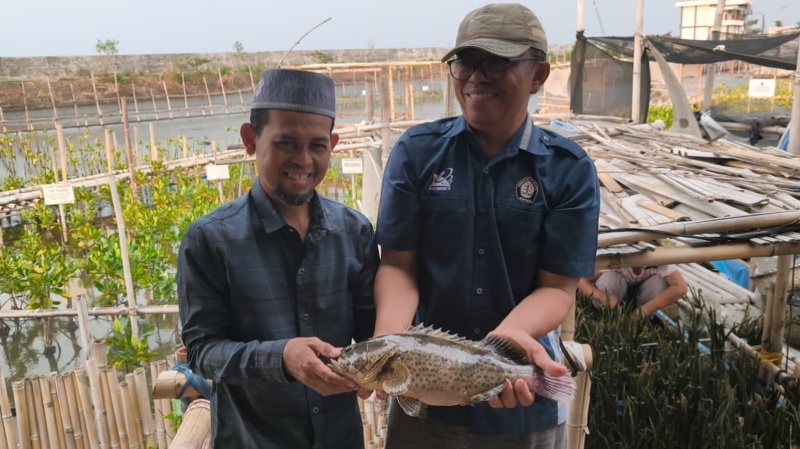
UNDIP, Semarang (5/11) – Who would have thought that tidal floodwater, which has long been a challenge for coastal communities, could be transformed into a promising opportunity for aquaculture? This potential has been demonstrated through the successful cultivation of orange-spotted grouper (Epinephelus coioides) using the Eco-Alami system in Tambakrejo, Tanjung Mas Urban Village, Semarang. After exactly 12 months of cultivation, the grouper weighed 1.5 kilograms, incurring no additional feed costs.
This achievement brings encouraging news and demonstrates that areas affected by tidal flooding still hold economic potential that can be developed. Through an aquaculture approach that leverages the surrounding ecosystem, tidal floodwater can be viewed not only as a challenge but also as a resource that may benefit local communities.
One of the unique features of the Eco-Alami system is its use of the natural food chain formed within the cultivation environment. The system integrates mangrove ecosystems, tilapia, and grouper in a mutually supportive relationship.
Algae growing around mangrove roots and trees serve as a food source for tilapia. In turn, tilapia eggs and larvae, along with naturally occurring organisms such as barnacles, become food sources for the orange-spotted grouper. Fish waste and decomposed mangrove leaf litter then provide nutrients for the mangroves. By utilizing naturally available food sources, artificial feed is not required, thereby reducing operational costs during cultivation.
In addition, natural processes within the ecosystem help support nutrient cycling between aquatic organisms and mangrove vegetation. This approach makes the Eco-Alami system a more environmentally friendly aquaculture alternative.
The development of this aquaculture model is part of a community service program conducted by the Department of Oceanography, Faculty of Fisheries and Marine Sciences, Universitas Diponegoro, led by Dr. Kunarso, S.T., M.Si., in collaboration with Pokmaswas Manunggal Bahari in Tambakrejo, chaired by Suratno.
“The successful cultivation of orange-spotted grouper reaching a weight of 1.5 kilograms and a length of 40 centimeters within 12 months demonstrates the potential for aquaculture development in coastal areas affected by tidal flooding,” said Dr. Kunarso, S.T., M.Si.
Beyond producing economically valuable fish, this innovation is expected to create new business opportunities, improve community productivity, and reduce the economic burden on residents who have long lived with recurring tidal flooding.
Through the Eco-Alami system, there is growing hope that tidal floodwater will no longer be seen solely as a problem to be endured, but can also be managed as a source of livelihood. This simple initiative has the potential to deliver significant benefits for coastal communities while supporting global development goals, particularly SDG 2: Zero Hunger and SDG 14: Life Below Water, by sustainably using marine resources. (Public Communication/UNDIP/Research Team)