
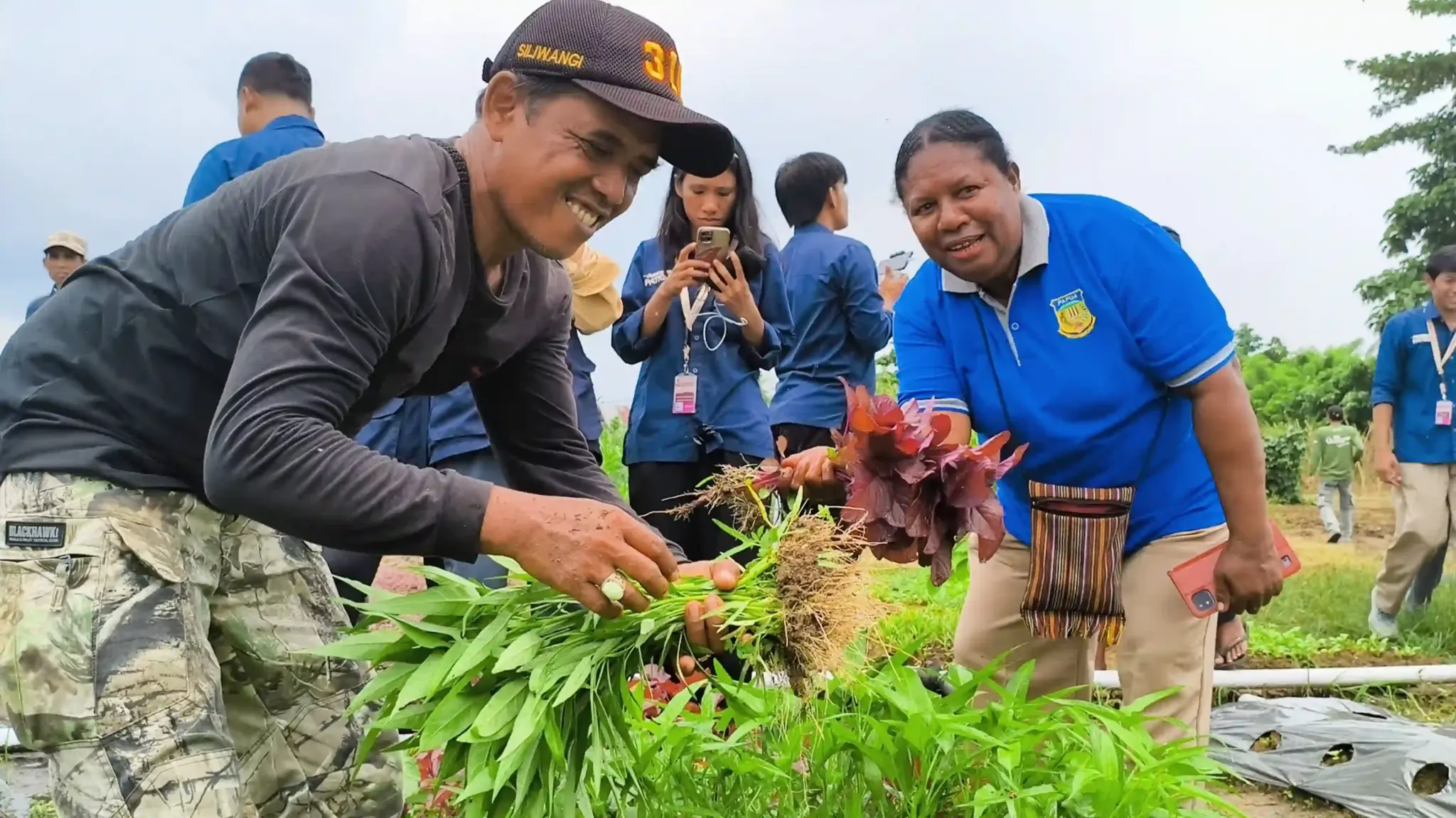
UNDIP, Senggi, Keerom Regency (2/11) – Universitas Diponegoro Patriot Expedition Team (TEP UNDIP) Team 7, together with local farmer groups and Patriot Perintis, carried out the first vegetable harvest at an agricultural demonstration plot in SP2 Woslay Village, Senggi Transmigration Area, Keerom Regency, Papua, on Monday (12/10). The harvest of water spinach and red amaranth marked the initial result of horticultural cultivation activities developed as an agricultural demonstration and learning facility for the local community.
The TEP UNDIP agricultural demonstration plot was developed to introduce food crop and horticultural cultivation practices that can be directly observed by the community. Covering approximately 200 square meters, the plot is used to cultivate several commodities, including chili peppers, upland rice, mustard greens, water spinach, and red amaranth. Through the demonstration plot, the team seeks to provide a learning space that connects land management practices with the agricultural needs of transmigrant communities.
The demonstration plot was developed through several stages, starting with land preparation and cultivation, seedling preparation, and the installation of mulch where needed. The plot is also equipped with a sprinkler irrigation system to water crops. Various maintenance activities were carried out during cultivation before the crops entered the harvesting stage.
On the water spinach and red amaranth beds, compost had been applied approximately one month before harvest. The use of compost forms part of the practice of utilizing organic materials in land management. Its application can be observed together with the community; however, this harvest cannot yet be used to conclude that compost increased productivity without comparative testing.
During the first harvest, crops ready for harvesting were located on two beds covering a total area of approximately 40 square meters. The harvested commodities were water spinach and red amaranth, while other crops in the demonstration plot remained at their respective stages of cultivation. The harvesting activity was carried out together with farmer groups and Patriot Perintis as part of the learning process and observation of crop yields at the pilot site.
One participant, Gundi, expressed appreciation for the TEP UNDIP activity, which connected compost-making practices to the results of vegetable cultivation at the demonstration plot. “Activities like this are very useful, especially because compost production is not only explained theoretically, but is also demonstrated through the vegetable harvest. So, we do not only hear the explanation, but can also see tangible evidence and directly experience the benefits,” he said. He hoped that similar demonstration activities could continue to be developed so that farmers could gain a better understanding of compost application through direct practice.
The first harvest was utilized in several ways. Part of the produce was distributed to other members of the Patriot Expedition Team. At the same time, the remainder was marketed through kiosks in Senggi to generate income from cultivation activities. This use demonstrates that the demonstration plot’s produce is not only used for learning purposes but can also be marketed as a local agricultural product.
Following the harvest, TEP UNDIP immediately began preparing the used beds for the next planting cycle. Seedlings for the subsequent planting had already been prepared in the nursery, allowing cultivation activities to continue by transplanting them into the field. This stage forms part of efforts to maintain the continuity of agricultural activities at the demonstration plot.
The first harvest of water spinach and red amaranth represents one of the early achievements in the development of the TEP UNDIP demonstration plot in the Senggi Transmigration Area. Through the involvement of farmer groups and Patriot Perintis, the pilot plot is expected to continue serving as a shared learning facility for crop management, the utilization of organic materials, and the development of local agricultural practices. This initiative also supports the achievement of the Sustainable Development Goals (SDGs), particularly SDG 2: Zero Hunger and SDG 12: Responsible Consumption and Production. (Public Communication/UNDIP)