
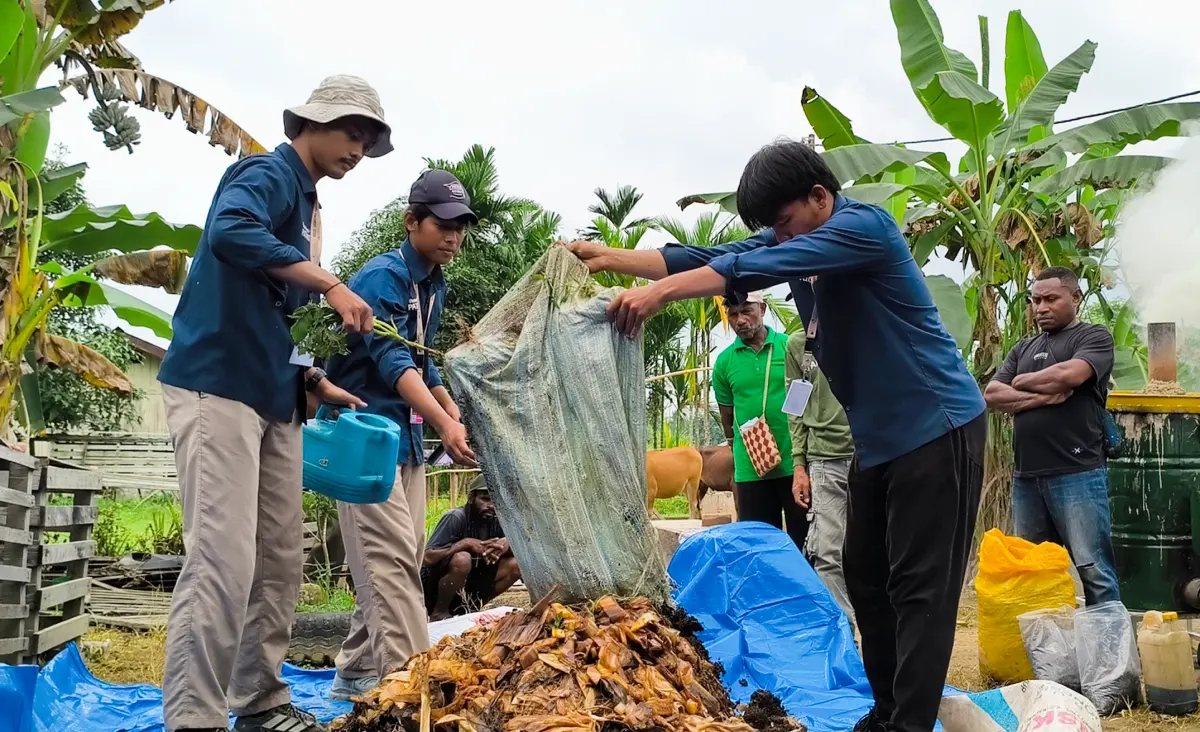
UNDIP, Senggi, Keerom Regency (4/11) – Universitas Diponegoro Patriot Expedition Team (TEP UNDIP) Team 7 held a simple compost-making practice as part of the Rumah Tani Trans program in the Senggi Transmigration Area, Keerom Regency, Papua, on Saturday (10/10). The activity involved agricultural extension officers (PPL), farmer groups, local communities, and Patriot Perintis in the livestock sector to introduce the utilization of agricultural and livestock waste as alternative sources of organic materials for farmland.
The activity was initiated in response to challenges related to agricultural waste management and fertilizer needs in the transmigration area. Crop residues such as rice straw and corn waste can be processed into compost, allowing them to be reused within the agricultural system rather than remaining merely as cultivation residues.
Through Rumah Tani Trans, TEP UNDIP provides a space for discussion and shared learning with farmers to address agricultural challenges and introduce solutions that can be applied with locally available materials. This approach is part of efforts to encourage the implementation of a circular economy by reusing resources available in agricultural and livestock environments.
During the compost-making practice, the team used rice straw, corn waste, banana stems, soil, and cattle manure as a mixture. The process also utilized rice-washing water, molasses, and EM4 as supporting materials for composting. Participants were introduced to the use of these materials and the mixing process as an initial stage in the decomposition of organic matter.
The activity was conducted in a participatory manner. Farmers not only observed the demonstration but also took part directly in compost-making and discussed the composition of the material and the possibility of applying the method using resources available on their agricultural land.
One participant, Udin, asked whether molasses could be replaced with material derived from sugarcane that he already had. The question reflected farmers’ interest in using locally available materials that are easier to obtain. Sugarcane-based materials may be considered an alternative sugar source for preparing solutions to support the composting process, although adjustments to composition and processing methods would be required.
The discussion also highlighted challenges related to access to subsidized fertilizer in Senggi. Sumbara, Head of the PPL, explained that some residents face administrative obstacles, including inconsistencies in population data and issues with document requirements. In addition, the limited number of fertilizer retail outlets presents another challenge in obtaining fertilizer for agricultural needs. These conditions have led to expectations that compost development could serve as an alternative to meet farmers’ fertilizer needs.
Processing waste into compost was introduced as one form of circular agriculture, in which organic materials from agricultural and livestock production residues are returned to the cultivation system. However, the materials produced during the practice still require further decomposition and maturation before they can be applied to crops. Compost is also positioned as a source of organic matter and nutrients, whose use should be adjusted to the needs of the soil and crops.
As a follow-up, TEP UNDIP plans to construct a compost facility to process and store organic materials. The facility is planned to be located near the mini ranch to facilitate access to cattle manure as one of the raw materials for composting.
Through Rumah Tani Trans, TEP UNDIP connects agricultural discussions and practices with the needs of the Senggi community. Collaboration with PPL, farmer groups, local communities, and Patriot Perintis is expected to initiate sustainable organic waste processing. This initiative also supports the achievement of the Sustainable Development Goals (SDGs), particularly SDG 12: Responsible Consumption and Production through the implementation of a circular economy, and SDG 15: Life on Land through efforts to maintain soil fertility. (Public Communication/UNDIP)