

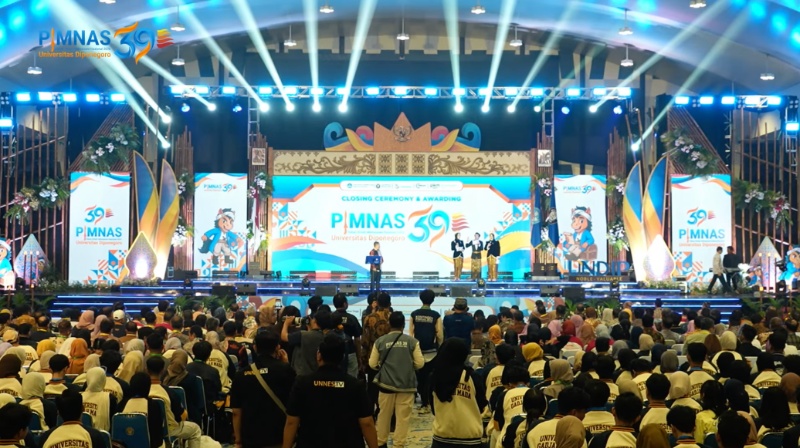
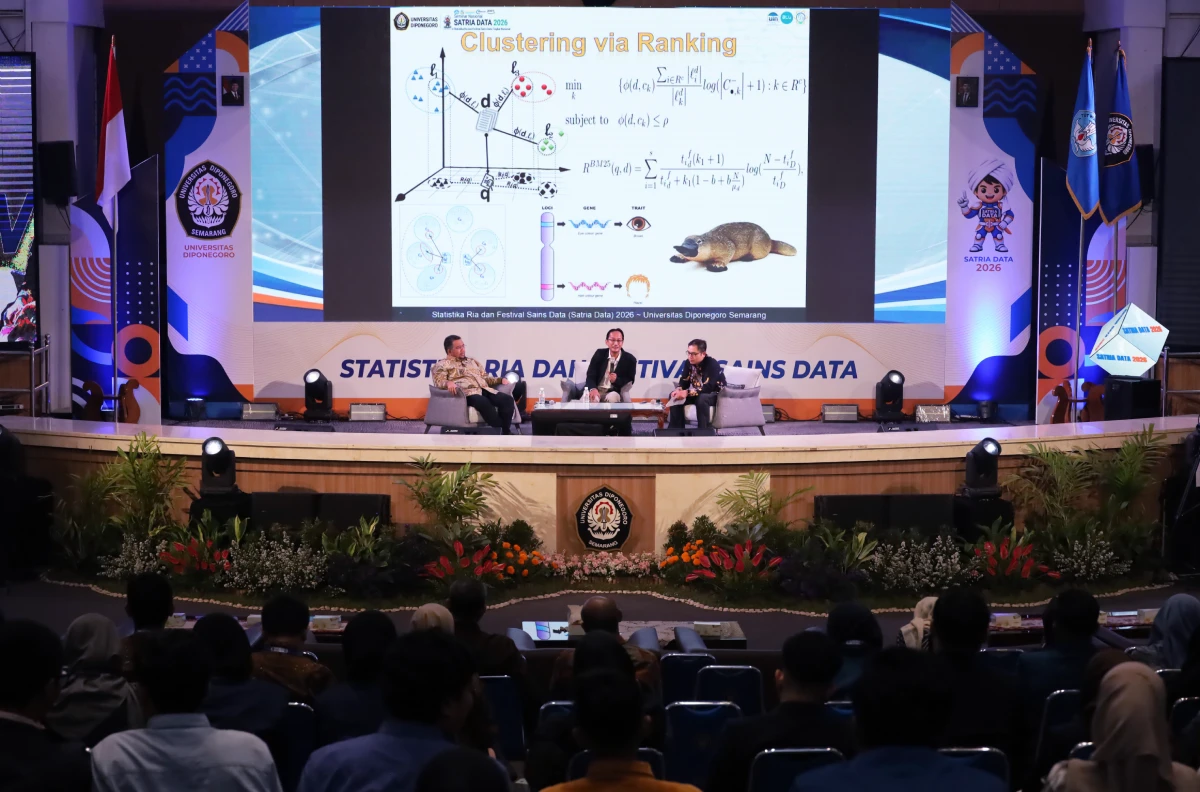
UNDIP, Semarang (27/10) – The use of data science and Artificial Intelligence (AI) is becoming increasingly widespread, ranging from academic research to decision-making in industry. However, the advancement of these technologies also brings several challenges, including high computational requirements, environmental impacts, and data quality, which determines the accuracy of analysis. These issues were highlighted at the National Seminar of Statistika Ria and Data Science Festival (SATRIA DATA) 2026, held at the Prof. Soedarto, S.H. Building, Universitas Diponegoro (UNDIP) Tembalang Campus, on Monday, October 26, 2026.
Carrying the theme “Impactful Data Science Talent: Processing Data, Driving the Nation toward Golden Indonesia 2045,” the seminar, held following the opening of SATRIA DATA 2026, brought together academic and industry perspectives to broaden participants’ understanding of how data science can be applied to address real-world challenges. The two speakers were Taufik Sutanto, M.Sc.Tech., Ph.D. from UIN Syarif Hidayatullah Jakarta and Divo Dharma Silalahi, Ph.D. from SMART Research Institute, PT Sinar Mas Agro Resources and Technology (SMART) Tbk. The discussion was moderated by Dr. Hasbi Yasin, S.Si., M.Si., a lecturer at UNDIP’s Faculty of Science and Mathematics.
In his presentation, Taufik Sutanto, Ph.D. emphasized the importance of developing Green AI, or artificial intelligence that takes resource efficiency and environmental impacts into account. According to him, advances in AI should be measured not only by accuracy but also by energy requirements, computing costs, water consumption, and the electronic waste generated in its development. He stressed the need for more efficient approaches so that the use of AI is not concentrated only in institutions with large-scale computing infrastructure, but can also be accessed by more universities and researchers.
Taufik also introduced the Data-Centric AI approach, which places greater emphasis on data quality and selection rather than simply increasing model size. One example discussed was ecoCluster, a mini-computer cluster concept that uses single-board computers to support AI and big data education at a lower cost and with lower energy consumption. This approach opens opportunities for educational institutions to develop data science competencies without always relying on large-scale computing devices, while also encouraging more inclusive and sustainable AI research.
Complementing this perspective, Divo Dharma, Ph.D., discussed “Robust Statistics for Big Data Processing: Industrial Experience.” He explained that industrial data can come from various sources, including sensors, satellite imagery, remote sensing, spectral measurements, and operational activities. Such diverse and high-dimensional data often contain outliers and high-leverage points that can alter modeling results. Therefore, statistical methods need to be capable of identifying anomalies and ensuring that analytical conclusions remain reliable.
Divo explained the application of robust statistical methods to improve analytical reliability, including developing models that are more resistant to data disturbances and selecting relevant variables. In practice, this approach can support remote sensing data processing for vegetation modeling, the identification of anomalies in larval size using drone imagery, monitoring of field activities, and interpretation of sensor data in plantations.
His main message was that the quality of decision-making is not determined solely by the volume of data or the sophistication of the model. The analytical process must also be able to distinguish meaningful patterns from anomalous data that could lead to misleading results.
Through this seminar, UNDIP provided a platform connecting knowledge developed in universities with its practical application in industry. Students not only gained insight into the latest developments in data science, but were also encouraged to consider sustainability, information quality, and the benefits of technology for its users.
These insights serve as important foundations for the younger generation in developing innovations that can be implemented responsibly.
As the host of SATRIA DATA 2026, UNDIP also encourages the strengthening of data science talent competencies to produce innovations that are relevant to society and the business sector. This spirit aligns with UNDIP’s commitment to being an excellent research university and its vision of ‘Noble and Valuable UNDIP’. Through collaboration among academics, students, and industry, mastery of data science is expected to evolve into tangible solutions that support digital transformation and Indonesia’s development toward Golden Indonesia 2045. (Public Communication/UNDIP/DHW)