







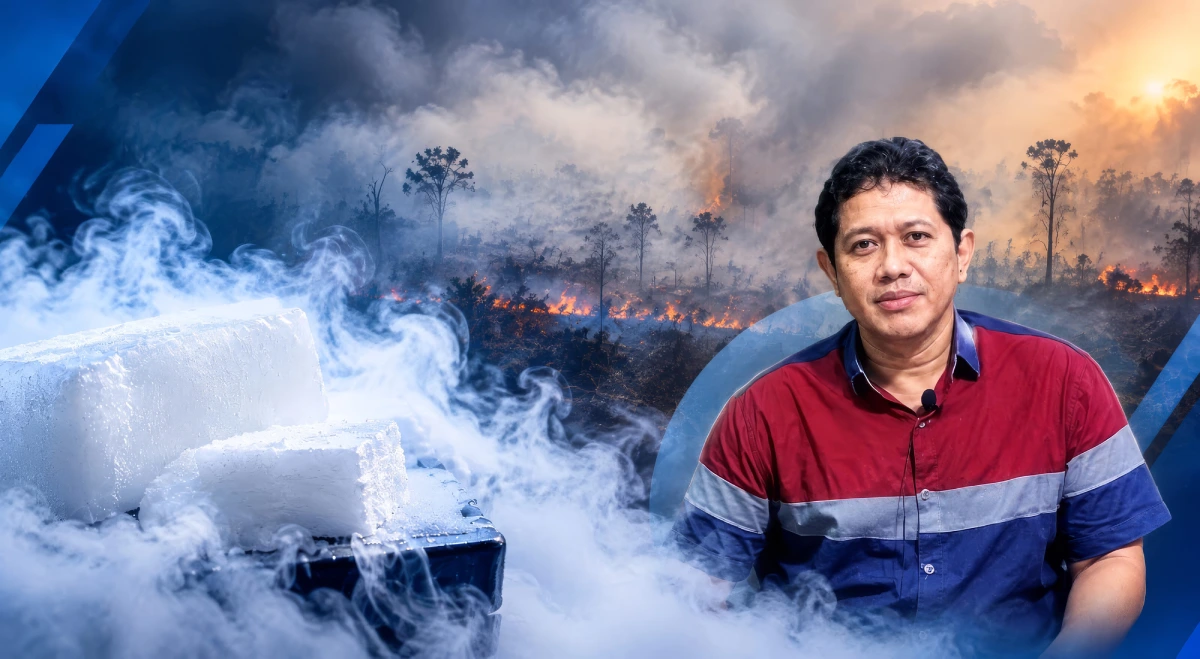
UNDIP, Semarang (27/10) – Peatland forest and land fires remain a serious challenge for Indonesia. Fires that spread into underground layers are often difficult to reach and can even reignite after the surface appears to have been extinguished. This condition highlights the need for technological approaches that can target heat sources more precisely. One alternative currently drawing attention is the use of dry ice, or solid carbon dioxide (CO₂), as a supporting technology for firefighting and smoke dispersion control.
This potential has drawn the attention of Dr. Mohamad Endy Julianto, S.T., M.T., a lecturer in the Industrial Chemical Engineering Technology Study Program (TRKI) at the Vocational School, Universitas Diponegoro (UNDIP). From a process engineering perspective, he has examined the potential of dry ice to help control heat and reduce oxygen availability around fire points. At a temperature of minus 78.5 degrees Celsius, dry ice can absorb heat as it changes directly from solid to gas through sublimation. This characteristic opens opportunities for its application in peatland fires, particularly as a complement to conventional firefighting methods.
According to Dr. Endy, peatland fires require a different approach from surface fires. Smoldering embers can persist at certain depths, meaning that spraying water from above may not necessarily reach all heat sources. The use of dry ice offers an interesting cooling mechanism for further study, although its effectiveness still depends on land conditions, fire depth, and application techniques.
“Every method has its strengths and limitations. Firefighting needs to be integrated so that the technology used is appropriate to the conditions of the fire,” he explained. For embers located deep below the surface, water injection remains an important option that needs to be combined with hotspot monitoring.
The potential is also supported by findings from international laboratory research discussed in his study. Research by Zhang and colleagues, reported in 2026 in the Fire Safety Journal, recorded the use of approximately 41 kilograms of dry ice per square meter, compared with around 90 kilograms of water under certain experimental conditions, with an effective cooling effect lasting up to 175 minutes. Although these findings indicate potential efficiency in material use, they cannot yet be used as a direct benchmark for tropical peat fires in Indonesia. Further testing is needed to determine effectiveness, the risk of reignition, and the economic feasibility of field application.
In addition to firefighting, Dr. Endy also reviewed the possibility of using dry ice to help disperse smoke trapped by temperature inversion. This phenomenon occurs when a layer of warm air prevents air below it from rising, causing smoke to remain near the surface. The cooling effect of dry ice can influence these conditions and promote smoke dispersion. However, he emphasized the distinction between dispersing and eliminating pollutants.
“Dry ice does not break down smoke particles, but it may potentially assist the dispersion process so that their concentration can decrease,” he explained. The effectiveness of this mechanism still needs to be demonstrated through controlled atmospheric testing.
From an industrial engineering perspective, the development of this technology also creates opportunities for innovation by enabling the use of a dry ice pelletizer. This device converts CO₂ into solid pellets. The production process involves compression, cooling, pressure reduction, and compaction using a hydraulic system. This expertise is closely related to Industrial Chemical Engineering Technology, particularly in thermodynamics, heat transfer, and process equipment design.
Dr. Endy also highlighted the importance of developing thermal detectors to map the location and depth of heat sources so that firefighting efforts can be more targeted and material use can be minimized.
Despite its potential, the use of dry ice still requires careful consideration, including energy production requirements, distribution costs, personnel safety, and the environmental impact of CO₂ emissions. Therefore, further research on the characteristics of Indonesian peatlands is an important step before this technology can be applied more widely. Comparisons with land rewetting, water injection, and other firefighting methods are also needed to determine the most effective, safe, and economical combination of approaches.
Dr. Endy’s study demonstrates the contribution of applied science at UNDIP’s Vocational School in addressing environmental issues that directly affect communities. The development of more precise firefighting technology is expected to help reduce the risk of recurring fires, protect peatland ecosystems, and reduce smoke exposure that affects public health and daily activities. Through strengthened research and interdisciplinary collaboration, UNDIP continues to open opportunities for evidence-based solutions to support more adaptive and sustainable forest and land fire management. (Public Communication/UNDIP–Vocational School/Endy; Ed. DHW)