


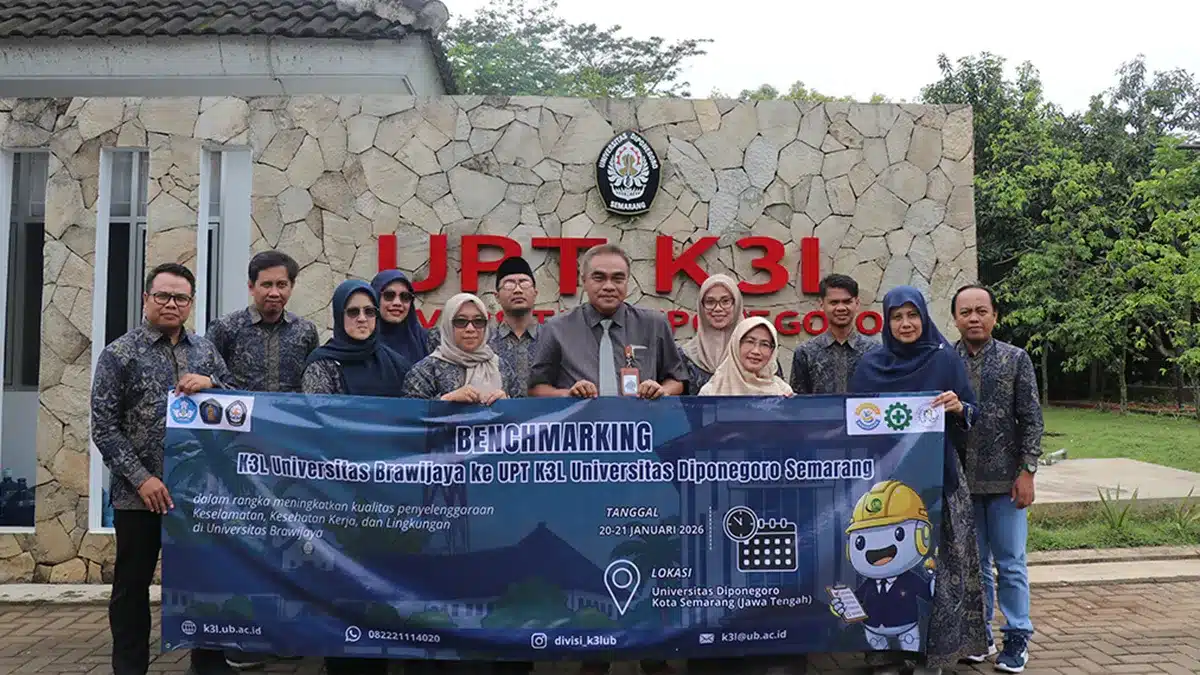
UNDIP, Semarang (21/1) – Universitas Diponegoro, through its Technical Service Unit for Occupational Safety, Health, and Environment (UPT K3L), welcomed a working visit from Universitas Brawijaya (UB) on Wednesday, January 21, 2026, at the Integrated Waste Processing Facility (TPST) of UNDIP’s Tembalang Campus. The benchmarking activity was attended by 15 representatives from UB’s K3L Division, who enthusiastically participated in a campus tour and shared best practices for strengthening K3L systems and sustainable campus environmental management.
The UB delegation was received by the UPT K3L UNDIP team at the UNDIP Circular Campus Studio (UCCS). It provided an overview of the waste management flow, from waste segregation at the faculty level to the processing of organic and inorganic waste, as well as various circular-economy–based innovations developed by UNDIP. The TPST area was also introduced as an open educational space that continues to be improved to become a more comfortable and representative public learning center.
In his remarks, the Head of UPT K3L UNDIP, Dr. Bina Kurniawan, S.K.M., M.Kes., expressed his appreciation for Universitas Brawijaya’s visit and reaffirmed UNDIP’s commitment to positioning TPST as an open learning laboratory. “TPST does not function merely as a technical facility, but also as a center for education, research, and collaboration. We open opportunities for students, lecturers, researchers, and external partners to engage in research, internships, and community service programs, so that TPST continues to develop as an inter-institutional laboratory,” he stated.
Dr. Bina further explained that UPT K3L was established in 2021 and serves as a strategic unit under the coordination of the Vice Rector for Planning, Finance, Assets, Business and Household. The implementation of K3L at UNDIP is based on three main pillars—occupational safety and health, healthy campus, and environment—strengthened through various internal regulations, including Rector Regulation No. 18 of 2025 on the Occupational Safety and Health Management System (SMK3) and Rector Regulation No. 5 of 2023 on Waste Management. UNDIP has also formed a K3 Task Force involving more than 160 certified lecturers and education staff to conduct inspections, safety patrols, and risk mitigation across all work units.
He also outlined several K3L service innovations, including the ‘Hero’ emergency application, healthy campus programs such as free health check-ups and mental health screening, strengthened healthy canteens, and smoke-free zones. In the environmental sector, the focus includes domestic and hazardous waste management, compost processing, maggot cultivation, pyrolysis, plastic recycling, and faculty research innovations such as plastic-to-fuel conversion and digital waste-sorting machines.
Meanwhile, the Head of the K3L Division of Universitas Brawijaya, Prof. Dr. Ir. Qomariyatus Sholihah, M.Kes., expressed her appreciation for UNDIP’s warm reception and regarded the visit as an opportunity to network and share best practices among universities. She explained that the benchmarking visit was part of UB’s commitment to strengthening internationally standardized K3 systems to create a safe and environmentally friendly campus. According to her, sustained synergy and collaboration between UB and UNDIP are essential to reinforce K3L systems and culture within higher education institutions. She also emphasized that UB’s K3L Division must serve as a role model, both internally and for the surrounding community—especially as the visit coincided with National Occupational Safety and Health Month.
Prof. Qomariyatus added that the visit to UNDIP was also motivated by UPT K3L UNDIP’s achievement in receiving the First Prize Award as Bhakti Husada Partner of the Year 2025 from the Indonesian Ministry of Health, in the category of Office Worker Health Protection, on December 8, 2025. “We want to learn directly from UNDIP’s best practices so that the strengthening of K3L at UB can be implemented in a more structured, gradual, and impactful manner,” she stated. She also emphasized the importance of strengthening K3L management systems as a moral responsibility to protect the academic community, in line with international standards such as ISO 45001 and ISO 14001.
Prof. Qomariyatus further explained that UB’s K3L Division is still in the institutional strengthening phase and is developing various initiatives, including strengthening standard operating procedures (SOPs), increasing the number of certified personnel, and developing digital systems for monitoring safety facilities. She expressed hope that this visit would serve as the starting point for sustainable collaboration between UB and UNDIP in building campuses that are safe, healthy, and environmentally friendly.
This visit is expected to strengthen inter-university collaboration networks, particularly in the development of sustainable environmental management systems. Through this activity, Universitas Diponegoro reaffirms its role as a higher education institution that consistently delivers concrete solutions in occupational safety, health, and environmental management, while opening broader opportunities for collaboration toward the realization of green and sustainable campuses in Indonesia. (Public Communication/UNDIP/DHW)