
UNDIP, Temanggung (31/7) – Campuranom Village, Bansari District, Temanggung Regency, has significant agricultural potential supported by fertile soil, scenic landscapes, and an agrarian community. However, developing this potential continues to face challenges, including pest control, electricity needs in agricultural fields, biomass and waste management, soil and water conservation, and the low added value of agricultural products.
In response to these challenges, 30 Universitas Diponegoro (UNDIP) students participating in KKN-IDBU Team 21 assisted the Campuranom Village Government in preparing the Campuranom Village Masterplan 2027–2034. The masterplan integrates regenerative agriculture, circular resource utilization, environmental sustainability, and technology, with a vision of establishing Campuranom as a Technology-Based Regenerative, Circular, and Sustainable Agricultural Tourism Village by 2034.
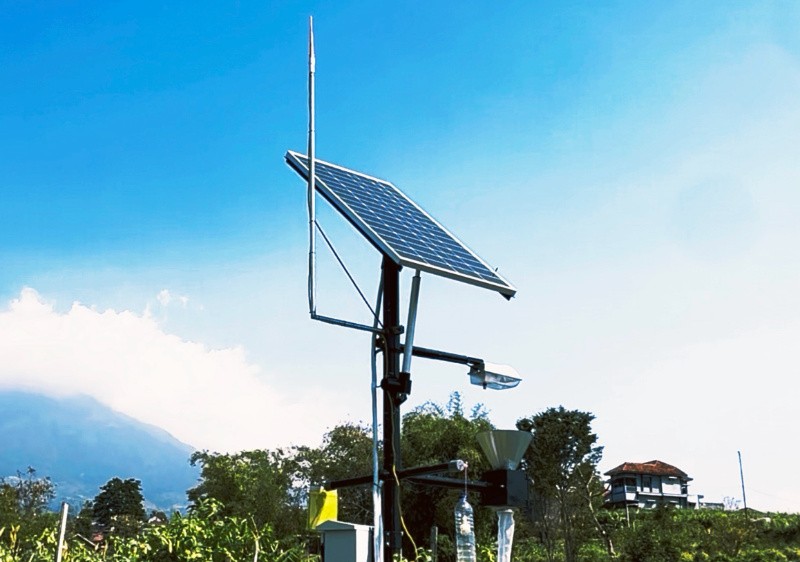
One of the masterplan programs currently being developed is a solar-powered smart light trap prototype as an initial portfolio, or “year zero,” for implementing regenerative, circular, and sustainable concepts in Campuranom Village.
The KKN program itself runs from June to August 2026 and involves students from various study programs and faculties at UNDIP. The team is supervised by Ardy Wibowo, Ph.D., as the lead academic advisor, along with Rendy Ega Pradhana, MAB, from the Department of Business Administration; Alfia Putri Wulandari, S.T., M.T., from the Department of Electrical Engineering; and Chaieydha Noer Afiefah, S.P., M.Sc., from the Department of Agroecotechnology.
Smart Light Trap for Pest Control
The solar-powered smart light trap prototype incorporates several innovations that distinguish it from conventional light traps. The device is designed not only to capture pest insects but also to adapt more effectively to field conditions, use energy efficiently, and be easy for farmers to operate.
The first innovation is a solar tracker system that enables the solar panel to adjust its position according to the direction of incoming sunlight. This mechanism is intended to optimize energy capture, enabling the device to operate more effectively in agricultural fields.
The second innovation is a sensor-based suction blower. When the sensor detects insects around the light source, the blower automatically activates and directs the insects into a collection container. This automated system is designed to improve trapping effectiveness without requiring farmers to operate the device continuously.
The device also features a height-adjustable pole to match crop height. This allows the smart light trap to be used with various crops and at different stages of plant growth. In addition, the device is portable, making it easy to move from one field to another to meet pest-control needs.
An AI-assisted pest-monitoring learning module for farmers complements technological innovations. The module is designed to help identify captured insects and provide initial recommendations on appropriate control methods. Thus, the use of the smart light trap goes beyond simply capturing pests and is also intended to support more accurate, information-based agricultural decision-making.
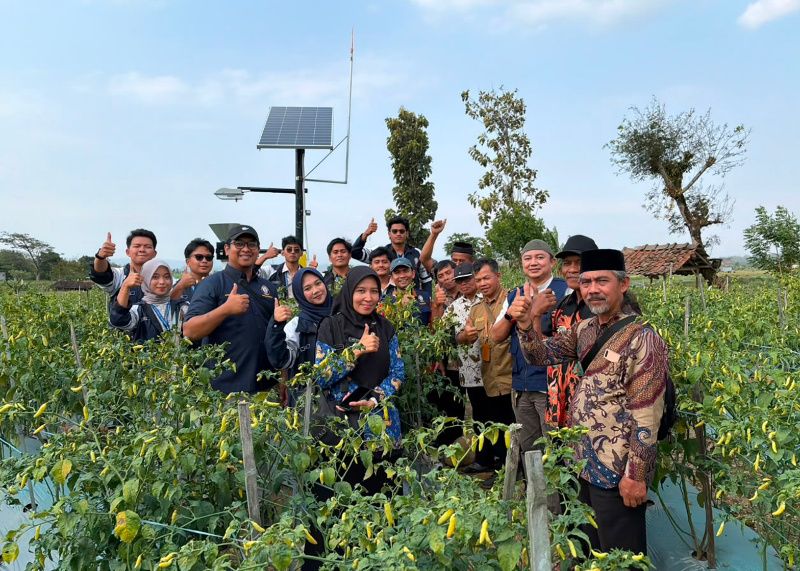
Nicholaus Ferdinand, who is responsible for developing the light trap, said the students designed the system from the initial stages, taking into account the agricultural needs of Campuranom Village.
“We developed this device from scratch, starting from developing the concept, selecting components, designing the energy system, sensors, and blower, to constructing the device structure. We added several innovations to make the light trap more adaptable to field conditions, easy to move, energy-efficient, and more practical for farmers to use,” Nicholaus said.
The development of the device focuses not only on its ability to capture insects. Data on pest species and their occurrence patterns are also expected to help farmers determine more appropriate control measures while reducing the unnecessary use of chemical pesticides.
Masterplan as a Development Roadmap for the Village
The masterplan was prepared based on studies of the village’s potential and challenges, field observations, discussions with the village government, and assessments conducted by students from various disciplines. The findings were then translated into interconnected stages of development through 2034.
Ardy Wibowo, Ph.D., explained that the masterplan is expected to serve not merely as a planning document but also as a shared roadmap for the consistent and sustainable development of Campuranom Village.
“We hope this masterplan will help the village government determine development directions and priorities based on the community’s potential and needs. Regenerative, circular, and sustainable principles serve as the foundation so that development not only generates economic benefits but also restores the environment, strengthens the agricultural sector, and enhances community capacity,” Ardy said.
According to him, the masterplan can also help the village government build collaborations with universities, government institutions, businesses, and various development partners. This will help ensure continuity in program implementation even when there are changes in program implementers or village leadership.
The masterplan is aligned with the vision for developing an agricultural tourism village outlined in the Campuranom Village Medium-Term Development Plan (RPJMDes). The village’s natural beauty, fertile soil, and agricultural activities serve as key assets for developing tourism based on agriculture, the environment, education, and technology.
Campuranom Village Head Wirawan, S.T., expressed hope that the masterplan would serve as a realistic development guideline that could be implemented gradually.
“We hope that by 2034, Campuranom Village will develop into a technology-based agricultural tourism village that continues to preserve its natural environment and identity as an agrarian area. This masterplan can serve as a guide so that development proceeds in a focused and gradual manner and provides tangible benefits for the community,” Wirawan said.
He also expressed hope that the programs formulated could continue after the KKN program ends through collaboration among the village government, community, UNDIP, and other partners.
Some Campuranom residents have already begun adopting more sustainable agricultural practices, such as using plant-based fertilizers and pesticides. These practices provide an initial foundation for developing agriculture that is oriented not only toward production but also toward soil health, ecosystem balance, and resource sustainability.
Five Pillars of Campuranom’s Development
The Campuranom Village Masterplan is based on five main pillars that connect agriculture, the environment, energy, the economy, and institutional development.
The first pillar is Regenerative Agriculture and Soil Health. This pillar focuses on restoring soil fertility and health, reducing dependence on chemicals, utilizing organic materials, and developing more environmentally friendly cultivation practices.
The second pillar, Biomass, Waste, and Settlement Circularity, focuses on managing agricultural biomass and household waste for reuse. Waste is not viewed merely as something to be discarded, but also as a potential resource that can be processed into compost, raw materials, and products with economic value.
The third pillar is Water, Irrigation, and Climate-Resilient Landscapes. Programs under this pillar include water resource management, irrigation system improvements, land conservation, erosion risk reduction and strengthening the village’s capacity to respond to changing climate conditions.
The fourth pillar, Clean Village Energy, promotes the use of renewable energy sources to support community needs and agricultural activities. One of the proposed programs is the development of a micro-hydropower plant (PLTMH), as farmers still need access to electricity in agricultural fields.
The fifth pillar is Downstream Development, Local Economy, and Institutions. This pillar focuses on processing agricultural products, strengthening marketing, developing value-added products, and reducing farmers’ dependence on middlemen. Strengthening community groups and village institutions is also necessary to ensure that each program can be managed independently and sustainably.
Akhtar Rasyad, coordinator of the masterplan development team, explained that preparing the document required cross-disciplinary coordination because the various challenges faced by the village are interconnected.
“The masterplan was developed by integrating the findings of students from various fields. Agriculture, energy, waste management, irrigation, conservation, downstreaming of products, and institutional development cannot be planned in isolation. All of them need to be connected through clear development stages leading up to 2034,” Akhtar explained.
According to him, one of the main challenges in preparing the masterplan was ensuring that the proposed programs matched community needs and could be implemented gradually. Each program needs to consider available resources, potential stakeholders, indicators of success, and the expected impact on the village.
Creating Benefits for the Community and UNDIP
Farmers are among the primary beneficiaries of this program. The masterplan and smart light trap innovation are expected to support pest control, improve soil health, expand access to energy in agricultural fields, improve water management, promote land conservation, and increase the added value of agricultural products.
Local businesses also have the potential to benefit through the development of processed products, stronger marketing, and the creation of agricultural tourism activities. Meanwhile, the village government gains a development roadmap that can serve as a reference for program planning, budgeting, and partnership development through 2034.
At Universitas Diponegoro, the program offers an opportunity to apply science and technology directly to address community challenges. Collaboration among students and lecturers from various disciplines connects agriculture, engineering, energy, the environment, administration, development planning, and the local economy.
The masterplan and smart light trap prototype also serve as a community-needs-based service portfolio that can be further developed through education, research, and community service activities. This approach has the potential to serve as a mentoring model for other agrarian villages, with adaptations tailored to the characteristics and needs of each area.
Through collaboration among students, lecturers, the Campuranom Village Government, and the local community, UNDIP reaffirms its commitment to delivering innovations that do not remain mere ideas but provide tangible solutions and benefits for society.
The program reflects the spirit of “Noble and Valuable UNDIP” and the “Diktisaintek Berdampak” initiative while supporting the achievement of the Sustainable Development Goals (SDGs), particularly Zero Hunger; Affordable and Clean Energy; Decent Work and Economic Growth; Responsible Consumption and Production; Climate Action; Life on Land; and Partnerships for the Goals. (Public Communication/UNDIP/Ardy Wibowo, Ph.D. and Team)