

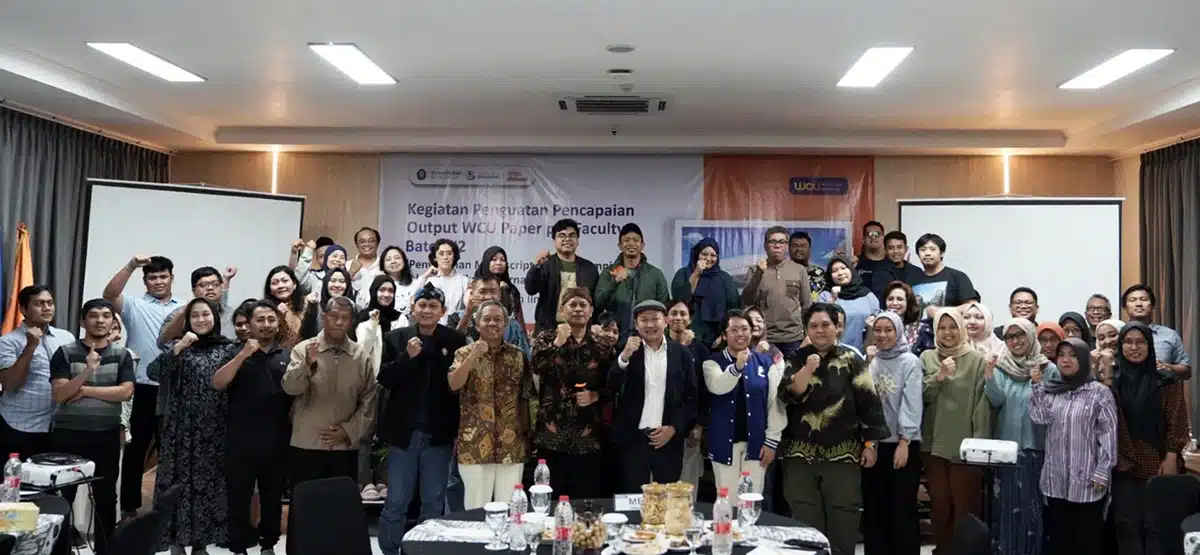
UNDIP, Jepara (November 28–30, 2025) – The Faculty of Social and Political Sciences (FISIP), Universitas Diponegoro (UNDIP), successfully held the Writing Camp for Strengthening WCU Paper Output per Faculty, Batch 2 at the UNDIP Jepara Campus. This activity was a continuation of Batch 1 and a reinforcement of FISIP’s institutional strategy to foster a culture of scientific writing as a foundation for becoming a World Class University (WCU).
Lecturers from the Departments of Communication Studies, Business Administration, and International Relations attended batch 2. The event was attended by the Dean of FISIP UNDIP, Dr. Drs. Teguh Yuwono, M.Pol.Admin., Vice Dean I S. Rouli Manalu, Ph.D., and Vice Dean II Ika Riswanti Putranti, Ph.D.
In his remarks, the Dean of FISIP UNDIP emphasized that the Writing Camp activity holds strategic value in supporting the grand vision of Universitas Diponegoro.
“Carry out this activity with good intentions and full commitment. Our scientific writings are an important part of realizing Universitas Diponegoro’s vision. One of UNDIP’s strategic objectives is to enhance its academic and research reputation at the international level,” he emphasized.
Vice Dean II of FISIP UNDIP, Ika Riswanti Putranti, Ph.D., reaffirmed that this activity serves as an important space for strengthening lecturers’ capacity in international scientific publications.
“This program is our collective effort in writing publications. Hopefully, it can meet both faculty and university targets. It is expected to be held regularly in the future. Manuscript practice and submission to international journals are the key elements of this activity,” Ika Riswanti said.
The event became even more meaningful with the presence of the Vice Rector IV for Research, Innovation, Collaboration, and Public Communication, Wijayanto, Ph.D., who delivered an inspiring reflection on the importance of a writing culture in higher education.
“In the past, after returning from my doctoral studies in the Netherlands, I imagined how wonderful it would be if lecturers gathered not only in meetings, but also in writing forums. Today, I am witnessing that dream come true. This activity is very strategic for UNDIP’s World Class University program. Believe me, we can all be productive, and we are on the right track,” he stated.
On the first day, participants attended a scholarly presentation by Prof. Drs. Sudharto Prawata Hadi, MES, Ph.D., who emphasized the role of social responsibility in academic work.
“Scientific writing is a form of our accountability to the public. It becomes a reference, shapes discourse, and safeguards the dignity of higher education institutions as centers of thought,” Prof. Sudharto explained.
Entering the second day, the Writing Camp was filled with intensive writing and mentoring sessions. At the end of the day, a progress review of all Groups of Expertise (KBK) was conducted under the Dean’s direct leadership. As a result, more than 20 scientific manuscripts were successfully submitted to international scientific journals on the second day alone.
On the final day, the final review session focused on manuscript refinement and strengthening the follow-up publication plans of each KBK. Overall, this activity produced approximately 85 potential scientific manuscripts, ready for development toward publication in reputable international journals.
The Heads of KBK and participants responded positively to the activity and expressed their hope that similar programs would be held regularly for all departments.
In closing the event, the Dean expressed his appreciation for the participants’ enthusiasm and encouraged all lecturers to make the Writing Camp part of FISIP’s academic culture.
The Dean also stated that this program will be conducted regularly starting next year, considering the practical benefits and tangible results achieved.
“Starting next year, we will hold the Writing Camp regularly because it has proven to be very beneficial, both in improving the quality of manuscripts and in encouraging a writing culture within FISIP,” he concluded. (Public Communication/UNDIP/FISIP Team)