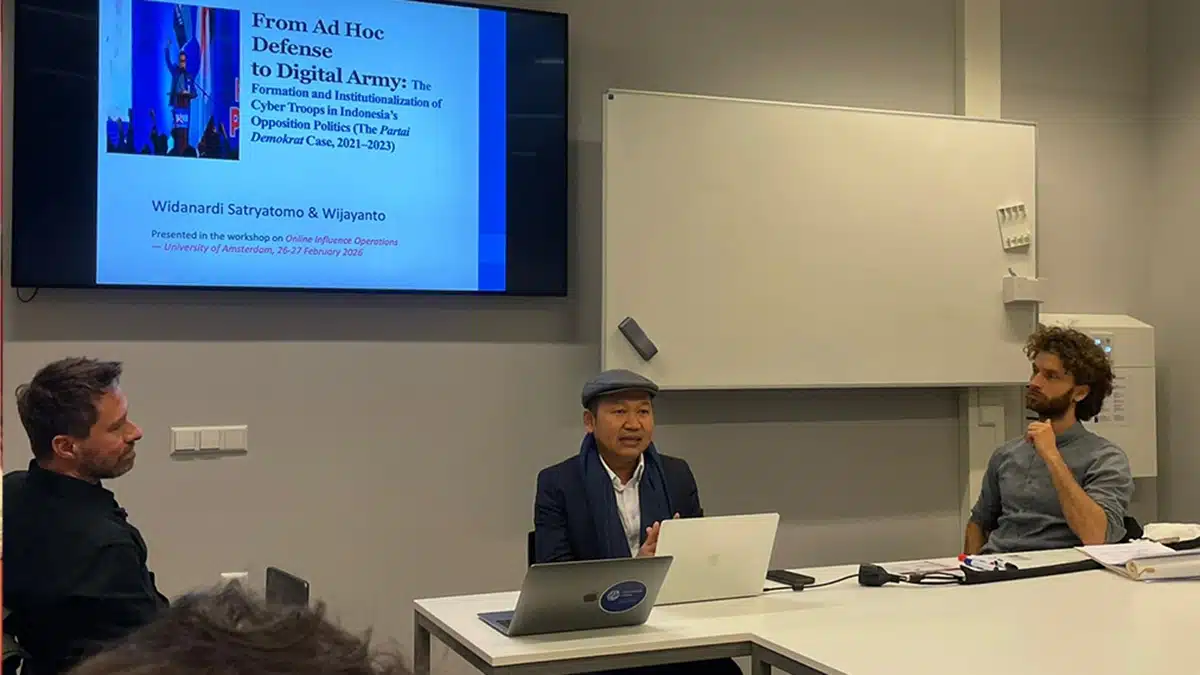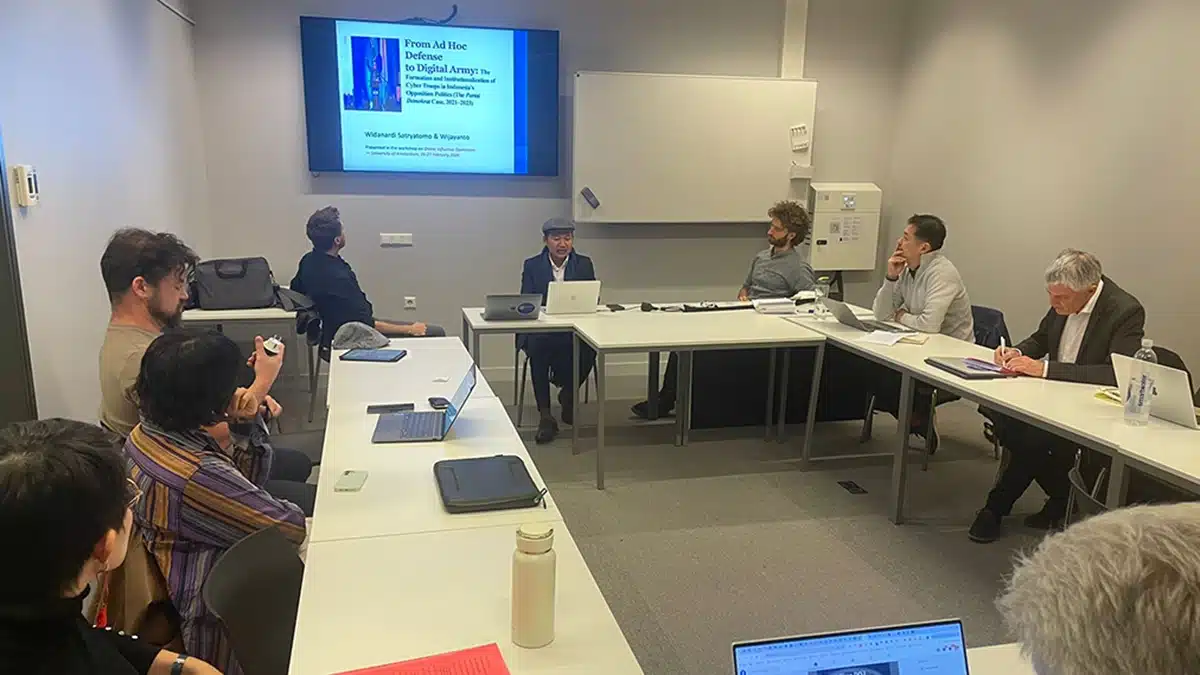

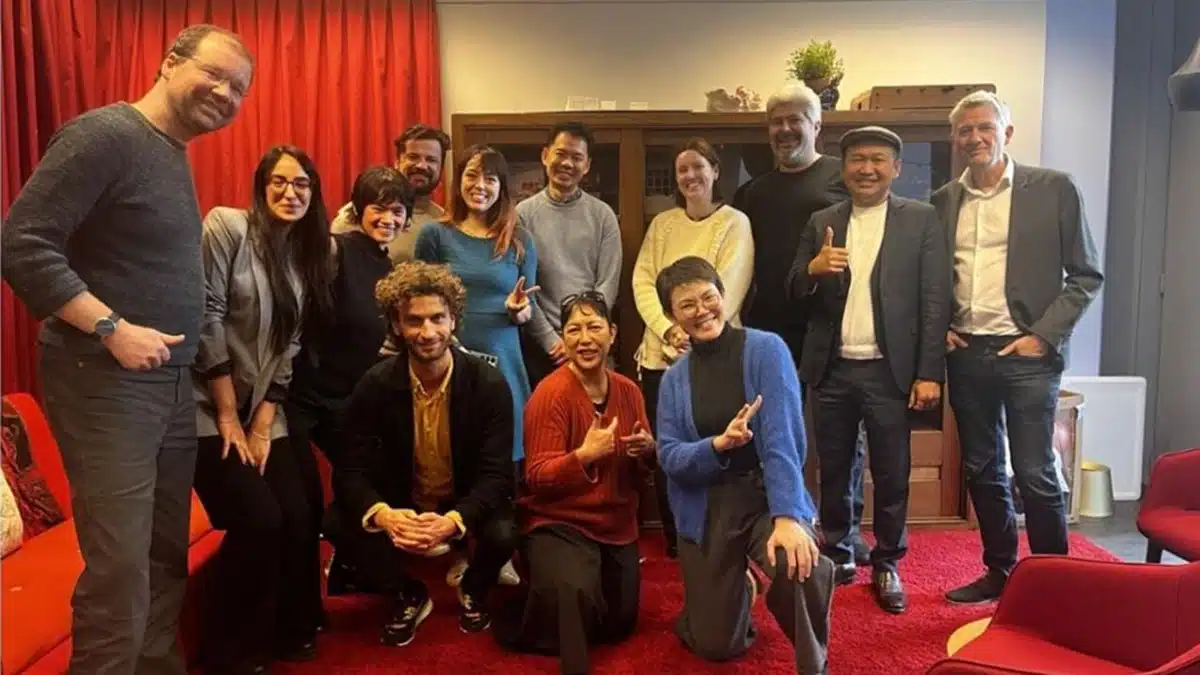
UNDIP, Amsterdam (26–27/2) – In the University of Amsterdam’s discussion rooms, academics from various continents gathered to bring together diverse perspectives and examine a defining phenomenon of our time: the infrastructure of influence operations that increasingly shapes the global digital landscape. Supported by the Netherlands Organisation for Scientific Research, the discussions bridged research on this issue occurring in Russia, Southeast Asia, the Middle East, Europe, Taiwan, and North Africa.
The meeting addressed a growing reality: the disinformation industry is no longer a sporadic occurrence but a systematic phenomenon. It has become entrenched, interconnected, and transnational, driven not only by algorithms but also by human actors, resources, and ideologies that are closely linked. Its impact extends to election processes, democratic systems, governance, and even society’s collective ability to respond to crises such as climate change.
Wijayanto, S.IP., M.Si., Ph.D., who represented Asia, viewed the forum not merely as an academic gathering but as a call to take responsibility for building a sustainable global research network—particularly to contribute to a special journal issue currently being prepared on the topic of influence infrastructure. The initiative also aims to pioneer long-term monitoring of disinformation challenges, inspired by research findings initiated by the University of Oxford on cyber troops and computational propaganda.
Ultimately, the conference was not only about papers and panels but also about a shared moment when differences in accents, histories, and political contexts converged in a common realization: the world is facing a similar global phenomenon.
At the conclusion of the conference, participants agreed on several strategic steps:
First, participants concluded that the disinformation industry and influence operations have become an increasingly massive and structured global phenomenon. Disinformation infrastructure is not solely technology- and algorithm-based but is also supported by networks of actors, organizations, funding sources, and interconnected ideologies. Its impact is evident on the quality of democracy, governance, social cohesion, and society’s collective capacity to address global issues such as climate change.
Second, participants agreed to prepare a special issue of an international journal that will compile findings from multiple regions. The initial draft is planned to be completed by the coming autumn as a concrete form of cross-national academic collaboration.
Third, and most strategically, participants committed to building long-term collaborative monitoring of the global disinformation industry. The objective is to conduct systematic, comparative cross-country monitoring, enabling the dynamics of influence operations to be regularly mapped using empirical data.
This initiative was inspired by practices carried out by the University of Oxford, as documented in publications such as “The Rise of the Disinformation Industry,” “Cyber Troops,” and “Computational Propaganda,” which periodically map the actors, strategies, and infrastructures of digital propaganda across countries. The approach highlights the importance of sustained observation and cross-regional collaboration.
The network established through this conference is committed to:
- developing periodic mapping of actors and infrastructures behind influence operations;
- building a comparative cross-country database;
- producing serial and thematic publications; and
- disseminating findings to policymakers, civil society, and the international community.
The meeting also marked the final phase of the 2022–2026 research collaboration on Cyber Troops and Social Media Influence Operations in Southeast Asia, conducted together with Ward Berenschot, Yatun Sastramidjaja, Kris Ruijgrok, Janjira Sombatpoonsiri, Fatima Gaw, and other colleagues. What once began as a regional collaboration has now evolved into a global network.
This step marks an important shift: studies on influence operations are no longer conducted separately or in short-term projects, but are now directed toward building a sustainable, structured global research network. Regional collaboration has opened new horizons, and global partnerships strengthen UNDIP’s commitment to advancing toward World-Class University status. (Public Communication / UNDIP)