
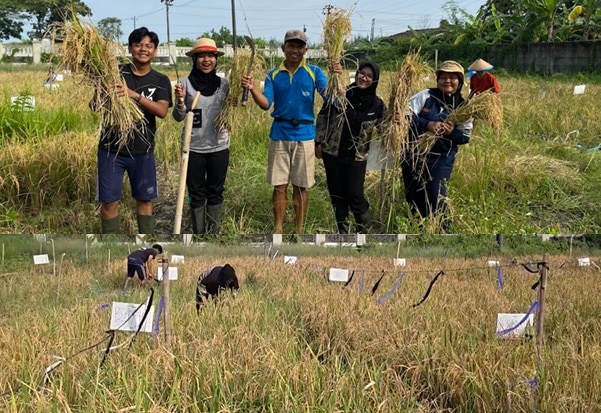
UNDIP, Jepara, Central Java (6/4) – Universitas Diponegoro (UNDIP), through its team of researchers and students, conducted the first harvest of Biosaline Rice + Biochar in the Teluk Awur area, Jepara Regency. This activity marks an initial step toward developing adaptive agricultural innovations for coastal lands with high salinity and alkalinity.
The Biosaline Rice + Biochar innovation was developed by Prof. Dr. Ir. Florentina Kusmiyati, M.Sc., along with fellow lecturers Anasrullah, S.P., M.S., Nani Kitti Sihaloho, M.P., and Bagus Herwibawa, S.P., M.P., Ph.D., as well as a team of Agroecotechnology students at UNDIP: Aisyah Sri Rahayu, Ifarel Noer Amanda, Listyana Arum Hapsari, and Syah Syafiq Muthawa’arief.
This innovation is driven by the condition of coastal land in Jepara, which has high salinity and alkalinity, resulting in low conventional rice productivity. Through this approach, a rice variety capable of adapting to such marginal land conditions has been developed. In addition to using adaptive varieties, the innovation also incorporates Biochar as a soil amendment to improve soil physical and chemical properties, enhance nutrient retention, and reduce the impact of salinity stress.
This harvest marks the first yield, which is expected to be independently cultivated by local farmers in the future. The results are encouraging: the biosaline rice demonstrated good growth, high survival rates, and optimal panicle formation despite suboptimal soil conditions. This harvest indicates strong potential for further development in coastal areas.
Compared to conventional rice varieties, biosaline rice offers a key advantage in its ability to adapt to soils with high salt content and pH levels. The application of Biochar significantly improves soil conditions and helps reduce greenhouse gas emissions. Early impacts observed include the reuse of less productive land, improved plant stability under stress, potential increases in farmers’ income, and sustainable use of marginal land.
This program is supported by the National Research and Innovation Agency (BRIN), which provides biosaline rice seeds. UNDIP serves as the academic partner, providing research funding, technical assistance, and technology implementation to ensure the innovation can be applied directly and sustainably in the field.
The collaboration between UNDIP and BRIN is expected to accelerate the development of biosaline rice as an adaptive agricultural solution for Indonesia’s coastal regions. In the future, this innovation will be tested on a larger scale to obtain more comprehensive production data.
Prof. Dr. Ir. Florentina Kusmiyati, M.Sc., stated that this innovation is a concrete effort to address agricultural challenges in coastal areas. “We developed biosaline rice + Biochar as an adaptive solution for land with high salinity and alkalinity. Through this initial harvest, we see great potential to improve coastal land productivity while supporting food self-sufficiency,” she explained.
Meanwhile, the Rector of Universitas Diponegoro, Prof. Dr. Suharnomo, M.Si., emphasized that this innovation reflects UNDIP’s commitment to delivering real solutions for society. He also highlighted the importance of collaboration in developing research-based innovations. “We encourage synergy among academics, government, and communities so that innovations like biosaline rice + biochar can be implemented more widely and sustainably,” he stated. This innovation is expected to become a strategic solution in supporting national food security, particularly through optimizing the use of marginal land in coastal areas. (Public Communication/UNDIP)