


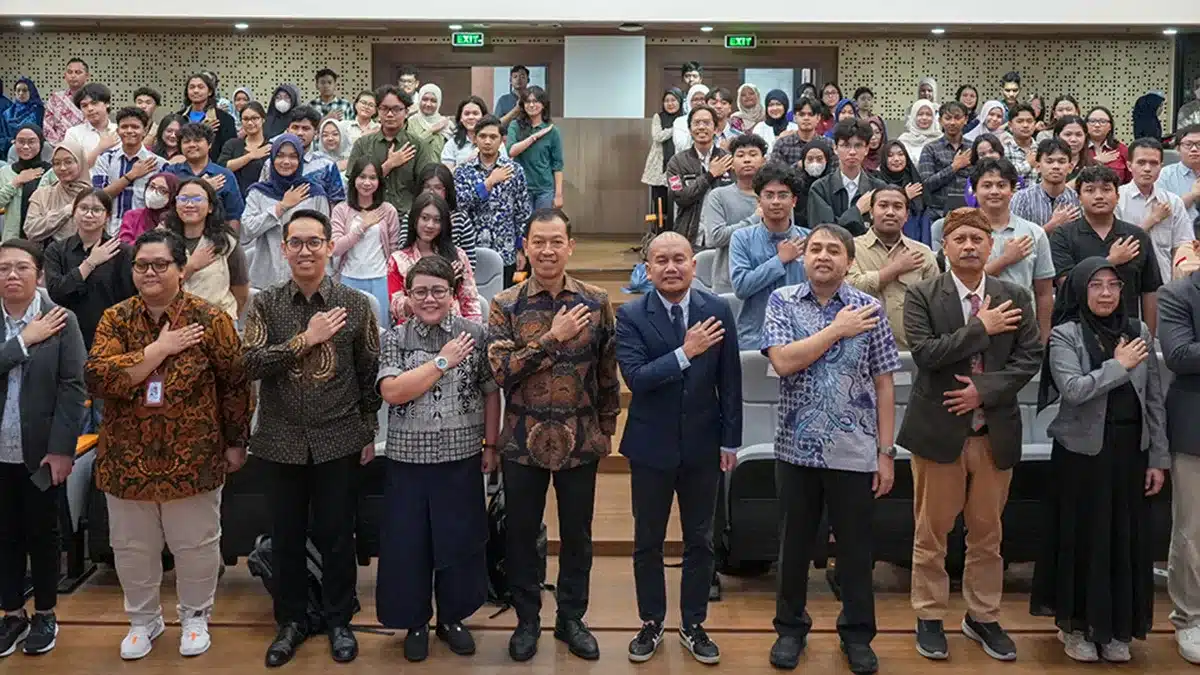
UNDIP, Semarang (7/4) – Universitas Diponegoro (UNDIP), in collaboration with the Ministry of Foreign Affairs of the Republic of Indonesia (MoFA RI) through its Directorate of Public Diplomacy, organized a Public Diplomacy lecture themed “Indonesia’s Maritime Diplomacy: Mainstreaming Soft Power in Sovereignty and Law of the Sea Issues.” The event took place on Tuesday, April 7, 2026, at the 5th Floor ICT Building, UNDIP Tembalang Campus. It was attended by university leaders, faculty representatives, officials from the MoFA RI’s Directorate of Public Diplomacy, and UNDIP students.
In his opening remarks, the Vice Rector for Academic and Student Affairs, Prof. Dr.rer.nat. Ir. Heru Susanto, S.T., M.M., M.T., expressed appreciation for the collaboration. “We should be grateful to participate in this Public Diplomacy event. Hopefully, it broadens our understanding of maritime diplomacy,” he stated.
He also reminded the audience that Indonesia, as an archipelagic nation, bears great responsibility in managing and safeguarding its maritime territory. “Living in an archipelagic and maritime country is a blessing. However, we must also engage in diplomacy with other nations to ensure sovereignty in utilizing our natural resources for the welfare of the Indonesian people,” he added.
Ani Nigeriawati, Director of Public Diplomacy at MoFA RI and an alumna of FISIP UNDIP, highlighted the ongoing partnership between MoFA and UNDIP. “Public Diplomacy Goes to Campus is part of the partnership between MoFA RI and UNDIP, enabling this event to be successfully held,” she said.
She emphasized the importance of maritime diplomacy, particularly in Semarang, as a port city that has long served as a gateway for Indonesia’s interaction with the world. “It is very relevant to discuss maritime diplomacy in Semarang, given its historical role as a port city and an entry point for global interaction,” she explained.
During the session, the Director General of Information and Public Diplomacy at MoFA RI, Heru Hartanto Subolo, delivered a lecture on maritime public diplomacy and stressed the importance of building public awareness that the sea represents Indonesia’s identity, economic strength, and strategic space. “Therefore, society must understand maritime diplomacy, and UNDIP should also take part in this effort,” he stated.
The discussion continued with Dr. Gulardi Nurbintoro, Deputy Director for Territorial Law and Treaties at MoFA RI, who presented on the ongoing diplomatic efforts led by Mochtar Kusumaatmadja to secure recognition of Indonesia as an archipelagic state through complex international negotiations, culminating in its acknowledgment in UNCLOS 1982.
“Since independence, this has been continuously pursued to ensure sovereignty over marine resources and prevent foreign vessels from entering Indonesian waters freely—until finally recognized in 1982, expanding from 3 miles to 12 miles,” he explained.
The discussion was moderated by Robetmi Jumpakita Pinem, S.AB., MBA., Ph.D., Secretary of the Undergraduate Business Administration Program. Prof. Ika Riswanti Putranti, Ph.D., a professor at FISIP UNDIP, served as a discussant and reinforced the speakers’ views on the strategic importance of the maritime sector. “The sea holds extraordinary strategic value. Indonesia’s future lies in its oceans,” she stated.
The event concluded with a screening of the film “12 Mile: Guiding The Archipelago,” which highlights the exemplary contributions of Mochtar Kusumaatmadja, a diplomat and former Indonesian Foreign Minister, in expanding Indonesia’s maritime sovereignty from 3 miles to 12 miles.
The film’s producer, Dr. M. Agus Imanuddin, S.H., M.Si., explained that the film was created to introduce Mochtar Kusumaatmadja’s significant contributions to Indonesia’s maritime sovereignty. “Many people are not familiar with Mochtar Kusumaatmadja, even though his contributions are immense. This film aims to make his legacy better known, especially among the younger generation,” he concluded. (Public Communication/UNDIP)