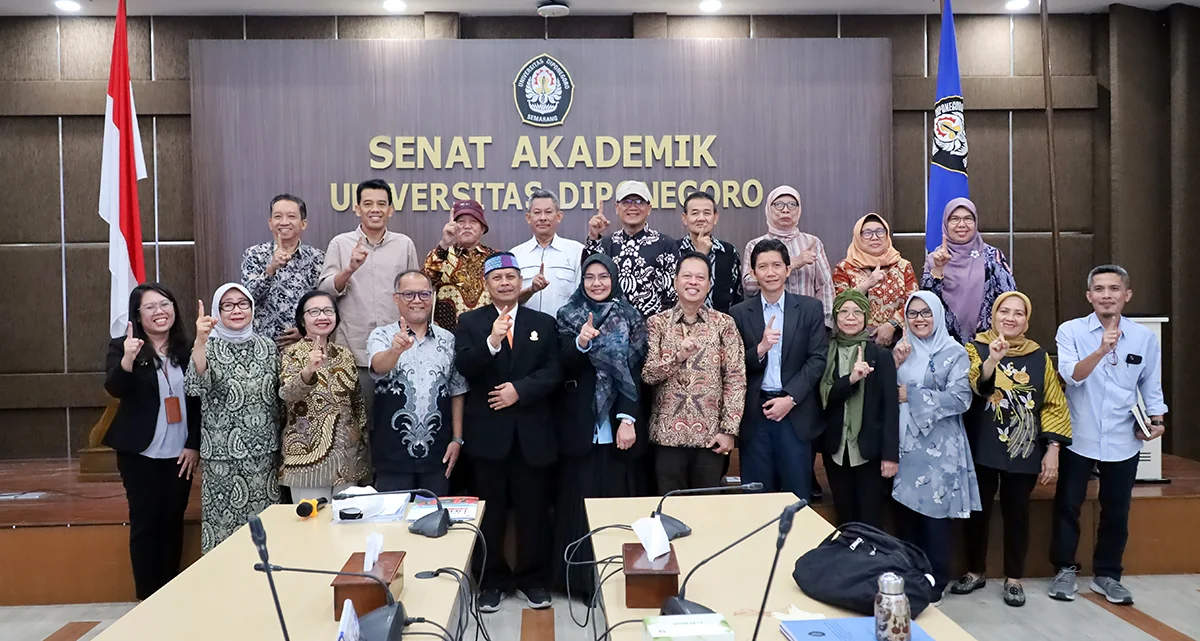


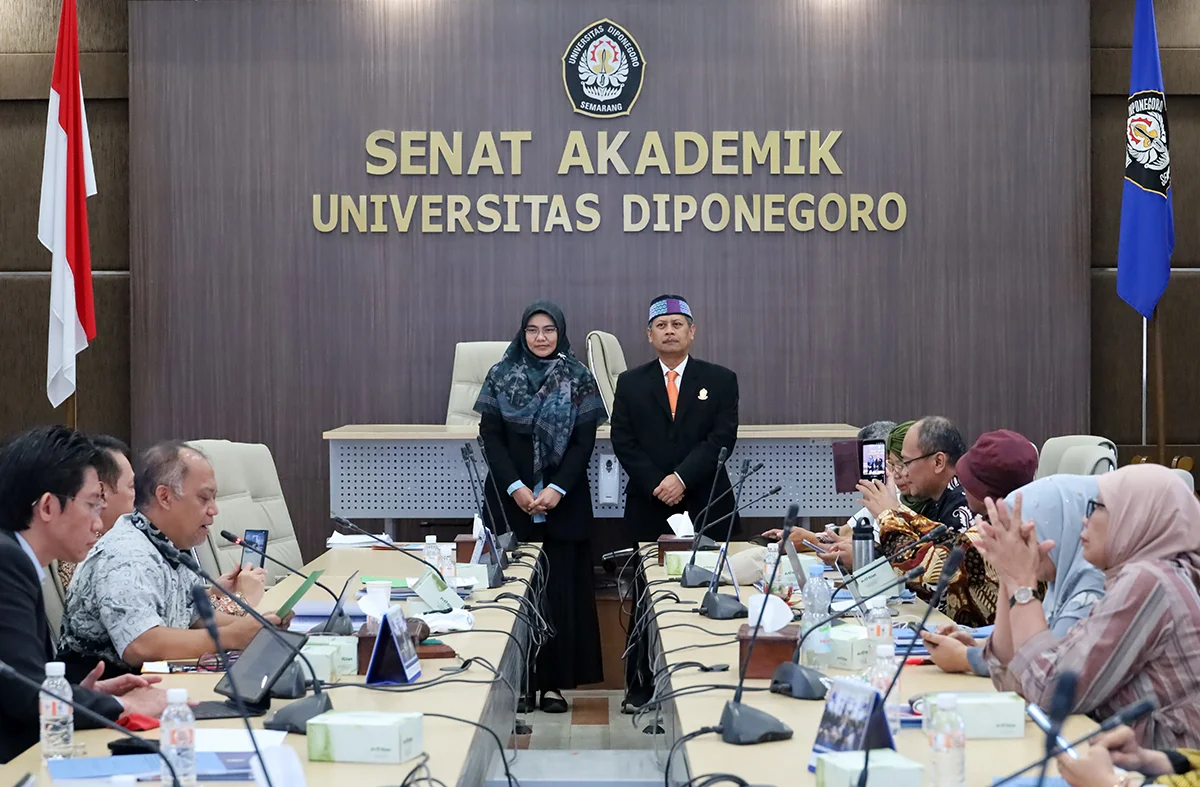
UNDIP, Semarang (10/6) – Universitas Diponegoro (UNDIP) once again held a scientific paper presentation session for two candidates for professorships, organized by the UNDIP’s Board of Professors on Wednesday, June 10, 2026, at 09:00 a.m. in the Academic Senate Meeting Room, 3rd Floor, SA-MWA Building, UNDIP Tembalang Campus.
The two professor candidates presenting their scientific papers were Dr. Drs. Teguh Yuwono, M.Pol. Admin from the Department of Politics and Government, Faculty of Social and Political Sciences, and dr. Muflihatul Muniroh, M.Si.Med., Ph.D. from the Faculty of Medicine.
In the first presentation session, Dr. Drs. Teguh Yuwono, M.Pol. Admin presented a paper titled “Building Relational Governance through the Integration of Politics and Administration toward Social Welfare in Indonesia.” He highlighted that institutional changes following Indonesia’s reform era and decentralization have not automatically led to effective governance due to persistent local political distortions, bureaucratic politicization, sectoral ego, and the limitations of conventional good governance approaches, which are often overly administrative and rigid.
Drawing on two decades of research, Dr. Teguh proposed the concept of Relational Governance. This new approach places the quality of relationships and levels of trust among stakeholders as the primary foundation for inclusive governance. For this model to succeed, several prerequisites are essential, including strengthening social capital, encouraging active public participation through people-centered development, utilizing digital governance, and developing institutions that are adaptive to crises.
Dr. Teguh emphasized that the integration of politics and administration must ultimately lead to substantive outcomes, namely the realization of tangible social welfare through improved quality of life, poverty reduction, lower stunting rates, and stronger protection for vulnerable groups in Indonesia.
dr. Muflihatul Muniroh, M.Si.Med., Ph.D., delivered the next presentation entitled “Regulation of the Reproductive System under Prenatal Mercury Exposure and Its Impact on Maternal Health and Child Development: An Approach through Inflammatory Mechanisms, Oxidative Stress, and Genetic Variations in In Vitro, In Vivo, and Human Studies.”
Through her research, dr. Muflihatul focused on the effects of prenatal mercury exposure on reproductive systems, maternal health, and child growth and development.
She explained that Indonesia’s dual burden of malnutrition and stunting is not solely caused by inadequate nutritional intake but is also exacerbated by heavy metal contamination, particularly mercury (Hg). According to dr. Muflihatul, consuming fish from contaminated environments releases methylmercury (MeHg), which rapidly binds with cysteine in the body. Because its structure resembles the essential amino acid methionine, this hazardous compound can easily cross both the blood-brain barrier and the placenta, accumulating in the fetus.
Based on in vitro and in vivo studies, sublethal mercury exposure has been shown to increase levels of inflammatory cytokines (such as IL-6, MIP-2, and IL-8) and oxidative stress, leading to neuroinflammation, reduced Purkinje cell numbers in the brain, and clinical symptoms such as ataxia.
In population studies conducted in the coastal areas of Semarang, Jepara, and Mamuju, dr. Muflihatul found that high daily intake of mercury (DIM) from seafood was negatively correlated with hemoglobin (Hb) levels, significantly increasing the risk of anemia among pregnant women. Furthermore, elevated maternal hair mercury levels combined with a history of cardiovascular disorders substantially increased the risk of gestational hypertension and preeclampsia.
For fetuses and children, prenatal mercury toxicity may result in various obstetric complications, including premature birth, low birth weight, reduced head circumference at 18 months of age, and a higher risk of stunting. The body’s response to mercury toxicity is also strongly influenced by individual genetic variations, including polymorphisms in the GSTT1, GSTM1, GSTP1, and GPX1 genes, which regulate mercury metabolism and excretion.
These presentations demonstrate UNDIP’s contribution through the downstream application of innovative ideas and research-based scientific solutions. Universitas Diponegoro continues to affirm its strategic role as a center for knowledge development that directly contributes to accelerating national development. The policy recommendations generated by these studies are expected to provide practical academic guidance for policymakers in governance and public health, supporting the realization of “Noble and Valuable UNDIP”. (Public Communication/UNDIP/Riri)