



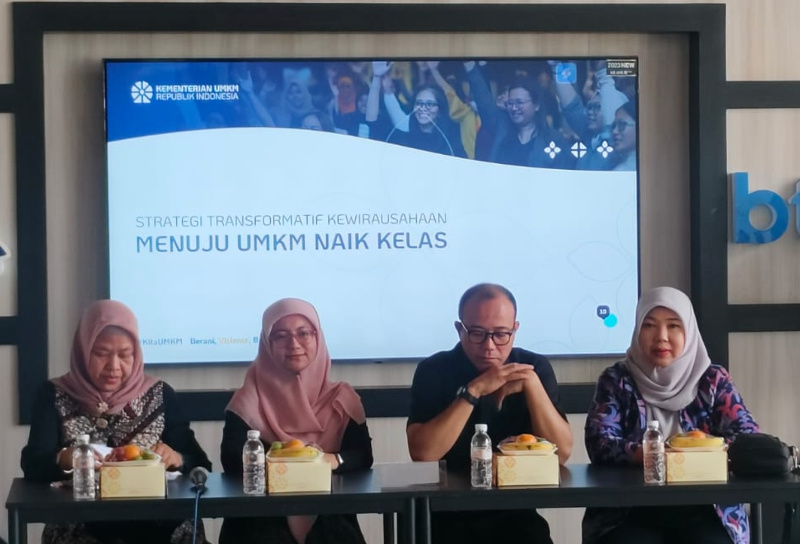
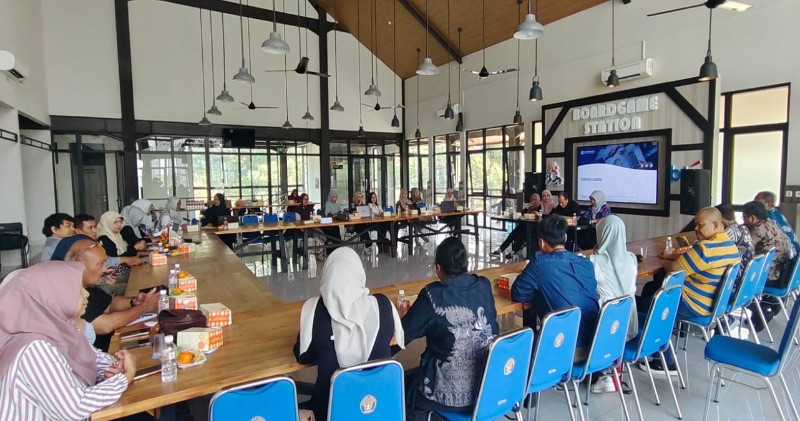
UNDIP, Semarang (2/7) – Held at DIPO HUB on the UNDIP Tembalang Campus, Universitas Diponegoro, through the KKIB Faculty of Economics and Business, the Office of Research Commercialization and Business Incubation (KHIB), and the Directorate of Innovation and Cooperation, in collaboration with Indonesia’s Ministry of Micro, Small, and Medium Enterprises (MSMEs), organized a forum entitled “Transformative Entrepreneurship Strategies for Advancing MSMEs.” The event aimed to strengthen synergy among universities, government agencies, business incubators, and industry stakeholders in building an innovative and sustainable entrepreneurial ecosystem.
The forum served as a strategic platform for business incubator managers across Central Java to discuss strengthening incubator capacity, developing innovation-based tenants, and aligning incubation programs with the Ministry of MSMEs’ national policies. Through this initiative, UNDIP reaffirmed its commitment to serving as a center of innovation that not only produces research but also transforms innovations into products and businesses that generate tangible benefits for society.
In her opening remarks, Dian Harjanti, Director of Innovation and Cooperation at Universitas Diponegoro, emphasized that UNDIP possesses significant innovation potential through the work of its lecturers, students, and researchers. She noted that this potential must be supported by a strong incubation ecosystem capable of producing competitive technology-based startups and MSMEs. Dr. Dian expressed hope that UNDIP’s assisted tenants and incubators throughout Central Java could collaborate with the university’s innovations to create value-added products, open new business opportunities, and contribute to the welfare of communities in Central Java and across Indonesia.
UNDIP is also developing collaboration between student-founded and faculty-founded startups within an integrated innovation ecosystem. Through this approach, the commercialization of research outcomes is expected to extend beyond academic outputs, evolving into sustainable enterprises that generate economic impact. The university is also encouraging mentorship support from the Ministry of MSMEs for commercialization-based tenants, similar to the assistance schemes already implemented through the Hiliriset program.
During the forum, Riza Damanik, Deputy for Micro Enterprises at the Ministry of MSMEs, presented the government’s national entrepreneurship transformation strategy through strengthening the business incubator ecosystem as a key instrument for developing resilient entrepreneurs and helping MSMEs move to the next level.
Riza Damanik explained that the Ministry’s priorities for 2026 include developing national policies and standards for incubation programs, strengthening incubator information systems through the ‘SAPA UMKM’ platform, implementing rankings of incubator institutions, and facilitating strategic support for business development. These efforts are intended to improve incubator quality, entrepreneurial capacity, access to financing, business legality, digital transformation, and market expansion.
He further noted that there are currently 754 incubator institutions registered with the Ministry of MSMEs and operating across various provinces in Indonesia. These incubators are expected to become key drivers in developing innovative and adaptive entrepreneurs capable of generating value for the national economy.
Riza also outlined the comprehensive tenant development process, which includes open calls and selection stages, boot camps, business matching sessions, coaching clinics, and monitoring and evaluation activities. In addition, the Ministry has developed the Outstanding Entrepreneur Exchange Program (Bursa Wirausaha Unggulan), which connects entrepreneurs with financing opportunities, licensing services, prospective buyers, business partners, digitalization support, and showcases of top-performing tenants from incubators nationwide.
Through this collaborative approach, the Ministry aims to help more entrepreneurs scale their businesses and contribute to both regional and national economic growth. The presentation aligns closely with UNDIP’s vision of building an innovation ecosystem that bridges research outcomes with industry and societal needs. Through collaboration with the Ministry of MSMEs, UNDIP is optimistic that more campus innovations can be commercialized into flagship products while fostering the emergence of new entrepreneurs capable of competing at national and global levels.
Desy Arijani, Acting Head of the Central Java Provincial Cooperative and MSME Office, added that strengthening MSMEs should not focus solely on production but must also address marketing, financing, legal compliance, and business development. According to her, a people-centered economy can only be built through collaboration among government institutions, universities, businesses, cooperatives, and communities, creating a sustainable MSME empowerment ecosystem.
The forum was attended by 40 participants representing various business incubators across Central Java, including Bynari Incubator, Hetero Incubator, IKTAS Business Incubator, Kampoeng Indonesia Peduli Business Incubator, KKIB Business Incubator, MWU NU Pabelan Business Incubator, Hasan Asy’ari Incubator, UNNES LPPM Business Unit Incubator, INWINOV, Nakerpreneur, Nawasena Business Lab, Semai Bisnis Sukses (SBS), Semarang Technopark, Sinersia Business Incubator, UDINUS Business Incubator, Solo Technopark, UKSW Technology Business Incubator, UNS Innovation, UPTD PLUT KUMKM Semarang City, KHIB UNDIP, and the UNDIP Directorate of Innovation and Cooperation.
This forum represents a concrete step by Universitas Diponegoro in strengthening the role of higher education institutions as catalysts for innovation and drivers of research-based entrepreneurship. By deepening collaboration with the Ministry of MSMEs, local governments, and business incubator networks, UNDIP remains optimistic about fostering the growth of more advanced, innovative, and globally competitive MSMEs. This initiative reflects Universitas Diponegoro’s commitment to realizing its vision of “Noble and Valuable UNDIP” through innovation and impactful contributions that advance Indonesian society. (Public Communication / UNDIP)