


UNDIP, Boyolali (12/7) — For most dairy farmers, providing drinking water is a routine task carried out several times a day. However, behind this seemingly simple activity lies an important factor that is often overlooked. The continuous availability of drinking water directly affects cattle health, feed intake, and milk productivity. Based on this scientific understanding, a research team from Universitas Diponegoro (UNDIP) has developed an automatic drinking water supply system for dairy cattle, which is now being implemented through the IndoDairy 2 Program.
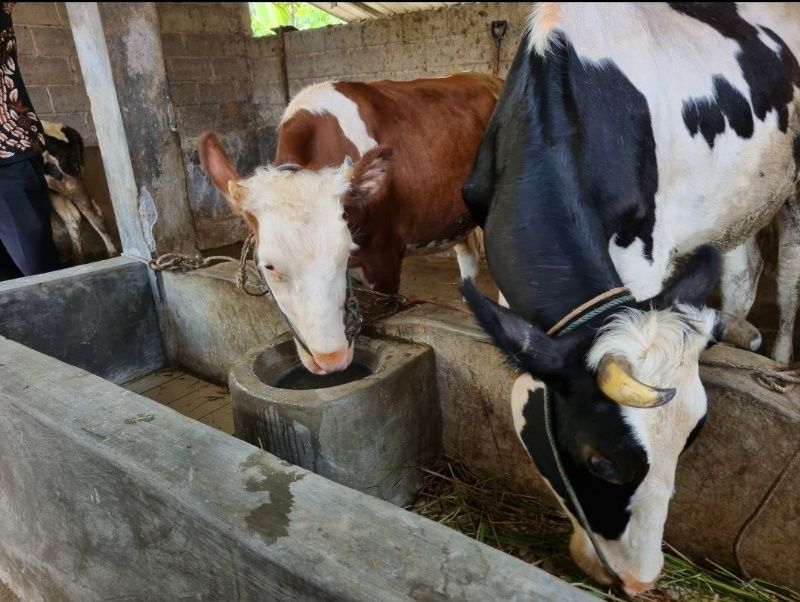
Funded by the Australian Centre for International Agricultural Research (ACIAR), the program is being implemented in Central Java and West Java as part of efforts to improve the welfare of smallholder dairy farmers through the adoption of Good Dairy Farming Practices (GDFP). In Boyolali, one of Central Java’s major milk-producing regions, UNDIP and KUD Mojosongo have installed an ad libitum drinking water system for 24 focus farms, allowing cattle to access water whenever needed without waiting for farmers to refill drinking troughs manually. Before the program was introduced, 70% of farmers in Boyolali lacked dedicated drinking water containers for their cattle. Instead, they provided water mixed with concentrate feed, a practice locally known as the “komboran system.” Under this system, dairy cattle did not have continuous access to drinking water, even though water is a vital requirement for dairy cattle to produce milk.
The program has now been expanded to another 28 assisted farmers in the KUD Musuk area of Boyolali. It will subsequently be replicated in other dairy farming centers across Central Java.
According to drh. Dian Wahyu Harjanti, Ph.D., Project Leader of the UNDIP IndoDairy Team, the assistance does not stop at installing the facilities. It will continue for 18 months through training, technical assistance, monitoring, and capacity building for dairy cooperatives to ensure that the innovation is adopted sustainably by farmers. The assistance also covers feed management and livestock husbandry practices.
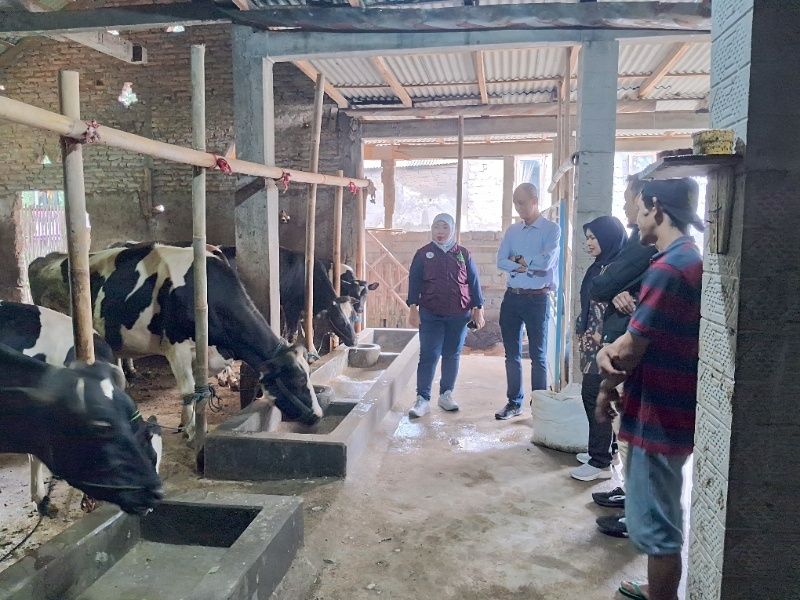
Interestingly, the drinking water technology does not use sensors, microcontrollers, automatic pumps, or electrical networks. The system operates entirely mechanically, using the principle of fluid equilibrium via a floating-valve mechanism. When the water level drops as cattle drink, the buoyant force on the float decreases, causing the valve to open and allowing water to flow automatically. Once the water reaches a certain level, the buoyant force closes the valve again, maintaining the water volume.
The floating valve principle has long been used in water storage tanks. However, the UNDIP Team has developed a new application by adapting the design specifically to the characteristics of dairy cattle housing. The water level is designed to remain at an ideal height, making it easily accessible to cattle, maintaining hygiene, and supporting an ad libitum drinking pattern. Because it operates entirely mechanically, the system is relatively inexpensive, resistant to humid barn conditions, does not require electricity, and can be implemented on smallholder farms with limited infrastructure.
The primary designer of the ad libitum drinking water system is Edi Prayitno, S.Pt., M.Si., a member of the UNDIP IndoDairy Team. According to the research team, the novelty of this innovation does not lie in discovering a new principle of fluid mechanics, but rather in developing a new application of the floating valve mechanism tailored to the drinking-water management needs of dairy cattle on smallholder farms. This approach makes the technology simpler, more affordable, easier to maintain, and more adaptable than electronic sensor-based automatic systems that are widely being developed today.
In addition to installing the automatic drinking water system, the IndoDairy 2 Team trains farmers through cooperative extension teams on the importance of adequate water intake, feed formulation, production recording, and routine monitoring. KUD Mojosongo serves as the main partner, ensuring that the innovations continue to be implemented through field assistance for its beneficiary farmers.
Initial results are beginning to emerge. KUD Mojosongo Chairperson Heni Prihatinningsih said that since the ad libitum drinking water system was implemented, the cattle appear healthier, with smoother and shinier coats. Several farmers have also reported improved milk quality and increased production of up to approximately one liter of milk per cow per day. At the same time, the farmers’ workload has become more efficient because they no longer have to repeatedly provide drinking water manually.
For the UNDIP IndoDairy Team, these results demonstrate that innovation does not always require complex or expensive technology. By appropriately applying basic scientific principles, simple technologies can have a tangible impact on the productivity of smallholder livestock farming. Through collaboration among universities, cooperatives, government institutions, and farmers, the system is expected to serve as a model for more sustainable dairy farming and improve the welfare of Indonesian dairy farmers. (Public Communication/UNDIP/Drh. Dian Wahyu Harjanti, Ph.D., ed. Nurul)