

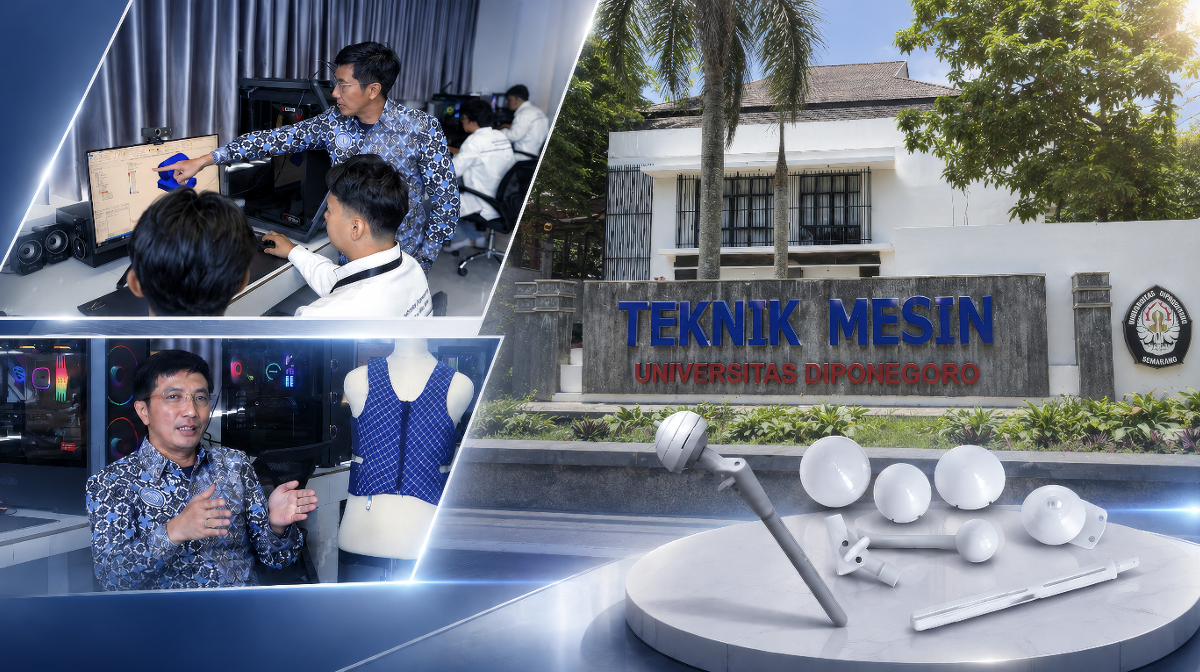
UNDIP, Semarang (26/8) – Who would have thought that the science of friction could help people walk more comfortably, undergo medical treatment, and even continue performing religious movements after receiving a hip implant? This was among the intriguing topics discussed with Prof. Dr. Ir. Jamari, S.T., M.T., IPU., ASEAN Eng., a Professor of Mechanical Engineering and Dean of the Faculty of Engineering at Universitas Diponegoro (UNDIP).
Prof. Jamari is internationally recognized as an expert in tribology. Tribology is a sub-discipline of mechanical engineering that focuses on the study of friction, wear, and lubrication based on contact mechanics. The term may still be unfamiliar to the general public. From this highly technical field, Prof. Jamari and his team have developed healthcare technologies through the UNDIP Biomechanics Engineering and Research Center (UBM-ERC), which has grown into one of Indonesia’s largest tribology research centers, integrating tribological mechanics with human anatomy.
The idea of developing high-standard medical devices emerged after Prof. Jamari returned to Indonesia following the completion of his doctoral studies in the Netherlands. Armed with an in-depth understanding of bearing contact mechanics, he was determined not to let his knowledge remain confined to theory far removed from social realities. Research supported by SKF led him to explore fundamental theories of mechanical contact. His reflections eventually brought him together with orthopedic specialists who frequently encountered limitations when using imported hip implants.
The main challenge with foreign-made hip implants lies in their mismatch with local body postures and cultural practices. The geometry of Western-made implants tends to be too large for the pelvic structures of many Asian patients, potentially requiring excessive removal of the patient’s natural bone. Beyond physical considerations, conventional implants are not designed to accommodate extreme ranges of motion, such as the final tasyahud sitting position during Islamic prayer, which may increase the risk of implant dislocation.
This technological gap prompted the UBM-ERC UNDIP team to design a ‘dual mobility total hip prosthesis’, an artificial hip joint tailored to the anatomy and movement requirements of Indonesian people. “Can we design a hip joint that can be used for prayer and is suitable for Indonesian people?” Prof. Jamari asked.
The foundational research began in 2007 and has continued to evolve through several generations of designs. Now in the fifth design iteration, with the third version having secured an official patent, the innovation offers a wider range of motion while maintaining precision. As a result, patients suffering from hip joint damage can return to their daily activities comfortably without having to compromise their religious practices or significantly restrict their range of motion.
This achievement would not have been possible without strong interdisciplinary collaboration among mechanical engineering expertise, anatomical knowledge from the UNDIP Faculty of Medicine, and manufacturing partners such as ATMI Solo and Universitas Katolik Atma Jaya Yogyakarta. This multi-stakeholder synergy ensures that every stage of the research—from numerical in silico simulations and in vitro testing to in vivo testing—meets the strictest clinical safety standards.
The research journey led Prof. Jamari to receive the Science and Technology Award 2025 from the Indonesia Toray Science Foundation (ITSF). Presented in early 2026, the award recognized the research’s scientific breakthrough, including the development of an idea from its initial stage through subsequent research progress. For Prof. Jamari, the award represents a source of pride for UNDIP while strengthening broader recognition and attention toward the university’s research achievements.
Behind this achievement lies a simple philosophy that Prof. Jamari continues to uphold: khoirunnas anfauhum linnas, meaning that the best of people are those who bring benefit to others. He learned this principle from his Quran teacher during childhood and has carried it throughout his journey as a lecturer and researcher. Today, the spirit is shared with a team comprising undergraduate, master’s, and doctoral students, as well as professors who work together to conduct research and seek funding opportunities to ensure its continued progress.
This philosophy is also reflected in the way Prof. Jamari builds his research group. He promotes a work culture that is friendly, egalitarian, and mutually supportive. His experience studying in Europe showed him the importance of professors being directly involved in mentoring students, including in experiments and scientific writing. He subsequently brought this approach to the UBM-ERC research environment. This continuous mentoring principle has helped him supervise more than 30 doctoral graduates, seven of whom have since been inaugurated as professors.
In research governance, Prof. Jamari firmly avoids what he describes as the “roving meatball vendor” style of leadership, in which one person attempts to take on every role alone. Modern leadership requires the courage to build trust and delegate responsibilities professionally. A well-structured division of responsibilities—from procurement and manufacturing to data analysis—has proven to be a key foundation for maintaining high productivity amid his responsibilities as a faculty leader. On average, UBM-ERC produces around 30 Scopus-indexed papers each year.
UNDIP’s long journey in tribology reaffirms that scientific progress should ultimately be measured by the extent to which it enhances human dignity. To young researchers, Prof. Jamari offers a message: “Stop demanding, stop complaining, keep working, while continuing to channel your energy into meaningful work.” Through focused hard work, interdisciplinary synergy, and a genuine commitment to sharing knowledge, university laboratories can continue to serve as wellsprings of innovation that improve the nation’s well-being. (Public Communication/UNDIP/DHW)