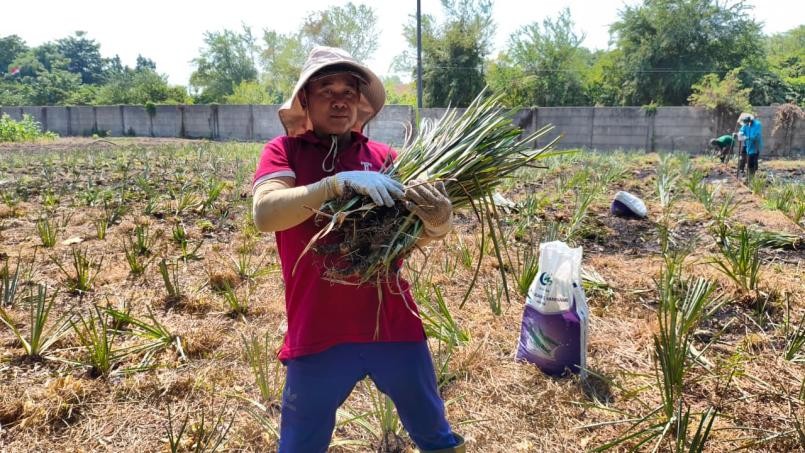

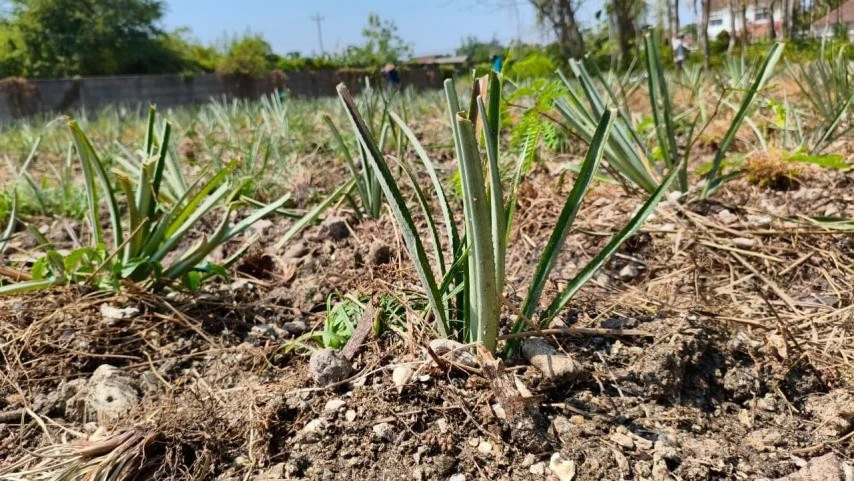
UNDIP, Jepara (3/9) – Amid the challenges of developing coastal land for agriculture, the Jepara Campus Management Agency (BPKJ) of Universitas Diponegoro (UNDIP) has introduced an innovation through honey pineapple cultivation. A total of 5,000 honey pineapple seedlings have been planted in the BPKJ UNDIP Teluk Awur area in Jepara as part of an effort to optimize campus land and transform it into a productive area with added value.
Land utilization is one of BPKJ’s priorities in developing the UNDIP Teluk Awur Campus area. In addition to serving as a space supporting academic and campus operational activities, some of the land is being directed toward productive activities that can provide long-term benefits, including the development of honey pineapple cultivation.
Challenging the Characteristics of Coastal Land
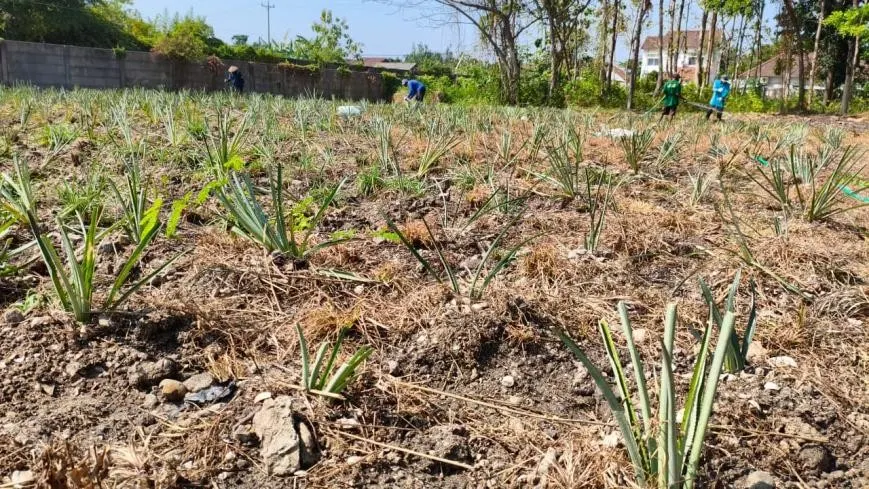
Developing a pineapple plantation at BPKJ presents its own challenges. The campus is located relatively close to the coast, making the soil in several areas fairly rocky, with stones that need to be cleared and managed before the land can be used for cultivation.
However, these conditions have not become an obstacle. Instead, the land’s characteristics have encouraged BPKJ to improve and manage the area more effectively.
The land has been prepared by creating raised planting beds, which help with plant arrangement, maintenance, and access throughout the cultivation process.
The planting pattern consists of two rows of plants on each raised bed. The distance between plants within a row is approximately 60 cm, while the distance between the two rows is approximately 50 cm. Approximately 1 meter of space is provided between the raised beds to facilitate maintenance.
With this pattern, the plants are expected to grow in a more orderly arrangement, making maintenance, fertilization, weed control, and harvesting easier.
This approach demonstrates that land utilization need not begin with perfect soil conditions. With proper planning and management, land that previously had limitations can still be developed into a productive area.
More Than Just Planting
For BPKJ, the initiative goes beyond planting seedlings. Honey pineapple cultivation is part of an effort to develop a productive area within the campus environment. Each stage, from land preparation, planting, maintenance, fertilization, and weed and pest control to harvesting, is part of a process that requires consistent management.
In the future, the area also has the potential to be developed as a field-learning facility. Students and other stakeholders will be able to observe firsthand how coastal land can be managed and transformed into a horticultural cultivation area.
In this way, the pineapple plantation can serve several functions at once: production, learning, research, greening, and optimization of campus land assets.
Towards a Productive Pineapple Plantation
Pineapple cultivation is a medium-term process that requires consistent maintenance. Following planting, the plants will be monitored regularly for leaf growth, soil conditions, water requirements, weeds, pests, diseases, and plant development leading up to fruit formation.
Each plant has a long journey before eventually producing fruit.
Later, when honey pineapples begin to fill the area, what can be seen will be more than rows of plants. It will be evidence that coastal land with inherent challenges can be transformed into a productive area.
From Campus to Food Security
Pineapple cultivation is one example of how the campus environment can be used not only for academic activities but also to develop productive initiatives.
Through land optimization, BPKJ UNDIP seeks to build a campus environment with added value from economic, environmental, educational, and social perspectives.
In the future, the development of this pineapple plantation is expected to be integrated into BPKJ UNDIP’s integrated productive agricultural area, alongside other cultivation activities. From campus land, BPKJ seeks to cultivate more than just plants. It aims to create opportunities for learning, productivity, innovation, and benefits that can continue to grow. Plant today, harvest the benefits tomorrow. (Public Communication/UNDIP)