
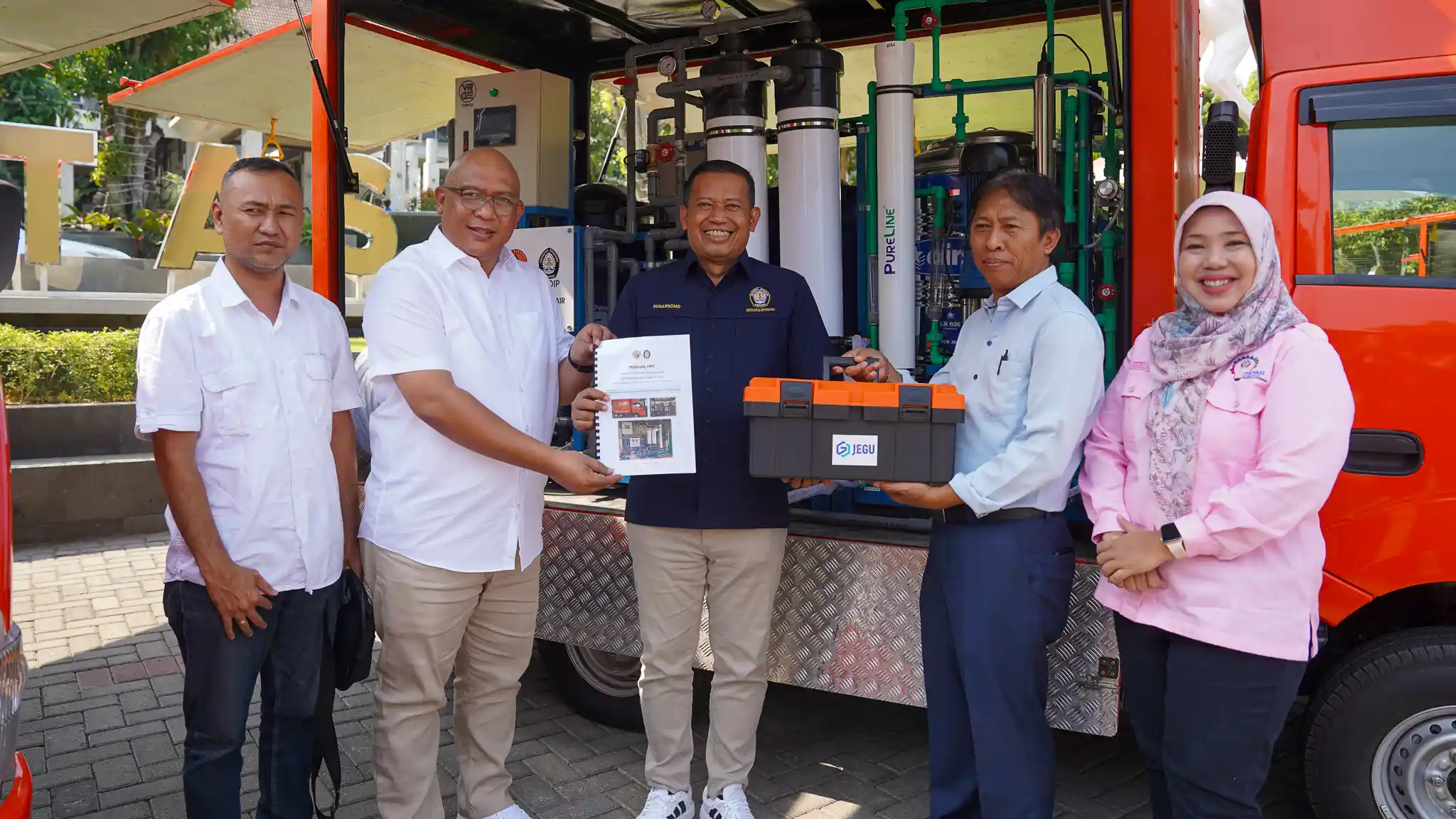
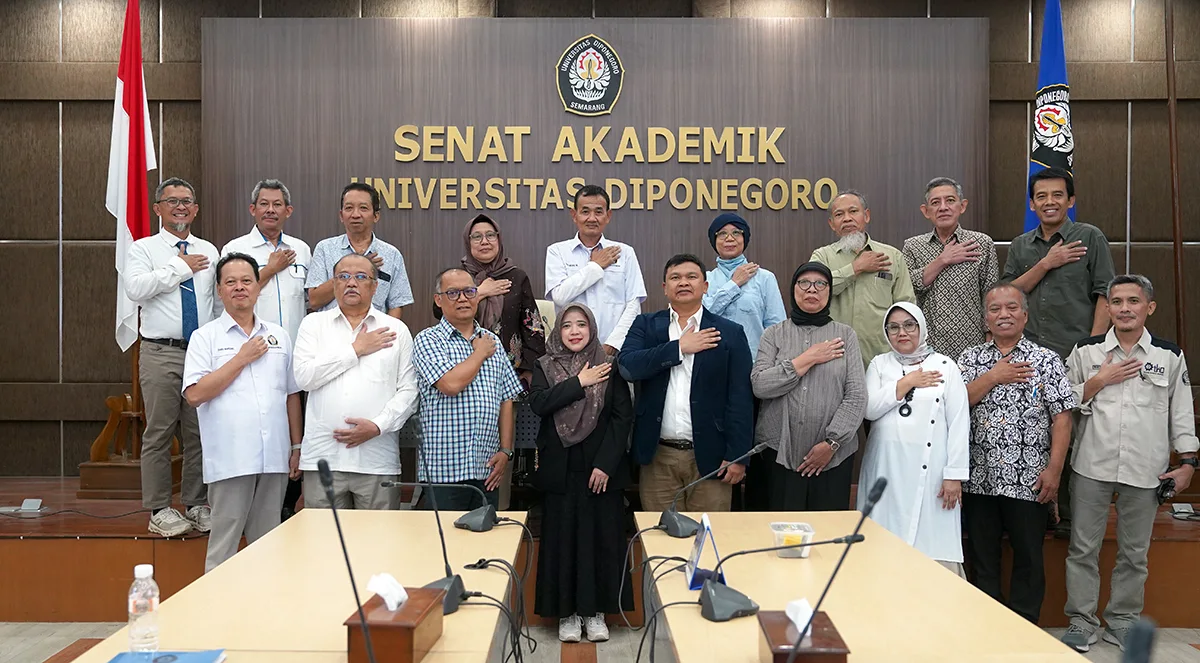
UNDIP, Semarang (7/9) – Universitas Diponegoro (UNDIP) held another scientific paper presentation by a professor candidate, organized by the UNDIP Board of Professors, on Monday (7/9) at the Academic Senate Meeting Room, SA-MWA Building, UNDIP Tembalang Campus.
On the occasion, Ir. Titik Istirokhatun, S.T., M.Sc., Ph.D., IPU, ASEAN Eng., a lecturer at the Department of Environmental Engineering, Faculty of Engineering, UNDIP, presented her scientific paper entitled “Development of Sustainable Functional Membranes for Water and Wastewater Treatment: Integrating Antifouling Engineering, Resource Recovery, and Circularity.” Her research addresses the growing challenges of water scarcity and the increasing complexity of contaminants found in water sources.
In her presentation, Titik explained that pressure-driven membrane technology holds significant potential because it does not require phase changes, making it more energy-efficient than conventional separation methods and offering modularity and ease of integration.
However, the development of this technology faces four key challenges: the permeability-selectivity trade-off, fouling and biofouling, wastewater complexity, and sustainability requirements. Addressing these challenges requires membrane engineering that integrates structural, surface, transport, separation function, application, and sustainability aspects. To overcome these barriers, Titik presented seven innovative strategies, including:
- Silica Mineralization: Using natural silica to enhance the membrane’s water absorption capacity and regulate its pore size. This strategy has been shown to increase water flux while achieving salt rejection of up to 95.2% and improving fouling resistance.
- Use of Silver (Ag) Nanocapsules: Employing silver nanocapsules as structural modifiers during membrane layer fabrication. The resulting membrane is thinner and has more precisely controlled pores, increasing water flux, achieving salt rejection of up to 97.7%, and effectively preventing the attachment of E. coli bacteria.
- Charge Engineering with Imidazole: Modifying the membrane surface’s electrical charge using imidazole derivatives. This method allows essential nutrients such as Nitrogen (N), Phosphorus (P), and Potassium (K) to pass through for reuse, with nutrient rejection below 25%, while retaining more than 91% of harmful micropollutants.
- Utilization of Natural Materials and MOFs: Combining Metal-Organic Framework (MOF) materials with biobased materials such as keratin, chitosan, collagen, and quinoa as environmentally friendly and economical adsorbents for azo dyes.
- Electroplating Wastewater Membrane (UiO-66-Keratin): Utilizing a combination of specialized materials and keratin in ultrafiltration (UF) membranes to treat wastewater from the metal electroplating industry. The resulting membrane significantly increased the rejection of toxic heavy metal copper from 34% to 76%.
- Plastic Bottle Recycling (rPET): Recycling waste bottles made from recycled Polyethylene Terephthalate (rPET) into high-value membranes for separating oil-water mixtures while supporting the principles of a circular economy.
- Marine Sponge Extract: Utilizing silica and natural compounds found in marine sponges to improve membrane resistance to fouling and eliminate harmful bacteria such as E. coli and S. mutans.
These strategies mark a major paradigm shift in the development of membrane-based separation technologies. “Membrane development is shifting from simply pollutant removal toward water reuse and resource recovery with a lower environmental footprint,” Titik explained.
Concluding her presentation, Titik outlined a research roadmap and future challenges, including long-term stability, the safety and leaching of modifiers, scaling up from flat-sheet membranes to industrial modules, the integration of Life Cycle Assessment (LCA) and Techno-Economic Assessment (TEA), and the advancement of precision separation.
The development of sustainable membrane technologies directly contributes to achieving the Sustainable Development Goals (SDGs). The research specifically supports SDG 6 (Clean Water and Sanitation) through the provision of efficient water recycling technologies; SDG 9 (Industry, Innovation and Infrastructure) through the development of advanced, energy-efficient material engineering; SDG 12 (Responsible Consumption and Production) through the application of circularity principles and waste valorization of plastic waste; and SDG 14 (Life Below Water) and SDG 15 (Life on Land) by minimizing environmental pollution caused by hazardous contaminants and microplastics. (Public Communication/UNDIP/Dhany)