
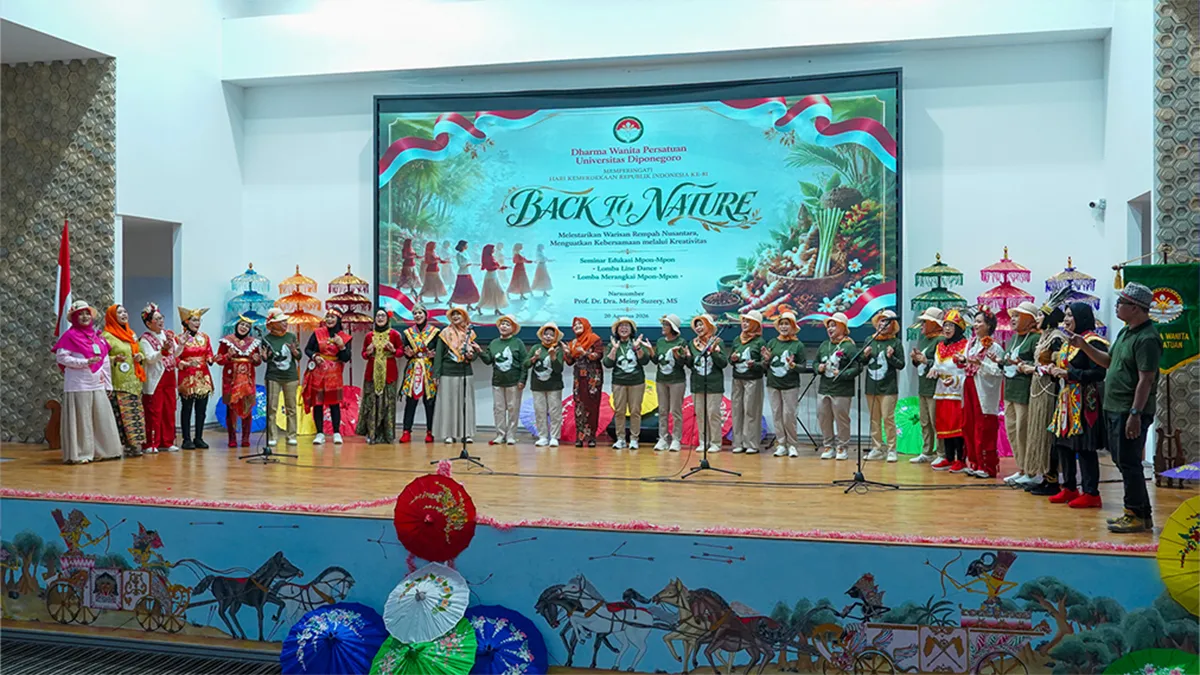
UNDIP, Semarang (20/8) – Dharma Wanita Persatuan Universitas Diponegoro (DWP UNDIP) commemorated the 81st Anniversary of the Republic of Indonesia’s Independence through activities that combined togetherness, creativity, culture, and health education. Carrying the theme “Back to Nature,” the event was held at the Art Center Building, UNDIP Tembalang Campus, on Thursday, August 20, 2026, featuring a talk show with Prof. Dr. Dra. Meiny Suzery, M.S., as well as a ‘Line Dance Competition’ and an ‘Mpon-mpon Arrangement Competition’.
A strong sense of togetherness was felt from the opening session, which also featured a performance by UNDIP’s UK Kolintang Gita Nusantara. The combination of education about spices and herbal plants, creativity, physical activity, and local cultural traditions was designed to provide an experience closely connected to family life while remaining aligned with the spirit of independence.
Chair of DWP UNDIP, Dewi Widayani Suharnomo, expressed her deep appreciation for the dedication and enthusiasm of all members attending the event. She encouraged participants to enjoy the competitions while upholding sportsmanship and appreciating the creativity, time, effort, and ideas each team contributed. According to her, the Independence Day commemoration can serve as a space to strengthen unity and present meaningful, beneficial activities.
“Indonesia’s natural and cultural wealth must continue to be introduced in ways that are closely connected to everyday life. Activities such as arranging mpon-mpon, processing traditional ingredients, and moving together through Line Dance not only create a festive atmosphere, but also provide opportunities for interaction, creativity, and stronger connections among DWP units,” she said.
Dewi also encouraged all DWP members to place meaningful contribution at the heart of every organizational activity. “Do not compete merely to be seen, but compete to be useful,” she advised.
She emphasized that a person’s presence becomes meaningful when it creates a positive impact on oneself, one’s family, the surrounding environment, and the wider community. This spirit was also reflected in DWP’s social concern for communities affected by the earthquake in Flores, East Nusa Tenggara (NTT), including through fundraising and distributing aid to translate solidarity into concrete action. She expressed hope that the culture of sharing, togetherness, and concern for the social environment would continue to grow across all DWP UNDIP programs.
Similarly, Tanzil, Chair of the Organizing Committee, stated in the activity report that the event formed part of DWP UNDIP’s efforts to celebrate the 81st Anniversary of Indonesian Independence while strengthening relationships among members.
“This activity is expected to strengthen bonds among members, enhance togetherness and a sense of family, while also fostering sportsmanship, teamwork, and creativity among participants,” she said.
The participants’ enthusiasm was reflected in the involvement of 15 DWP UNDIP Implementing Units (UP). A total of 141 participants took part in the Line Dance Competition, while 43 participants joined the Mpon-mpon Arrangement Competition.
Strengthening the “Back to Nature” theme, Prof. Meiny Suzery from the Department of Chemistry, Faculty of Science and Mathematics (FSM) UNDIP, presented a session entitled “Healthy with Herbal Remedies: From Traditional Wisdom to Scientific Evidence.” She encouraged participants to develop a more critical understanding of herbal remedies.
According to her, the public’s familiarity with jamu and medicinal plants is an important asset, but knowledge passed down through generations should go hand in hand with scientific understanding. She highlighted several misconceptions that remain common, such as the belief that natural plants are always safe for daily consumption, that higher doses produce faster results, or that jamu cannot interact with prescription medicines. In reality, the use of herbal products is still influenced by the type of ingredient, dosage, preparation method, duration of use, the user’s health condition, and other medicines being consumed.
Prof. Meiny also explained the differences among herbal ingredients, jamu, and traditional medicines to prevent the public from treating them as the same. Herbal ingredients refer to plants or plant parts used as raw materials, while jamu has developed from empirical knowledge and tradition. Traditional medicinal products, meanwhile, require appropriate processing as well as adequate quality and safety control.
Therefore, before using herbal products, people should develop the habit of asking five simple questions: what the ingredient is, what it is used for, how much should be used, how it should be prepared, and who will consume it?
Participants were also encouraged to become more critical consumers when selecting herbal products. The composition, manufacturer, marketing authorization for commercial products, expiration date, instructions for use, and the reasonableness of health claims should all be checked before use. The main message was simple: natural does not always mean safe, and herbal drinks are not substitutes for medical treatment.
At the same time, natural resources hold significant potential when developed through scientific knowledge. Prof. Meiny gave the example of shallot peels, which are often regarded as waste but contain phenolic compounds, including quercetin. Pegagan (Centella asiatica) and turmeric also contain various bioactive compounds that warrant further study. Herbal ingredients can therefore be developed into health beverages, functional foods, natural cosmetics, dried herbal materials (simplisia), and other economically valuable products when their raw materials, processing, quality, and marketing are properly managed.
The festive atmosphere grew as participants joined the Line Dance Competition and the ‘Mpon-mpon Arrangement Competition’, showcasing each unit’s teamwork and creativity. Based on the judges’ assessment, the Faculty of Engineering (FT) won first place in the Line Dance Competition with a score of 766, followed by the Faculty of Public Health (FKM) in second place with 750 points, and the Faculty of Law (FH) in third place with 737 points. In the Mpon-mpon Arrangement Competition, the Faculty of Medicine (FK) won first place with a score of 98, Diponegoro National Hospital (RSND) came second with 94 points, and the Faculty of Science and Mathematics (FSM) placed third with 88 points.
The commemoration of the 81st Anniversary of Indonesian Independence with DWP UNDIP ultimately brought the spirit of independence closer to everyday life through active movement, creative hands, shared knowledge, and stronger interpersonal connections.
Through the spirit of “Back to Nature,” the event served as a collective reminder of the importance of preserving Indonesia’s local wisdom and maintaining a spirit of togetherness that provides meaningful benefits to the academic community and society at large. (Public Communication/UNDIP/DHW)