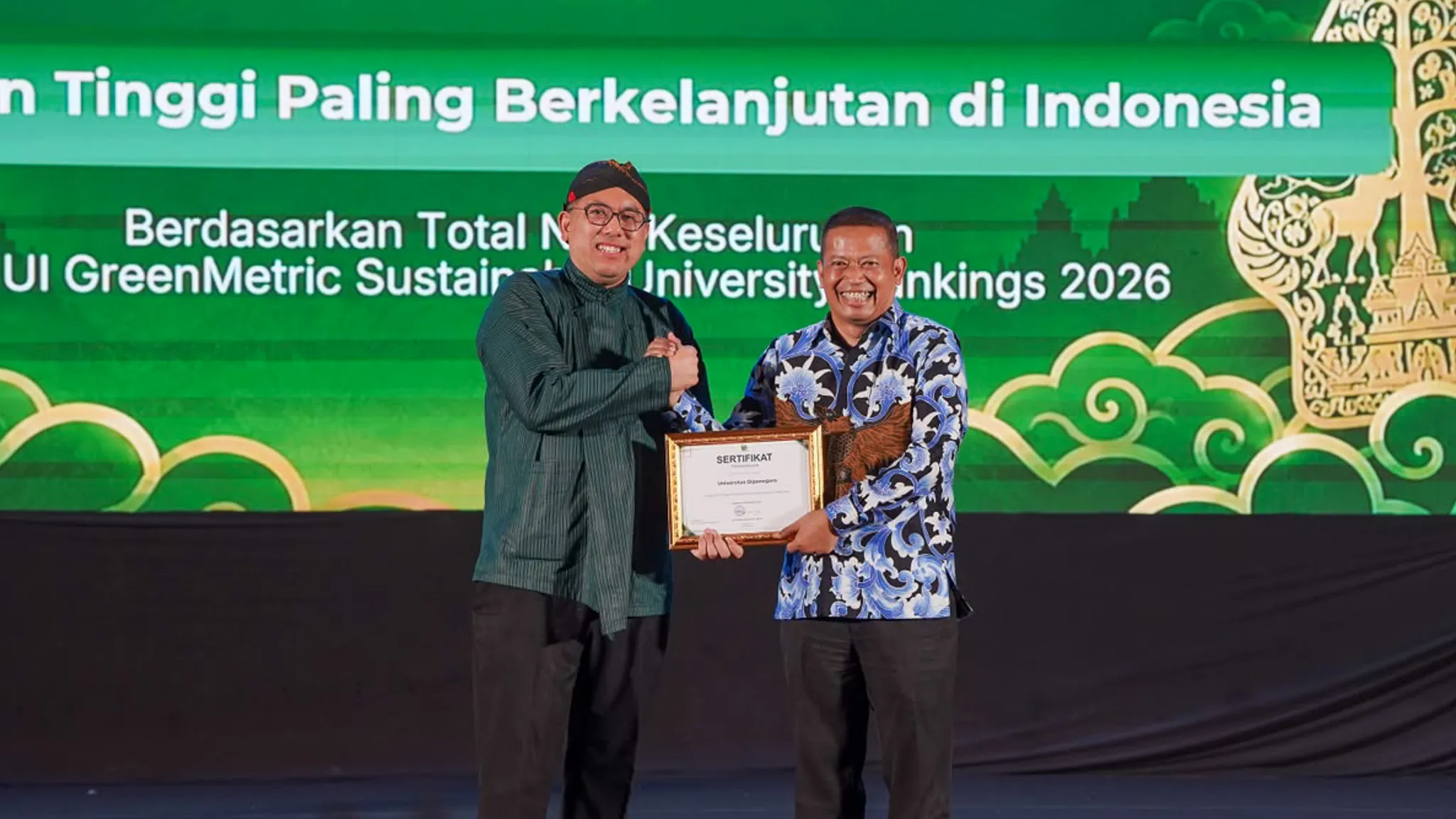
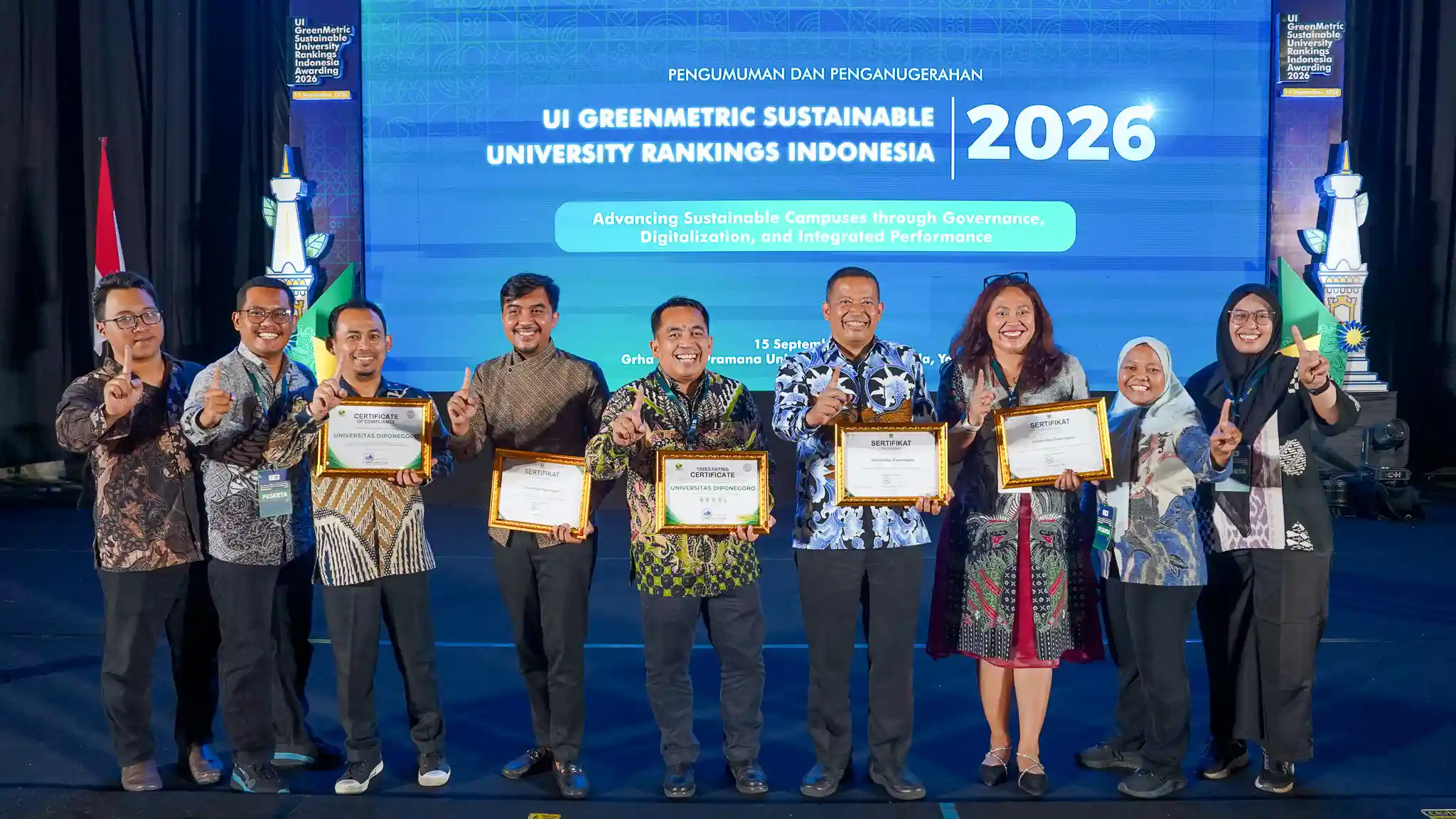
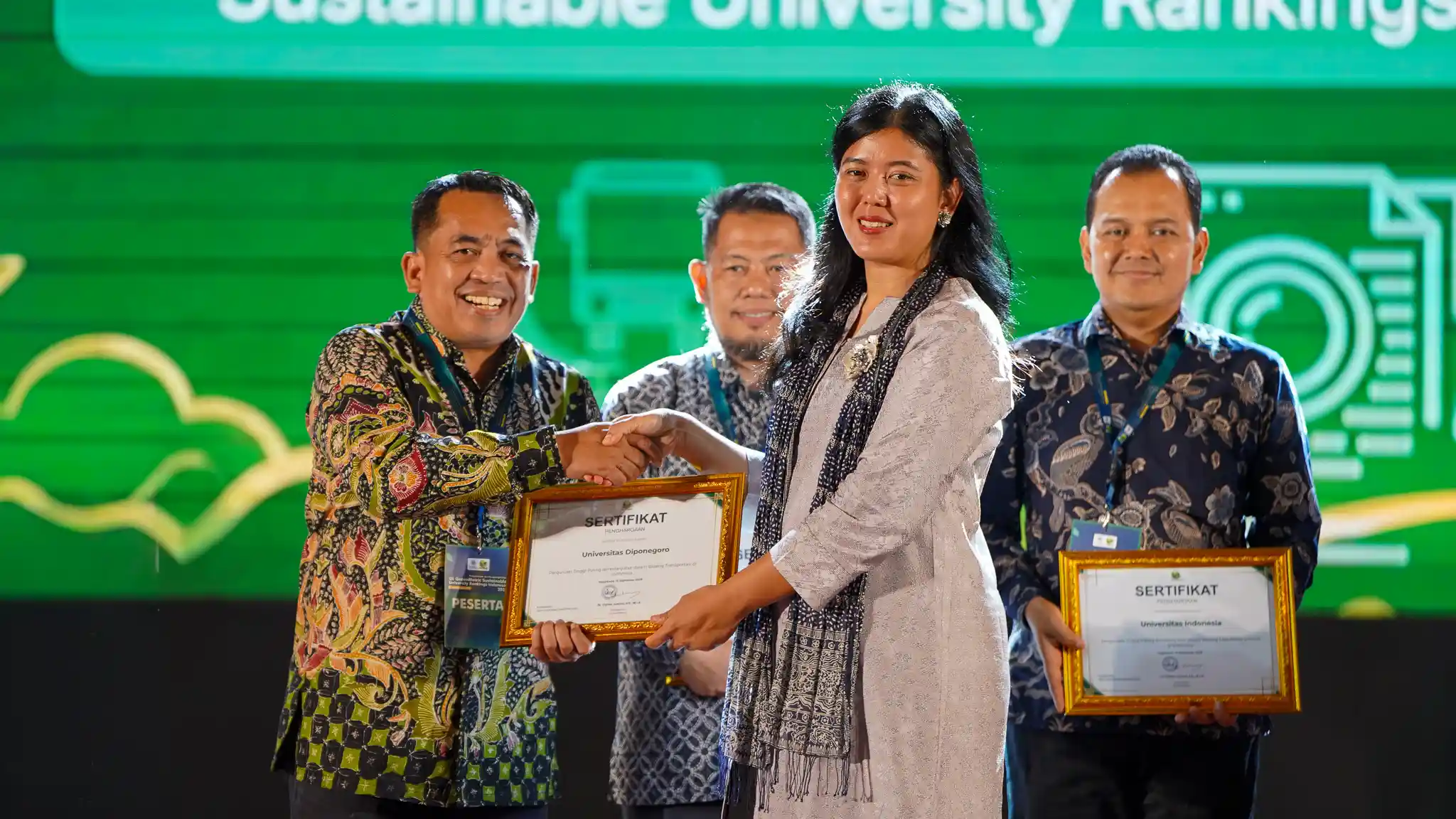
UNDIP, Semarang (25/9) – Universitas Diponegoro (UNDIP) has once again recorded an outstanding achievement in an international sustainability ranking. In the UI GreenMetric World University Rankings 2026, UNDIP ranked 20th globally and 3rd in Asia, maintaining its 2nd national position.
This achievement also marks UNDIP’s success in maintaining its position as the second-ranked university in Indonesia for seven consecutive years, from 2020 to 2026. In 2024, UNDIP was ranked 26th globally and 4th in Asia; in 2025, it improved to 23rd globally and 4th in Asia; and in 2026, it rose again to 20th globally and 3rd in Asia.
Based on the official UI GreenMetric 2026 results, UNDIP earned a total score of 9,337.5. In the Energy and Climate Change category, UNDIP scored 1,900; Transportation, 1,650; Waste, 1,550; Education and Research, 1,287.5; Governance and Digitalization, 1,025; Water, 1,000; and Setting and Infrastructure, 925.
Rector of Universitas Diponegoro, Prof. Dr. Suharnomo, S.E., M.Si., stated that UNDIP’s improved global ranking reflects the collective efforts of the entire university community in integrating sustainability principles into governance, education, research, and campus life.
“Alhamdulillah, this achievement is the result of the collective efforts of the entire UNDIP academic community and extended family. For us, sustainability is not merely about rankings, but about how knowledge, innovation, and university governance can truly create an impact on the environment and society. UNDIP’s rise to 20th in the world and 3rd in Asia shows that the transformation we are undertaking is moving in an increasingly positive direction,” said Prof. Suharnomo.
“Targets are certainly important, including how UNDIP can continue to improve its position globally. However, even more important is ensuring that every sustainability program has measurable impact, is grounded in research and can be replicated to address real challenges in society. This is the spirit of noble and valuable UNDIP,” he added.
New Challenges in Governance and Digitalization
UI GreenMetric 2026 introduced an important change to its assessment methodology by adding Governance and Digitalization (GD) as the seventh indicator, with a weight of 11 percent. The indicator assesses, among other aspects, sustainability budgets, sustainability and financial reporting, institutional structures responsible for sustainability, the use of information technology for planning and monitoring, the adoption of digital technologies such as AI and IoT, integrity and complaint-handling systems, and digital literacy.
Director of the Directorate of Global Reputation, Partnerships, and Connectivity, UNDIP, Prof. Hadiyanto, stated that the inclusion of the new indicator has made the UI GreenMetric 2026 competition more challenging while encouraging universities to view sustainability more comprehensively.
“Alhamdulillah, by the grace of Allah, Universitas Diponegoro has successfully achieved 20th place globally and 3rd in Asia in UI GreenMetric 2026. This achievement is concrete evidence of UNDIP’s performance and commitment to realizing a green and sustainable campus,” said Prof. Hadiyanto.
He explained that the inclusion of Governance and Digitalization as the seventh indicator adds a new dimension to the measurement of sustainability performance in higher education institutions.
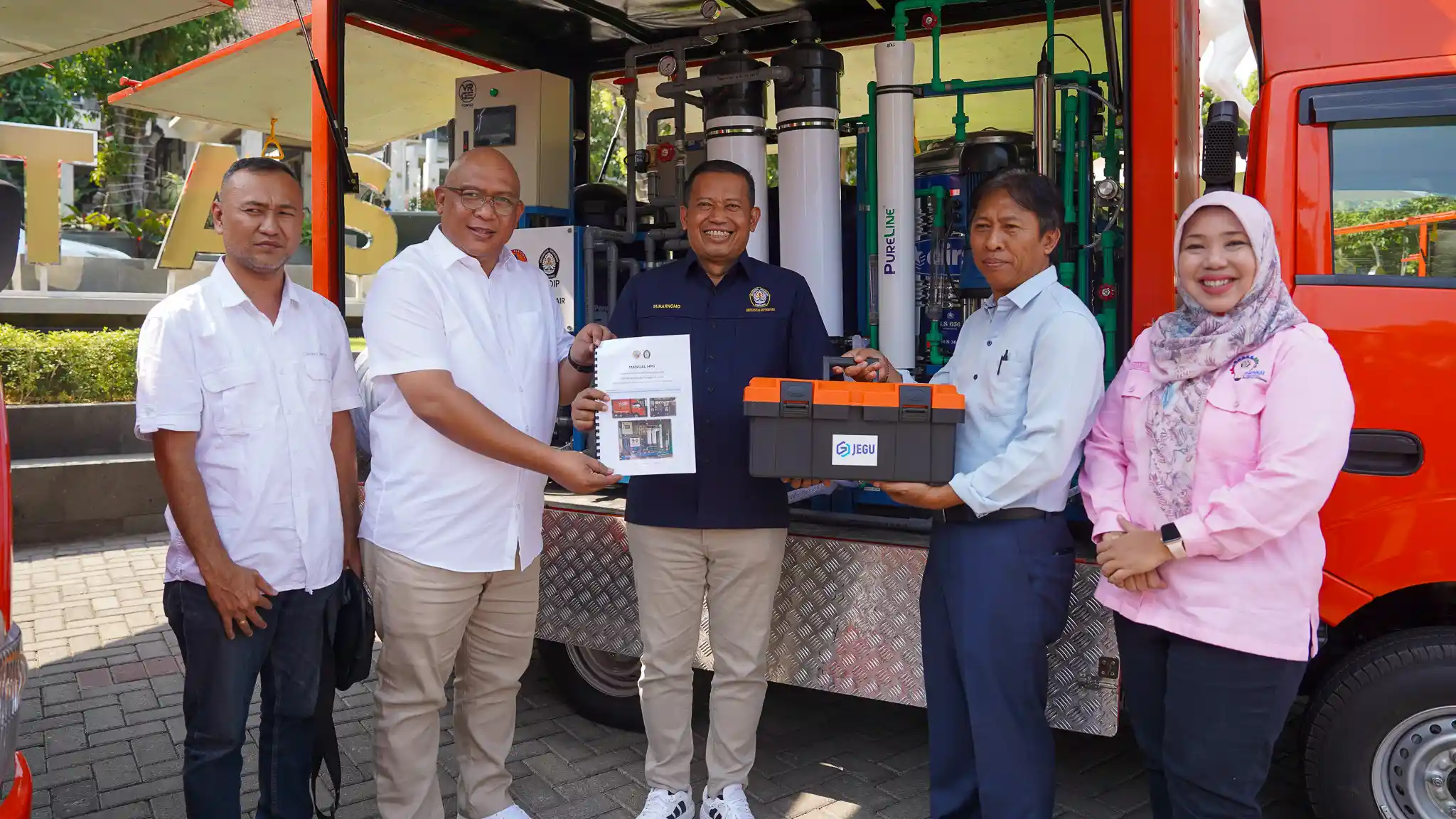
“This year presents a new challenge with the inclusion of Governance and Digitalization as the seventh indicator. In the future, UNDIP will continue to strengthen innovation across all indicators through various programs, including UNDIP Zero Waste, wastewater treatment, and the development of green transportation,” he explained.
“We hope these innovations will continue to develop and deliver tangible impacts so that UNDIP can further improve its sustainability performance and move toward the world’s top 10,” Prof. Hadiyanto continued.
From Zero Waste to Technology-Based Water Management
UNDIP’s improved sustainability performance is supported by various programs that are being developed at the university, faculty, and school levels. One of these is UNDIP Zero Waste, implemented in accordance with Rector Regulation No. 5 of 2023 on Waste Management. The program applies the 5R principles and develops an Integrated Waste Processing Facility (TPST) as a center for science-based innovation and learning.
At TPST UNDIP, organic waste is processed into compost, while food waste is utilized through maggot cultivation. Pyrolysis technology is also being developed to process various types of waste into value-added products. UNDIP has also developed mechanisms to encourage the academic community to participate in sorting and reducing waste at the source.
Sustainability innovation is also being advanced through the “SV Zero Discharge” program at UNDIP’s Vocational School. The program integrates water, energy, and waste management in line with circular economy principles. Rainwater is reused, while domestic wastewater is treated for non-consumptive purposes such as plant irrigation and toilet flushing. An Internet of Things (IoT)-based monitoring system is also used to track sustainability indicators in real time.
In the energy sector, UNDIP has also expanded the use of renewable energy, including solar panels and implemented various energy-efficient infrastructure and systems. These programs strengthen UNDIP’s approach to sustainable campus development, which goes beyond greening initiatives by integrating research, technology, behavioral change, governance, and environmental innovation.
The UI GreenMetric World University Rankings 2026 marked its 17th edition and included 2,016 institutions from 110 countries, making it one of the global university rankings focused specifically on institutional sustainability performance. This year, UI GreenMetric carried the theme “Advancing Sustainable Campuses through Governance, Digitalization, and Integrated Performance.”
UNDIP’s achievement in entering the global top 20 further strengthens the university’s consistency in developing a higher education ecosystem that is excellent, green, innovative, and capable of delivering tangible benefits to society and the environment. UNDIP, Noble and Valuable. (Public Communication/UNDIP)