



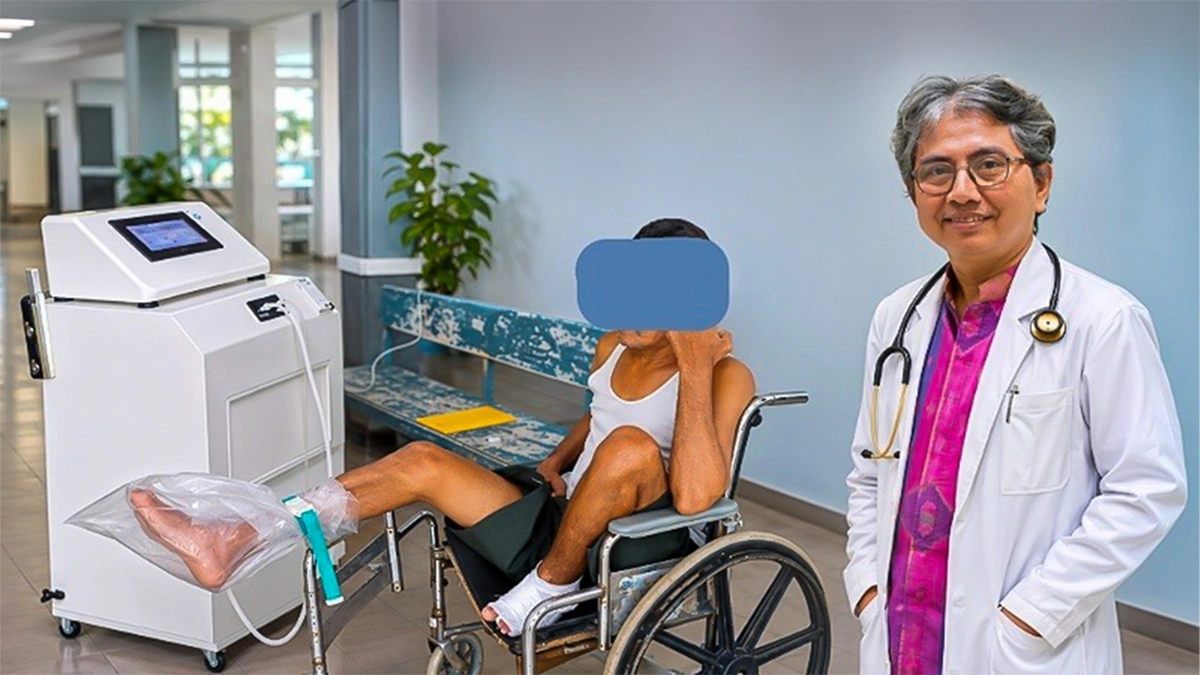
UNDIP, Semarang (13/11) – Universitas Diponegoro (UNDIP), through an innovation developed by dr. Muslimin, Sp.D.V.E., Subsp. O.B.K., FINSDV, FAADV, together with a team from the Faculty of Medicine, has introduced a combination therapy using ozone and Platelet-Rich Plasma (PRP) to help accelerate the healing of leprosy ulcers. This innovation opens opportunities to develop further healthcare services for leprosy patients with chronic wounds who are at risk of disability and even amputation.
Leprosy ulcers are chronic wounds caused by nerve damage that reduces skin sensitivity, particularly on the soles of the feet. This condition makes wounds difficult to heal and vulnerable to complications. Conventional treatments, such as wound debridement and sterile dressings, do not always yield optimal results, necessitating additional therapeutic approaches to support tissue regeneration.
According to dr. Muslimin, the strength of this innovation lies in the use of two complementary biological approaches. “Ozone therapy helps control microorganisms and stimulate the healing process, while PRP derived from the patient’s own blood contains growth factors that support tissue repair and the formation of new blood vessels,” he said.
The innovation has undergone a clinical trial involving 29 patients with leprosy ulcers at the Donorojo Leprosy Hospital in Jepara. Evaluation was conducted over six weeks by comparing standard therapy, standard therapy with ozone, standard therapy with PRP, and a combination of both additional therapies. The results showed that groups receiving additional therapy experienced a statistically significant reduction in wound area compared with the group receiving standard therapy.
However, the combination of the two therapies has not yet demonstrated consistent superiority across all biological indicators of healing. Therefore, the innovation still requires further development and research. Variations in platelet concentrations in autologous PRP, which can differ between patients, as well as the large proportion of elderly patients, are among the factors that need to be considered when evaluating treatment outcomes. These conditions may explain why several outcome parameters did not show statistically significant results, despite better wound-healing outcomes.
These findings open opportunities for the development of more effective adjunctive therapies that are oriented toward patient needs. In the future, the innovation has the potential to be developed through collaboration with hospitals, healthcare facilities, medical technology industries, and other partners involved in healthcare service development. Further testing, procedural standardization, and safety evaluations remain necessary before the therapy can be implemented more widely.
As the unit responsible for managing innovation and Intellectual Property (IP) services at UNDIP, the Directorate of Innovation and Cooperation (Dirinovki) facilitates the identification of potential IP, assists with IP protection, and develops partnership networks to support the downstream implementation of innovations. This role is important to ensure that healthcare innovations have an appropriate protection framework and sustainable opportunities for utilization.
This innovation aligns with Universitas Diponegoro’s commitment to advancing the Sustainable Development Goals (SDGs), particularly SDG 3: Good Health and Well-Being, by developing therapeutic approaches to heal leprosy ulcers and improve the quality of healthcare services.
Through stronger innovation, IP protection, and cross-sector collaboration, UNDIP continues to foster the development of healthcare solutions that address community needs. This initiative reflects the spirit of “Noble and Valuable UNDIP” by delivering excellent, impactful, and sustainable innovations to improve people’s quality of life. (Public Communication/UNDIP/Directorate of Innovation and Research)