

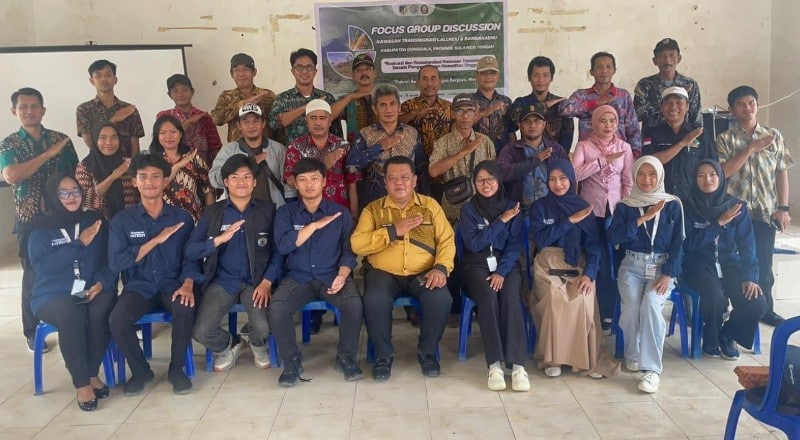
UNDIP, Donggala (October 9, 2025) – Team 2 of the UNDIP Patriot Expedition held a Focus Group Discussion (FGD) at the Rio Pakava District Office, Donggala Regency, Central Sulawesi. The team identified crucial data for evaluation, revealing that damaged roads and land disputes are significantly hindering the development of the region’s abundant palm oil plantation potential.
The activity served as a strategic forum bringing together district government officials, village administrations, transmigrant communities, and farmer groups to formulate development designs for leading commodities and to seek solutions to various challenges in the Lalundu and Bambakaenu transmigration areas.
During the discussion, a range of long-standing issues resurfaced—ranging from agricultural and plantation potential to road and bridge infrastructure, and from boundary conflicts to unclear land certificates. These conditions are considered significant barriers to investment and economic growth for transmigrant communities.
Sukarjoni, Head of Bukit Indah Village, stated that land uncertainty and poor infrastructure have stalled many economic opportunities.
“Road infrastructure problems must be addressed and prioritized. If roads and land certificates are not resolved, investors will not dare to enter. Yet the agricultural and palm oil plantation potential in this area is enormous, but road conditions cause losses,” he said.
Abundant Palm Oil, Damaged Roads, and Expensive Fertilizers
Although Rio Pakava has extensive palm oil plantations, the selling price of Fresh Fruit Bunches (FFB) is suppressed due to poor transportation access. Pothole-ridden roads and damaged bridges significantly increase transport costs, resulting in local palm oil prices that are far lower than those in Sumatra and Kalimantan.
The FGD also revealed that approximately 40% of palm oil plants in Rio Pakava originate from uncertified “wild” seedlings, which negatively affect productivity and harvest quality. Farmers expect government support to improve seed quality and adjust pricing mechanisms to make local palm oil more competitive.
Another significant issue is fertilizer scarcity and high prices. Widayat, A.Md., from the Rio Pakava Agricultural Extension Center (BPP), explained that local palm oil farmers do not receive subsidized fertilizers. In contrast, non-subsidized fertilizer prices can reach three to four times higher.
“Palm oil prices here are the lowest, but fertilizer prices are the highest. We hope there will be regulatory changes on subsidized fertilizers from the Ministry of Agriculture to be fairer to palm oil farmers,” he stated.
Despite these challenges, the spirit of the Rio Pakava community remains strong. They continue to sustain agricultural productivity while developing new potentials. The UNDIP Patriot Expedition Team has also taken concrete action by collecting soil samples for laboratory testing to identify potential crops for medium- and long-term development.
The team—consisting of Muhammad Iqbal Fauzan, S.P., M.Si., Muhammad Naufal, Nafachani Timmu Nafsi, S.P., Sholikatul Azizah Nur Fitriani, S.P.W.K., and Arla Disayna Azzahra Yuniaz, S.A.P.—is committed to providing scientific data to serve as a policy foundation for transmigration area development based on local potential.
Initial Steps Toward Change
The FGD became a vital catalyst for aligning community aspirations with government policy directions. The UNDIP Patriot Expedition Team will present these field findings as recommendations to the Ministry of Transmigration, including improvements to road and bridge infrastructure, resolving land disputes, and supporting the sustainable development of key commodities.
Head of Team 2 of the UNDIP Patriot Expedition for the Lalundu and Bambakaenu Transmigration Area, Muhammad Iqbal Fauzan, S.P., M.Si., emphasized that the activity marks the beginning of cross-sector collaboration.
“This activity is the starting point for collaboration among communities, local governments, and ministries so that the Rio Pakava transmigration area can grow into a new economic center based on leading agricultural commodity potential,” he concluded.
The UNDIP Patriot Expedition supports SDG 11 (Sustainable Cities and Communities) by strengthening regional governance and infrastructure in transmigration areas, and SDG 8 (Decent Work and Economic Growth) by promoting the development of leading commodities and local employment opportunities based on regional potential. (Public Communication/UNDIP/Nurul)