










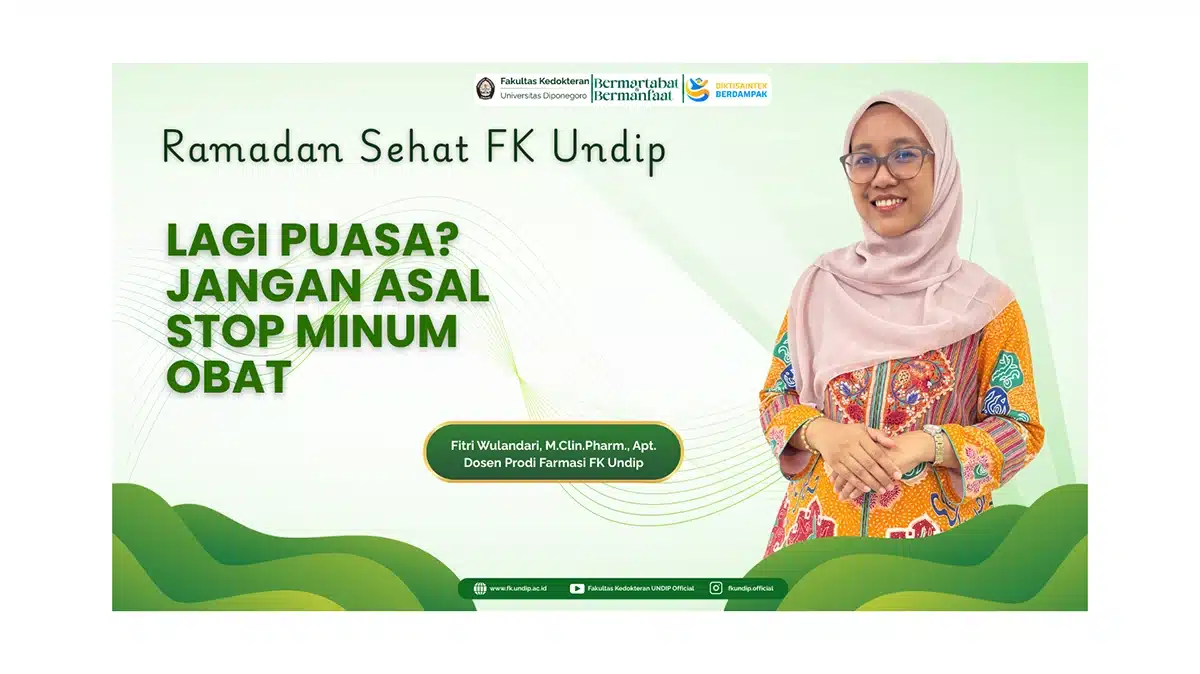
UNDIP, Semarang (10/3) – During Ramadan, some people hesitate to continue their medication. Many choose to stop taking medicine out of concern that it may invalidate their fast. In fact, stopping medication without guidance from healthcare professionals can disrupt the healing process.
A lecturer from the Pharmacy Study Program, Faculty of Medicine, Universitas Diponegoro, Fitri Wulandari, M.Clin.Pharm., Apt., emphasized that medication can still be taken safely during Ramadan with proper timing adjustments. “Don’t be confused and don’t stop your medication. Treatment can still be effective during Ramadan if the timing of intake is adjusted,” she explained.
According to Fitri, once-daily medications can be taken at suhoor or iftar. For medications taken twice daily, they can be divided between suhoor and iftar.
For medications that must be taken three to four times a day, scheduling becomes more challenging. In such cases, patients are advised to consult a doctor to adjust the dosage or switch to once- or twice-daily medications.
However, if the medication must still be taken three times daily, it can be scheduled for iftar (around 11:00 PM before sleep) and suhoor. For medications required four times daily, they can be taken at approximately four-hour intervals, for example, at 6:00 PM (iftar), 10:00 PM, 1:00 AM, and 4:00 AM (suhoor).
People also often ask about medications that must be taken before or after meals. Fitri explained that medications taken before meals can be taken about 30 minutes before suhoor or iftar. In comparison, those taken after meals should be taken about 5–10 minutes after eating.
Furthermore, she clarified that not all medications invalidate fasting. As long as the medication does not enter through the digestive tract, it generally does not break the fast. Examples of medications that can still be used during fasting include topical ointments or creams, injections (as long as they are not nutritional), eye drops, nasal drops, and mouthwash (as long as it is not swallowed).
The most important thing is to ensure that medication schedules remain consistent and to consult healthcare professionals when needed. “So there is no reason to skip medication during fasting. This schedule helps keep the body healthy and energized during fasting. If you have questions about medication, don’t hesitate to consult a doctor or pharmacist,” she concluded. (Public Communication/UNDIP/Dhany, adapted from FK UNDIP’s Official Instagram)