

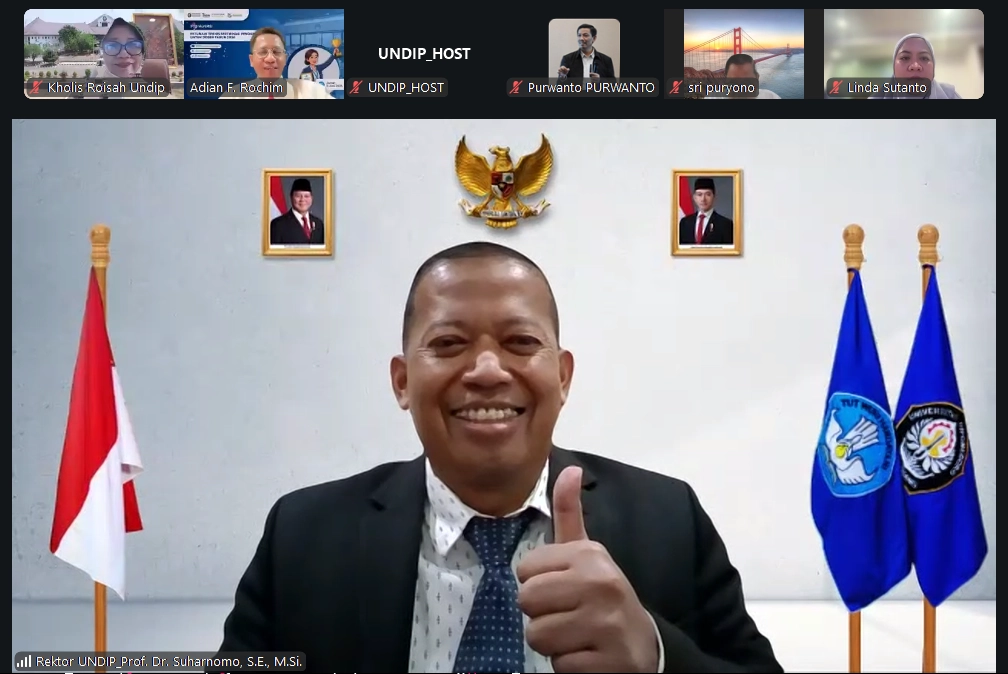
UNDIP, Semarang (9/6) – Universitas Diponegoro (UNDIP) continues to strengthen its commitment to delivering high-quality, inclusive, and impact-oriented higher education governance. To align perspectives and accelerate institutional readiness, UNDIP organized a2026 State University with Legal Entity Status (PTN-BH) Key Performance Indicators (IKU) Data Entry Assistance Program. The strategic meeting was held online via Zoom Meeting on Monday, June 8, 2026.
Moderated by Prof. Dr. Kholis Roisah, S.H., M.Hum., the interactive forum featured Linda Sutanto, S.E., M.PSDM., CPM., Expert Staff of the Secretariat General of the Ministry of Higher Education, Science, and Technology, to strengthen participants’ understanding of impact-based KPI implementation. The event was designed as a two-way discussion platform to ensure accurate data entry and to align institutional perspectives across the university. The high level of participation was reflected in the attendance of university leaders, faculty representatives, institutes, agencies, directorates, and various strategic units within UNDIP.
In his opening remarks, UNDIP Rector Prof. Dr. Suharnomo, S.E., M.Si. emphasized the importance of mastering the Plan-Do-Check-Act (PDCA) management cycle, guided by the philosophy of Kaizen, to continuously improve the university’s internal business processes. “In management, planning and evaluation are inseparable twins. There can be no evaluation without planning, and planning is meaningless if it is never evaluated. Therefore, this session aims to provide a more precise understanding of the KPIs of the university, how they should be completed, and how the results can serve as a basis for assessing whether we are on the right track,” said Prof. Suharnomo.
He also highlighted UNDIP’s recent progress, noting that the university had successfully advanced into the top 10% high-performance category, after previously remaining in the 70% medium category. According to him, these achievements must be sustained through stronger coordination among university units and continuous improvement of internal processes.
However, Prof. Suharnomo reminded all university stakeholders not to become complacent. He emphasized that external recognitions, such as awards from the Ministry of Higher Education, Science, and Technology, should be viewed merely as by-products of sound internal governance. Comprehensive evaluations from the ministry should instead be embraced as objective reflections to identify shortcomings and formulate future improvement strategies.
Concluding his remarks, the Rector expressed gratitude to the resource persons and the teams from the Planning and Development Agency (BPP) and Public Relations Division IV for their commitment to ensuring data synchronization. He hoped that the comprehensive insights provided by the ministry would broaden the university’s perspective in evaluating both macro-level achievements and technical details that still require acceleration. Through collective commitment, the KPIs evaluation framework is expected to become not merely an administrative reporting tool but a compass guiding the entire academic community in making meaningful contributions to national development.
In her presentation, Linda Sutanto provided an in-depth explanation of the national policy framework and roadmap for the “2026 Impact-Oriented Higher Education Key Performance Indicators (IKU Diktisaintek Berdampak 2026). This year’s evaluation framework adopts the principles of the Strategic Focus Organization (SFO) approach. The framework is designed to ensure that all budget allocations, work plans, and operational activities within universities contribute directly to creating public value, with a focus on developing outstanding talent, fostering innovative research, and strengthening good governance.
Linda outlined several mandatory indicator clusters that form the foundation of the new evaluation system. These include the Educational Efficiency Rate (AEE), which measures students’ on-time graduation rates and the proportion of graduates who secure employment, pursue entrepreneurship, or continue their studies within one year after graduation. The framework also assesses student participation and achievements outside their academic programs through internships, research activities, and socially impactful partnership programs recognized by the university.
Another critical indicator concerns the ratio of outputs generated through collaboration among universities, industry partners, or startups, including joint scientific publications, applied products, and creative works successfully commercialized and utilized by partner organizations. Universities are also encouraged to increase non-tuition revenue through research commercialization, royalties, and independent business units, while simultaneously developing integrated strategic plans to improve faculty welfare in accordance with institutional financial standards.
Beyond the mandatory indicators, universities are provided opportunities to compete globally through optional indicators, such as the proportion of faculty members receiving international recognition in research and the arts. Equally important, the latest evaluation framework requires universities to demonstrate a strong commitment to the Sustainable Development Goals (SDGs) by contributing to SDG 1 (No Poverty), SDG 4 (Quality Education), SDG 17 (Partnerships for the Goals), as well as two additional SDGs selected based on each institution’s local strengths and priorities.
Through this initiative, UNDIP expects all work units to share a common understanding and to implement KPIs reporting accurately, effectively, and meaningfully. The assistance program also represents a concrete step toward strengthening a transparent, accountable, data-driven performance culture, in line with UNDIP’s vision of becoming a world-class university that excels academically while making tangible contributions to society. (Public Communication/UNDIP/DHW)