









UNDIP, Semarang (25/7) – Protecting data from unauthorized access is one of the key challenges in the field of cybersecurity. Addressing this need, an academic from the Faculty of Science and Mathematics (FSM) at Universitas Diponegoro (UNDIP) has demonstrated that mathematics plays a tangible and strategic role in safeguarding the confidentiality of messages and information in digital environments.
The expert is Dr. Nikken Prima Puspita, S.Si., M.Sc., who also serves as Head of the Algebra Studies Division of the Indonesian Mathematics Society (IndoMS). She has successfully applied concepts of matrix and vector algebra to a data security system by developing the Hill Cipher Cryptography, a technique for protecting messages through encryption (converting the original message into an unreadable form) and decryption (restoring the encrypted message to its original form).
The Hill Cipher Cryptography method was first introduced by Lester Hill in 1929. In its original form, the method used integer arithmetic modulo 26, covering only the 26 letters of the Roman alphabet. However, because modern text is far more complex and includes uppercase and lowercase letters, numbers, and punctuation, Dr. Nikken subsequently developed the classical method further.
“This cryptosystem was generalized into Modulo 95 Hill Cipher Cryptography. The system involves 95 characters consisting of letters, numbers, and punctuation marks, such that its encryption and decryption algorithms involve integer modulo 95 operations,” Dr. Nikken explained regarding her research.
The development of this algebraic approach did not stop at the conceptual level. Together with UNDIP computer science expert Nurdin Bahtiar, M.T., the research was developed into a software application. This innovation has also received official recognition through an Intellectual Property Rights (IPR) certificate issued by the Ministry of Law and Human Rights, Number EC00202319591, titled “Hill-Cipher Modulo 95 Cryptography Software Application with ASCII Code.”
The application is considered highly beneficial to users, particularly the general public, as it no longer requires manual mathematical calculations for data security. As a result, the process of securing data becomes more practical and efficient.
The Modulo 95 Hill-Cipher Cryptography application consists of several stages. When establishing a cryptosystem, a Secret Key (Private Key) is required for both encryption and decryption. In this application, users select a 2×2 matrix as the key. Specifically, the key matrix is limited to those with determinant 1 or -1.
After entering the cipher matrix, users click the “Calculate Inverse” menu, which restores the encrypted message to its original form. Users then enter the original message (plaintext) they wish to secure.
The application also supports the reverse process, namely decryption, allowing encrypted messages to be restored into readable text. By clicking the process button, the system automatically calculates the inverse matrix and displays the original message that had previously been encrypted.
This cybersecurity innovation aligns with the mission of UNDIP’s Department of Mathematics to challenge the perception that mathematics is merely a difficult subject. Instead, mathematics is presented as an applied discipline closely connected to societal needs and directly impacting the development of everyday technology.
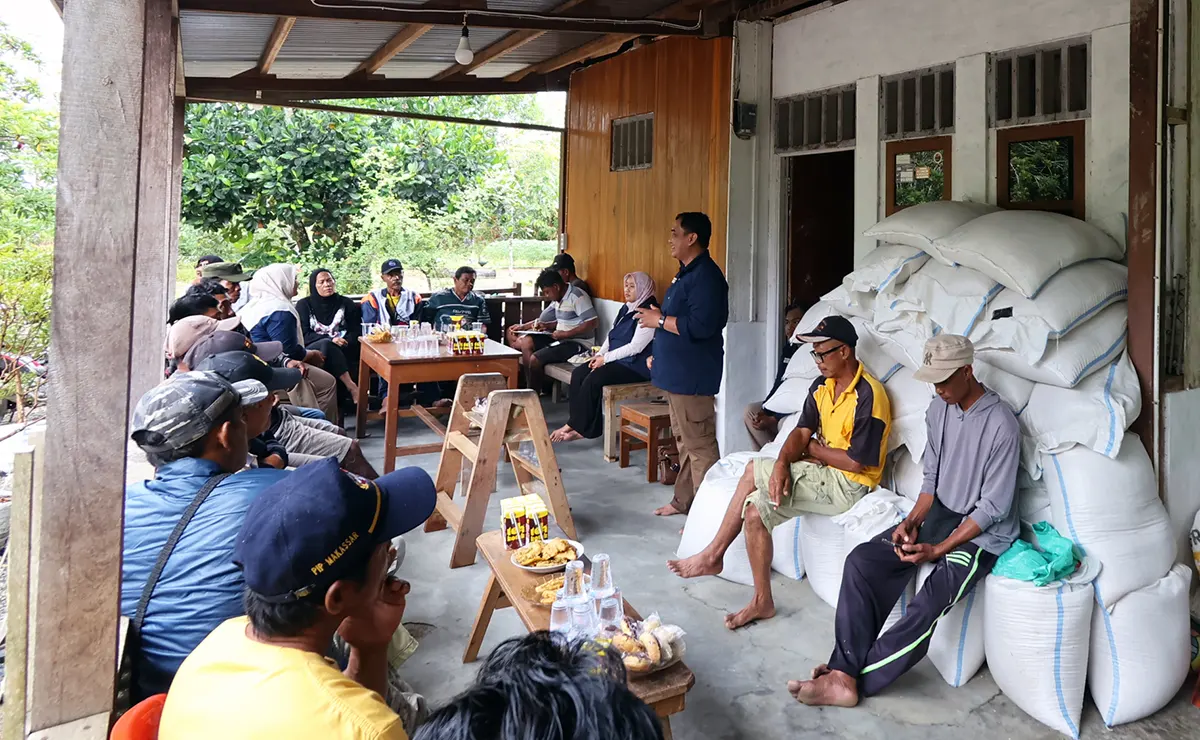
Beyond data security, Dr. Nikken is also actively applying algebraic modeling in community service activities. In collaboration with various partners, ranging from educational institutions to government agencies, mathematical knowledge is used to address practical challenges. One notable achievement came in 2022, when a community service collaboration led by Dr. Nikken, together with the University of Lampung and the Lampung Provincial Forestry Agency, received the “Most Inspiring IndoMS Community Service Grant” award for applying mathematics to the sustainable management of productive forests.
This innovation demonstrates UNDIP’s commitment to delivering knowledge that is not only academically excellent but also relevant to societal needs and technological development. The effort is aligned with the achievement of the Sustainable Development Goals (SDGs), particularly SDG 9 on Industry, Innovation, and Infrastructure and SDG 16 on Peace, Justice, and Strong Institutions through strengthened digital data security. This spirit further affirms Universitas Diponegoro’s role in realizing “Noble and Valuable UNDIP.” (Public Communication/FSM/ed. Nurul)