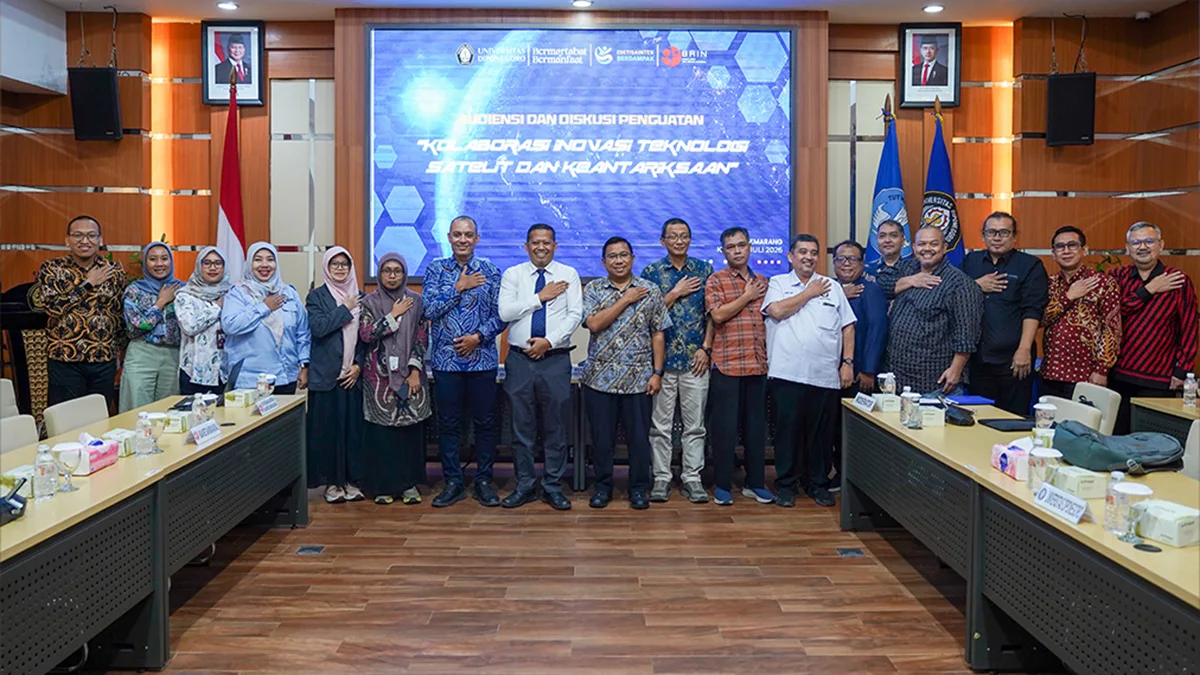

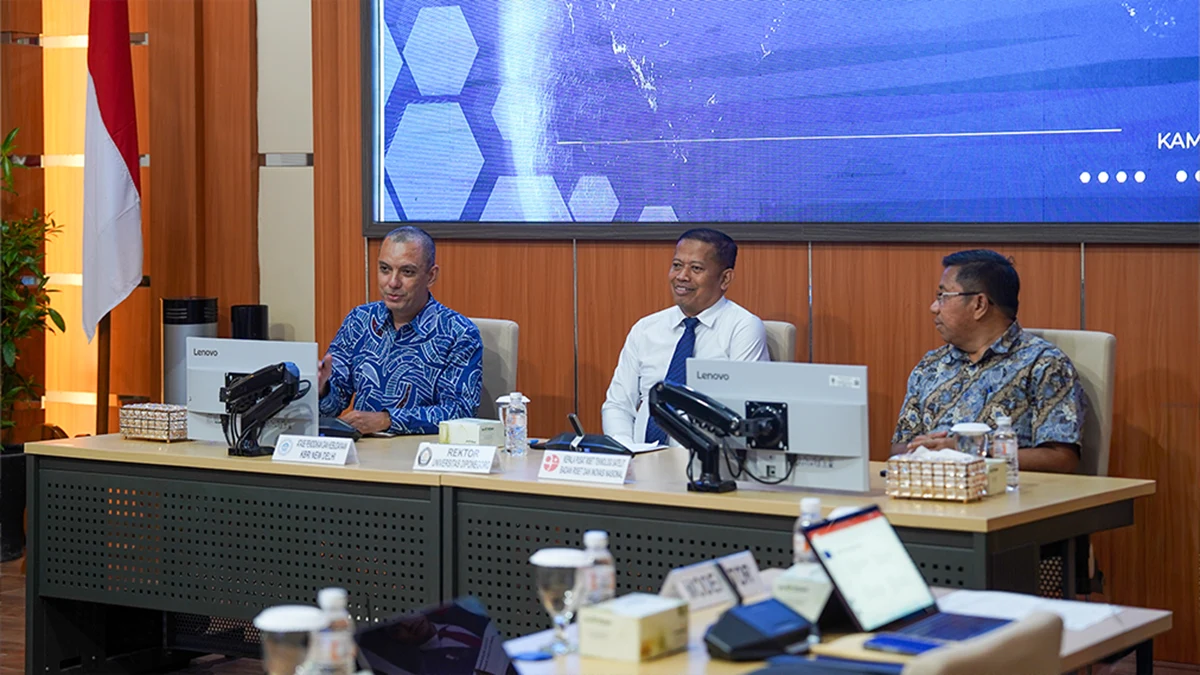
UNDIP, Semarang (9/7) – Universitas Diponegoro (UNDIP) is exploring collaboration opportunities in the development of satellite and space technology through an Audience and Discussion on Strengthening Collaboration in Satellite and Space Technology Innovation held in the Rector’s Meeting Room, Widya Puraya Building, 2nd Floor, UNDIP Tembalang Campus, on Thursday, July 9th, 2026. The audience discussed various collaboration opportunities between universities, the National Research and Innovation Agency (Badan Riset dan Inovasi Nasional / BRIN), industry, and international partners in the development of research and human resources in the space sector.
This activity was attended by the Rector of Universitas Diponegoro, Prof. Dr. Suharnomo, S.E., M.Si., as well as the Head of the BRIN Satellite Technology Research Center, Prof. Dr.-Ing. Ir. Wahyudi Hasbi, S.Si., M.Kom., Head of the Space Policy Team of the Directorate of Environmental, Maritime, Natural Resources, and Nuclear Policy of BRIN Intan Perwitasari, S.E., M.E., Education and Cultural Attaché of the Indonesian Embassy in New Delhi Prof. Fuad, Ph.D., and the CEO of PT LEN Industri (Persero) Prof. Joga Dharma Setiawan, Ph.D. who participated in the activity online. Also present were the Director of Innovation and Cooperation, the deans, and the leadership of Universitas Diponegoro.
In his opening speech, Prof. Suharnomo stated that the audience provided an opportunity to explore various collaborative opportunities that could be developed together. “The key is collaboration. These days, we’re still doing it alone, and it seems inadequate. We should be able to optimize it. What we have and what they have create a synergy,” he said.
The Rector hopes that the discussion can be followed up with various forms of collaboration, both in research and development of innovations that benefit society.
The Education and Cultural Attaché of the Indonesian Embassy in New Delhi, Prof. Fuad, Ph.D., explained that this forum was a follow-up to communications established through international space forums. He stated that satellite technology holds significant potential to support the resolution of various national issues, necessitating cross-institutional and cross-disciplinary collaboration.
Meanwhile, the Head of the BRIN Satellite Technology Research Center, Prof. Wahyudi Hasbi, outlined various collaboration opportunities that universities can leverage, ranging from joint research, laboratory utilization, internship programs, to talent development through various educational programs in the space sector. He believes that UNDIP has strong capital to develop this field because it is supported by various disciplines. “If UNDIP has an idea to develop the space sector, I think it is very possible. This satellite is multidisciplinary. It cannot be just electrical engineering alone. There must be people from mechanics, electronics, communications, software, and even legal aspects. So it is a complete system,” he explained.
Prof. Hasbi added that BRIN is ready to support research development by utilizing existing facilities so that collaboration can be realized immediately. “There is no need to buy equipment first, we already have it. Just come to the space laboratory. I think that is more efficient and we can create more intense collaboration,” he said.
On the same occasion, the CEO of PT LEN Industri (Persero), Prof. Joga Dharma Setiawan, Ph.D., explained the development of the national satellite industry and the importance of synergy between universities, research institutions, industries, and the government in strengthening Indonesia’s space ecosystem. He also shared experiences regarding industry involvement in the development of national satellite technology and the importance of mastering technology to support national self-reliance. The discussion was interactive, involving faculty leaders and lecturers from various scientific fields. Various topics that emerged included opportunities for developing university satellites, the use of satellite data for research, access to BRIN research facilities, satellite component development, and strengthening human resource capacity through education, training, and international collaboration. (Public Communication/UNDIP/Hng)