

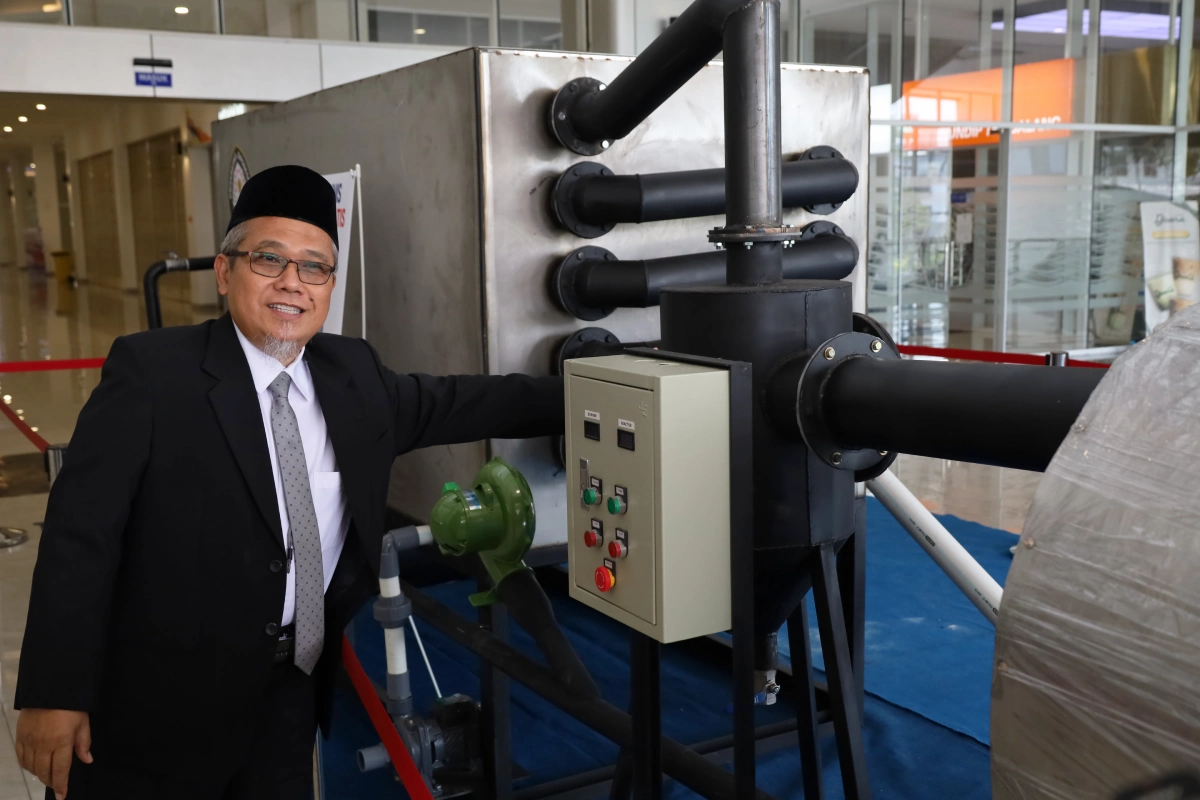
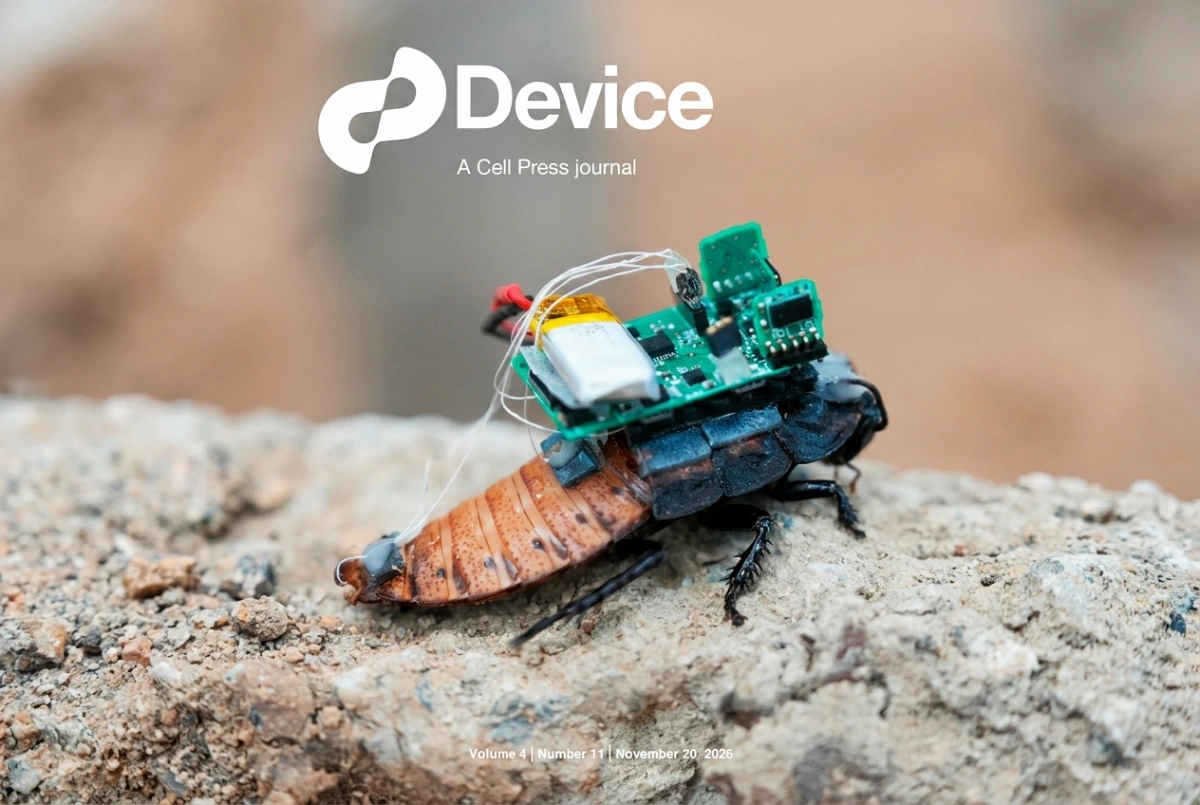
UNDIP, Semarang (23/11) – A technological innovation developed by a Universitas Diponegoro (UNDIP) lecturer has once again received international recognition. Collaborative research led by Mochammad Ariyanto, S.T., M.T., Ph.D., a lecturer at the Department of Mechanical Engineering, Faculty of Engineering, UNDIP, together with a research team from The University of Osaka, Japan, was selected as the cover feature of the prestigious international scientific journal ‘Device‘, published by Cell Press, Elsevier, Volume 4, Issue 11, dated November 20, 2026.
The research, entitled “Biohybrid Navigation through Real-Time Terrain Recognition and Natural Climbing in Cyborg Insects,” presents an innovative artificial intelligence (AI)-based navigation system for cyborg insects that can recognize terrain characteristics in real time while utilizing the insects’ natural ability to traverse various obstacles.
This achievement demonstrates UNDIP researchers’ contribution to the development of advanced robotics through international research networks. Beyond its academic significance, the innovation creates opportunities to develop technology that supports search-and-rescue missions in areas that are difficult for humans or conventional robots to access.
Mochammad Ariyanto is UNDIP’s principal researcher in developing this technology in collaboration with a team from The University of Osaka led by Prof. Keisuke Morishima. The research forms part of his academic activities as Visiting Academic Staff in the Department of Mechanical Engineering at The University of Osaka, Japan.
Combining Artificial Intelligence with the Natural Abilities of Insects
The key strength of this research lies in combining the biological abilities of insects with robotics and artificial intelligence technologies.
In conventional systems, cyborg insect navigation is generally designed to avoid obstacles. However, insects naturally possess the ability to climb and traverse uneven surfaces. This approach was further developed through an AI-based terrain recognition system that allows the insect’s movements to adapt to the characteristics of its surrounding environment.
Using miniature electronic devices mounted on the insect’s body, the system can identify flat surfaces, uphill and downhill terrain and holes in real time. Test results showed that the AI-based terrain classification system achieved 92 percent accuracy in offline evaluation.
This capability enables the system to reduce unnecessary control commands during climbing, allowing the insect to move more efficiently across complex terrain.
In a previously published interview through UNDIP’s official channels, Ariyanto explained that the biohybrid approach was selected because it allows researchers to leverage insects’ biological advantages without having to recreate the entire locomotion system mechanically.
“If we force ourselves to build a fully mechatronic robot at a very small scale, the challenges become much more complex. This approach instead takes advantage of the insect’s natural abilities while still ensuring that its survival is maintained,” Ariyanto explained in an UNDIP interview published in September 2025.
Meanwhile, Prof. Keisuke Morishima of The University of Osaka, in an official university publication in August 2026, explained that the primary challenge of the research was developing a system capable of recognizing terrain conditions directly without interfering with the insect’s natural movement capabilities.
Morishima described the team’s approach as biohybrid physical AI, referring to the integration of artificial intelligence with the physical capabilities of living organisms to create a more efficient autonomous navigation system.
Potential to Support Disaster Search and Rescue Technology
Cyborg insect innovation has promising potential for development in search-and-rescue operations, particularly in disaster sites with limited access, such as gaps within collapsed buildings and spaces too narrow for conventional robots.
For Indonesia, a country highly vulnerable to natural disasters, the development of this technology is particularly relevant in supporting innovation-based disaster management systems.
In a previous interview with UNDIP, Ariyanto also expressed optimism about the potential for this technology’s use in Indonesia.
“I believe this technology can support rescue missions in Indonesia, especially in densely populated urban areas,” he said.
The potential application of this technology has also attracted the attention of Indonesia’s National Disaster Management Agency (BNPB). In May 2026, UNDIP’s Cyborg Insect team was invited to demonstrate its robotic cockroach technology in a disaster victim search simulation. The activity also created opportunities for collaboration in developing disaster-technology innovations.
Nevertheless, the navigation technology published in Device remains at the research development and testing stage. Its operational use in actual rescue missions will require further development and validation.
Strengthening UNDIP’s International Research Reputation and Collaboration
The success of UNDIP’s research collaboration with The University of Osaka in securing a cover feature in Device demonstrates Indonesian researchers’ capacity to contribute to the advancement of science and technology globally.
Device is an international scientific journal published by Cell Press focusing on devices, engineering, and interdisciplinary technological innovation. The selection of this research as the cover feature of its November 2026 issue provides broader international visibility for scientific work involving UNDIP.
The research has also attracted attention from several international science media outlets and portals, including Science Magazine, EurekAlert!, TechXplore, and Asia Research News.
For UNDIP, this achievement also strengthens strategic collaboration with international universities in advancing leading research, particularly in robotics, artificial intelligence, and biohybrid technology.
This collaboration demonstrates that the internationalization of higher education is realized not only through academic mobility but also through the co-production of knowledge, publications in reputable scientific journals, and the development of innovations with the potential to benefit society.
In line with the spirit of “Noble and Valuable UNDIP,” this achievement reaffirms Universitas Diponegoro’s commitment to continuously promoting globally competitive research that not only earns academic recognition but also offers solutions to real-world challenges faced by society. (Public Communication/UNDIP)